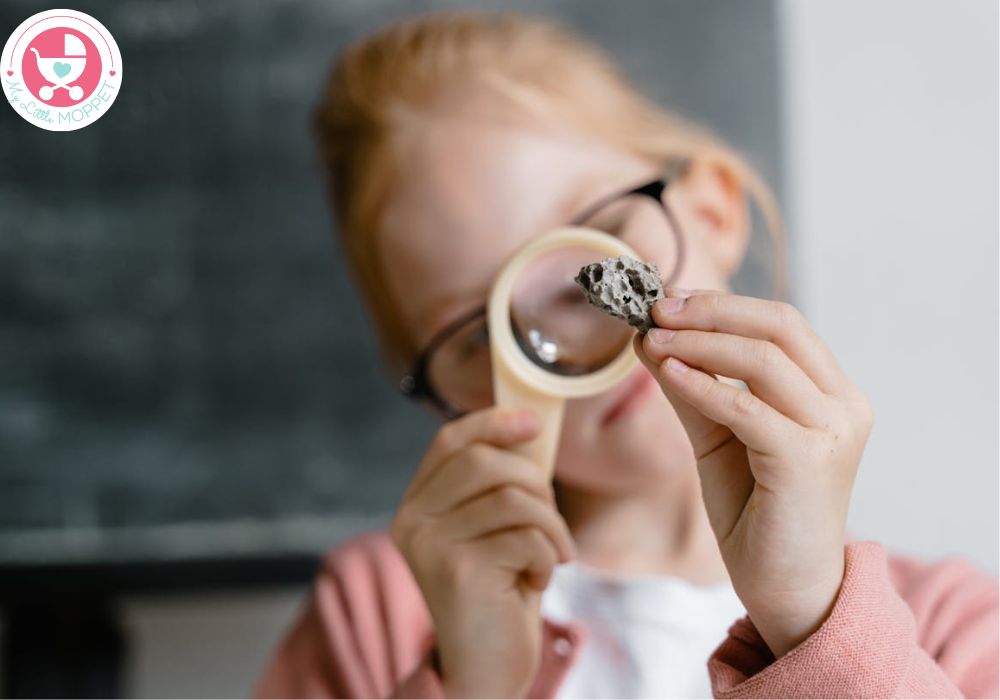
Give your kids a head start in life with these practical ways to introduce science to young children! From books, tech and more, there’s a lot to try!
For most of us growing up, science was the name of a subject taught at school. It was simply another thing to study from books and then regurgitate on paper. Very few of us actually looked at science the way it should be – with excitement, joy and curiosity!
Thankfully, things are changing, and as parents and teachers evolve, our kids do too. But to truly make sure your child develops a scientific temper early and enjoys learning, it’s important to introduce science to young children – even toddlers!

When can you introduce science to young children?
Honestly speaking, there is no right age to introduce science to young children – they’re born ready! For babies and toddlers, all play is learning – that’s how they understand the world around them.
If you look carefully, you’ll notice your little one conducting experiments all the time – stacking things till they fall, throwing items to see what sound they make, or even jumping on you simply to see your reaction!
With World Science Day on 10th November and STEM Day on 8th November, we think it’s the perfect time to learn a few easy ways to introduce science to young children. And don’t worry, you don’t have to sign up for anything!

1. Encourage their questions

The first time your toddler asks you a question like, “Mommy, why is the moon moving with us?”, you smile and think about how adorable it is.
Fast forward a little, and now the incessant questions are driving you crazy! Toddlers are as curious as they come, and their increased language skills mean that the questions don’t stop.
What many parents do at this point is just try to shut it down so they can get some peace. However, this isn’t the best way to cultivate a scientific temper in your child. If you keep ignoring their questions or treat them as a nuisance, eventually your child will stop asking, and that kills their inquisitive spirit.
Instead, encourage their questions – it’s the best way to introduce science to young children. At a young age, they don’t really need complicated answers, but don’t make up stories simply to shoo them away.
2. Ask them questions

Toddlers aren’t the only ones who have a right to question – you have too! The advantage here is that you can ask questions that you already have the answers to!
Nearly every daily activity can be turned into an opportunity to introduce science to young children. At bathtime, talk about how some toys float, but some sink. In the kitchen, try weighing different ingredients. When gardening, talk about what will happen if you don’t water the plants.
Please remember that learning should be fun – don’t turn everything into a boring science lecture! A few questions throughout the day will encourage your child to look at regular tasks or things with new eyes and explore them from a different angle.
3. Find answers together

Your child may think that you’re an encyclopedia of facts, but you know that you aren’t! There’s no shame in that – there isn’t anyone on the planet with all the answers.
And that is exactly the message we want to give our children – that it’s okay not to know everything, and that there’s no shame in admitting it. Let kids learn that not knowing something is simply an opportunity to explore the subject.
So the next time your child asks you a question you don’t know the answer to, say, “I don’t know; let’s find out!” This way, you also show your child how to look for answers in books, pictures or videos. Learning together is a wonderful way to introduce science to young children, and to boost your own knowledge too!
4. Let them lead

You may love everything to do with technology, but then you find out that your child is more of a natural world person! It is natural for a parent to want to share their love of something with their children, but we need to remember that every child is their own person, with their own interests and talents.
That’s why it’s important to let them lead when trying to introduce science to young children. Let them figure out their natural interests. You can introduce them to multiple subjects, but be aware that they’re not going to be interested in all of them.
Studies have shown that when children follow their natural interests and explore through play, they are more likely to learn and understand scientific concepts better. So observe them to identify what they naturally deviate towards, and let them follow at their own pace.
5. Give them space

When your child is young, it can be natural to jump in and show them the correct way to do something. But that can actually hinder their natural curiosity and exploration, and interfere with them building their own analytical and problem-solving skills.
Science is all about learning through trial and error, and this takes time. Kids need the space to be able to think on their own, without a parent hovering over them all the time or pointing out their mistakes at every turn.
When they’re playing or exploring something, let them lead the conversation, instead of getting them to do it the ‘right’ way. Take a step back and let them experiment and try to figure things out. If they start getting frustrated, you can step in calmly, but only to redirect them – don’t take over completely!
6. Try simple experiments

When we think about experiments, we think about people in white lab coats and goggles, juggling various colourful liquids amidst a maze of beakers and test tubes. But that’s not what experimentation means when it you’re trying to introduce science to young children!
There’s no need to go out and buy a full lab kit for a preschooler. You can simply use the things you have lying at home to conduct simple experiments – water, food colouring, baking soda, vinegar and the like.
The main things to remember here are safety and your child’s developmental stage. Here are a few resources that feature science experiments for all age groups:
7. Use mistakes as learning opportunities

When you’re trying to introduce science to young children, there are bound to be mistakes – on your part and theirs! How you respond in this situation can be crucial in their attitude towards learning in the future.
First of all, show them that it’s completely fine to make mistakes – it’s just another way that you know it doesn’t work! Help them identify the reasons why it didn’t work, so they can try something new. Older kids can identify the different variables involved, and they can change one variable at a time to see how it changes things.
This is also an excellent time to ask each other questions, try to seek answers from other sources, or even talk to someone you know, like a teacher. When kids realize that making mistakes is just part of the journey, they’ll stop fearing failure and start thinking of it as another step towards success.
8. Take it outdoors

A simple 30-minute walk outdoors works better to introduce science to young children than any amount of YouTube! When you’re outside with your kids, draw their attention to small things like what plants are growing by the wayside, how the colour of the leaves looks different from last time, or new bird sounds they’re hearing.
Being outdoors is also an excellent sensory experience, as children touch leaves, listen to animals and birds, smell the flowers or feel the warm sun on their skin. Of course, toddlers jump in puddles and dig their hands in dirt without being asked, but that’s how scientific exploration begins!
You can also collect things on your walks, like leaves and rocks, or take pictures of birds and flowers. Once you’re home, you can study these more closely. It might just send you down a rabbit hole of discovery!
9. Follow up with books

We always prefer books over screens to introduce science to young children. There’s something about going through the pages of a physical book, looking at the bright pictures and hunting for an answer. Of course, we understand that this may not be practical in all cases, but books are an excellent option to introduce kids to basic concepts or famous scientists. Here are a few recommendations:
10. Use tech smartly

Despite all this talk about screen-free time for kids, it’s a truth of our times that we can’t keep our kids away from tech for too long. So why not use it for something educational, rather than just brain rot?
Let kids use a camera to take photos of a butterfly, or a rainbow, or to record a bird song or a frog’s sounds. Many apps offer interactive science games or puzzles for kids to try. Use the image search feature to find the name of a particular plant or animal. Audio books are also fun to listen to, especially when travelling.
Besides these, you can still leverage screentime to introduce science to young children through fun TV shows. Here are a few of our top picks:

We hope you’ve got lots of ideas to introduce science to young children from this post. We’ve tried to list them in order so that you can start your young kids out with the earlier tips, and move on from there as they grow. Always remember to let your child’s interests be the starting point, and don’t forget to make it fun!
Resources:
Buy Healthy Nutritious Baby, Toddler food made by our own Doctor Mom !
Disclaimer: This content was automatically imported from a third-party source via RSS feed. The original source is: https://www.mylittlemoppet.com/introduce-science-to-young-children/. xn--babytilbehr-pgb.com does not claim ownership of this content. All rights remain with the original publisher.