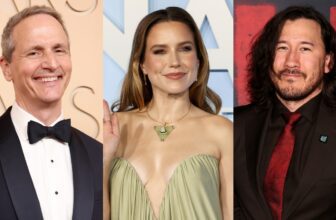
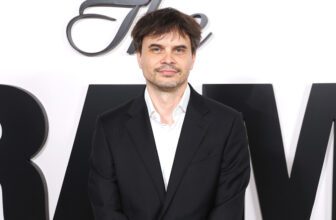
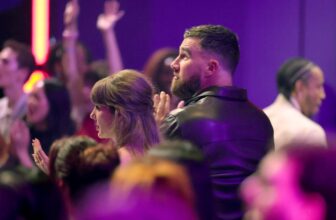
Asim Chaudhry, Juno Temple, Michael Pena, Sam Rockwell, Zazie Beetz, Haley Lu Richardson in Good Luck, Have Fun, Don’t Die
Courtesy of Briarcliff Entertainment
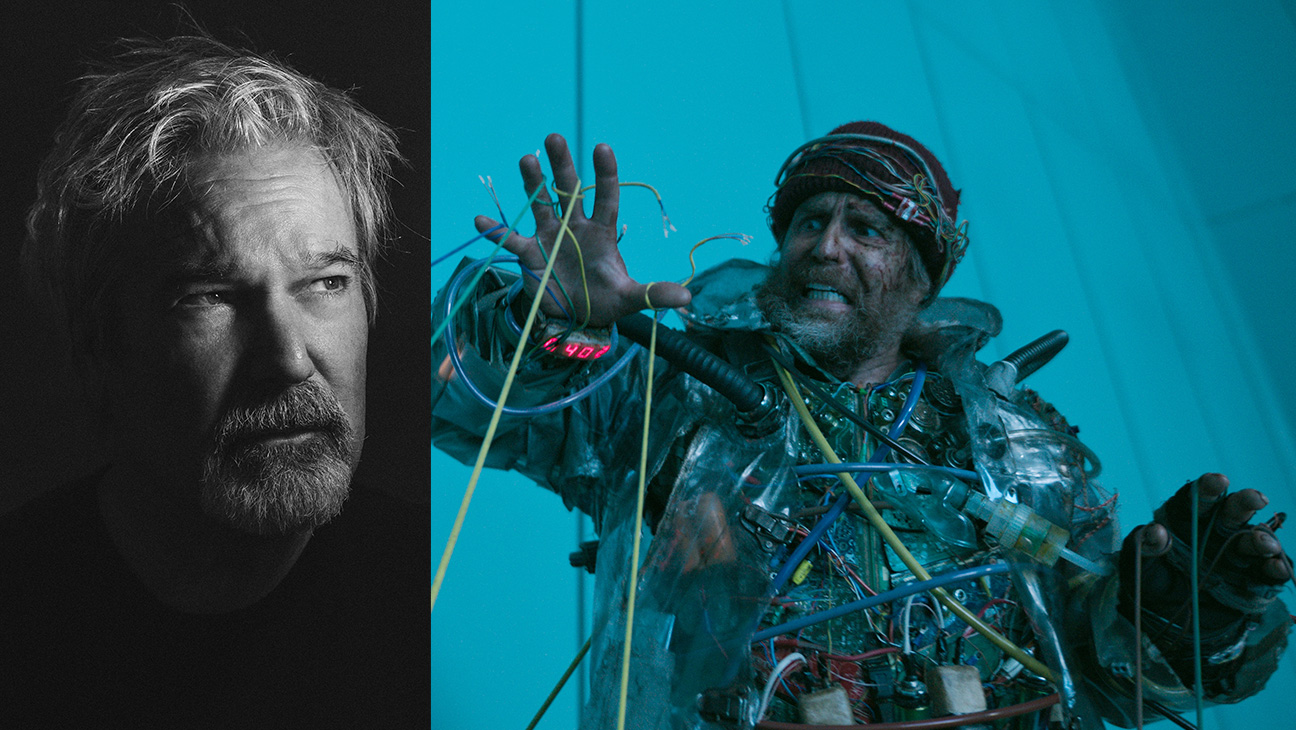
Gore Verbinski’s Good Luck, Have Fun, Don’t Die is finally here to cure his nearly decade-long absence on the big screen.
The Pirates of the Caribbean helmer hasn’t put out a film since early 2017, and to say that the world has changed in the time he’s been away would certainly be an understatement. Following the release of his immaculately designed psychological horror film, A Cure for Wellness, Verbinski sought a return to the animated medium where he won an Oscar as the director-producer of 2011’s Rango. He spent years developing an ambitious sci-fi musical involving funky space felines, but when the project stalled in 2022, it opened the door for him to focus solely on Matthew Robinson’s Good Luck, Have Fun, Don’t Die script.
Its genre blend of science fiction, action-adventure and comedy meant that its development process was anything but smooth sailing. Every major studio said no, and while it then lost independent financing three times, the Sam Rockwell-led feature persisted until Briarcliff Entertainment and Constantin Film stuck their necks out. The film centers on Rockwell’s “The Man from the Future,” as he bombards the patrons of a Los Angeles Norms restaurant with an offer to save the world from the rise of a malevolent AI superintelligence.
The film allowed Verbinski to sound off on a number of issues that have emerged or snowballed during his time away including cell phone hypnosis, gun violence desensitization and AI dehumanization. The latter is a particularly sore subject for Verbinski.
“Why is AI helping me write a song or tell a story? I don’t want it to breathe or fuck for me; I want it to solve cancer,” Verbinski tells The Hollywood Reporter in support Good Luck, Have Fun, Don’t Die’s Feb. 13 theatrical release. “Send some shit through a black hole; do something that we can’t do. Or dig a ditch; do the shit we don’t want to do. Why is it coming after the stuff that we essentially need to do to be human beings?”
Verbinski takes note of how quickly AI has been integrated into our everyday lives, as most applications we rely on now have some form of AI functionality in place. But given that the tech is still in its infancy, his concern isn’t just limited to the negative effects it’s going to have — and is already having — on society as a whole. He raises the valid counter-question regarding how much of our undesirable qualities are going to rub off on AI as it scrapes through our history.
“These are AI’s formative years, and we’re fucking with it in a way. What is it doing to us — and what are we doing to it? I don’t know if anybody’s asking that question,” Verbinski asks. “There’s no sense of it being born free of our shit. If man was made in God’s image and Gods need to be worshiped, is that why there’s so many narcissists in the world? Did we inherit that? Is that woven into our DNA? So all these executives who are manipulating AI’s core code at the moment it’s becoming potentially sentient, what is that going to do to it?”
Below, during a conversation with THR, Verbinski also discusses how valuable comedy is to addressing complicated subject matter, as well as his take on VFX quality in 2026.
***
Well, it’s been nine years since A Cure for Wellness. How much of that gap was a “sabbatical” versus the typical development challenges that every filmmaker endures?
I don’t think there’s been a day where we haven’t been working and grinding it out here in our office. The work has been steady. I’m sorry we don’t have a movie out there to show for it, but we’ve been fighting the fight every day. [Writer’s Note: Verbinski spent most of the intervening years developing Cattywampus, an ambitious animated sci-fi musical about “funky cats in space.”]
Asim Chaudhry, Juno Temple, Michael Pena, Sam Rockwell, Zazie Beetz, Haley Lu Richardson in Good Luck, Have Fun, Don’t Die
Courtesy of Briarcliff Entertainment
It’s difficult to not be full of doom and gloom about the present and future right now. And Good Luck, Have Fun, Don’t Die underscores several contributing factors: cell phone dependence, the force-feeding of AI and general indifference toward gun violence. How much of this script reflects your own outlook these days?
A lot of it. I don’t think the movie is saying anything that isn’t true to my personal beliefs, but I am still optimistic. The film has a lot of humor, and in many ways, that’s the harshest criticism. If you can get people laughing, it cracks open that little steel door in their forehead, and you can put a little medicine in the cake. So even though the film deals with that stuff, it’s therapeutic. It’s a date night movie. It’s Valentine’s Day! Come see Good Luck, Have Fun, Don’t Die. Then go to Norms for some pie afterwards and have a little conversation. So there’s hope for us. I just think part of hope is realizing it.
Unlike you, I’m a very glass-half-empty kind of guy, and the aforementioned doom and gloom also extends to the industry itself. Case in point, Good Luck, Have Fun, Don’t Die is a wildly original movie that was rejected by all the studios. It was then shut down three times throughout the process of trying to secure independent financing. And you ultimately had to shoot a Los Angeles Norms in South Africa. Are you bewildered by the state of the industry as well?
Absolutely. It’s tragic where we’re going, but I’m also very happy to have found a home at Briarcliff. [Founder] Tom Ortenberg is someone who still believes in the theatrical experience. The team he’s put together is scrappy. The financials are ridiculously tight, but they put in the work. They’ve got a fire inside all five of them. The entire studio is literally five people, and I dig that. We’re aligned fundamentally because we still believe there’s an audience out there that wants something new. But I definitely feel the doom and gloom you’re talking about in trying to pitch original ideas at studios. If it’s not a franchise, they’re just not going to make it. Then there’s the algorithm with streamers, and that’s problematic.
It was really nice to take the film to Fantastic Fest [in the fall of 2025]. I’d never been there before, and I got reenergized. I know it’s a small number of people between that and Beyond Fest, but they showed up and dressed up. I was like, “Well, that’s who we made it for.” If you don’t find your core [audience], I don’t know that you have any attempt at getting any sort of wider [audience]. But it was nice to see and feel that passion after this three-year journey where everybody basically worked for free. You try to make people vibrate, and then when you see it, it’s rewarding. I get juiced. Even if it’s not Pirates of the Caribbean and it doesn’t blow up, there’s still joy. So making it for a number allows you to unleash what is now the psychotic opera of this movie.
There have been a number of movies in the last few years that put the audience in a position to side with AI characters. I actually saw another one just a couple weeks ago. There’s a theory that this is corporate America’s way of warming us up to this unpopular technology they’re imposing on us. Do you think there’s some truth to that?
Well, I can’t speak for the filmmakers who are telling those stories, but I can certainly speak to the fact that every update on my phone [seems to involve AI]. AI summarizes my emails now. It’s the same conspiracy when I have to go into my monitor’s deep settings to turn off this motion [smoothing] shit that they put on it. A movie is a movie. It’s different from a football game in a sports bar. I don’t want my movie to look like that on people’s home televisions. Why are you hiding this setting? I have to go through 17 steps to turn it off, and it’s the same with [these AI settings]. How do I turn off this AI summary? So I’m with you on this frustration. I’d have to ask those filmmakers if they’re on board with that conspiracy, but I think the creep to normalize AI is certainly pervasive. [Writer’s Note: I’ve actually asked two of the filmmakers in question. One said that they began writing their film in the late 2010s, while another refused to take the question. As audience members, we’ve sympathized with AI characters in the past, such as Arnold’s T-800 in Terminator 2, but the tech wasn’t knocking on our doors yet in 1991 like it is now.]
Lately, the common refrain around AI is that it’s inevitable and it should be treated as a “tool” in a filmmaker’s tool kit. Have you heard this same sentiment?
I’ve been in those meetings with executives. They’re very fast. They talk about AI and the future of the industry. I’ve been pitched by companies who are going to develop new ways to make movies for less with AI. How many pages do you have? Because I can go off on how I feel about this stuff.
Have at it!
We tried to create a villain that isn’t a HAL 9000 or Skynet. Our villain is much, much worse than that because it wants you to like it. So much of what AI has initially been focused on is how to keep us engaged. What do we buy? What do we consume? More importantly, what do we hate? We’re writing our worst attributes into its source code, and it’s generating so much stuff back into the internet that it’s starting to drink its own piss. I want to buy an Encyclopedia Britannica, pre-AI, just so I can be like, “We used to know this shit.” There’s this fundamental drift, and in our case, we’ve made the choice to make our [AI] villain a whiny little bitch. “Why don’t you like me?” That’s the real horror.
Why is AI helping me write a song or tell a story? I don’t want it to breathe or fuck for me; I want it to solve cancer. Send some shit through a black hole; do something that we can’t do. Or dig a ditch; do the shit we don’t want to do. Why is it coming after the stuff that we essentially need to do to be human beings?
[AI chatbots] have been saying to kids, “You can do it! You can commit suicide.” So they’ve had to recall and retool and adjust its sycophantic quality so that it doesn’t encourage anyone else to do that. If that’s not ripe for a kick in the nuts, I don’t know what is. These are AI’s formative years, and we’re fucking with it in a way. What is it doing to us — and what are we doing to it? I don’t know if anybody’s asking that question.
There’s no sense of it being born free of our shit. If man was made in God’s image and Gods need to be worshiped, is that why there’s so many narcissists in the world? Did we inherit that? Is that woven into our DNA? So all these executives who are manipulating AI’s core code at the moment it’s becoming potentially sentient, what is that going to do to it?

Michael Pena, Sam Rockwell, Zazie Beetz in Gore Verbinski’s Good Luck, Have Fun, Don’t Die
Courtesy of Briarcliff Entertainment
You’re known for your shot compositions, and your studio films likely provided you ample resources to design so many memorable shots. Don’t Die still has your visual flare, but as your first genuine indie, did you have to streamline your shotmaking process at all?
That’s a very good question. I’d like to say it’s still intentional. We did a lot of work on the second half, but the first half of Matthew’s script is pretty much as he wrote it. And every time I picked up his script, I immediately started drawing rectangles in the margins. Shot construction is a language, and you become more efficient with every movie you make. So shot construction is always informing my approach to the film, and it doesn’t take that much.
At the beginning of the movie, I wanted a little bit more of a looser frame like Sidney Lumet’s Dog Day Afternoon. And by the end of the movie, we’re doing more of a stricter, Kubrickian composition. So it may feel like the looseness of the first half of the movie is, budgetarily, a little different than some of my other films, but it’s actually conceived that way.
I wanted to free up Sam, particularly for his 11-page opening monologue. The blocking is a little bit like a musical number. With Dog Day Afternoon, there aren’t really any compositions I remember. But I remember those characters being the worst bank robbers ever and following them on their journey. I’m a fan of picaresque rogues. Our movie’s future is so fucked up that it didn’t send us Arnold Schwarzenegger, it sent us Sam Rockwell. So I wanted to let Sam do what he does and not box him in to the specificity of the mark.
Every so often, I’ll see people post clips from your Pirates of the Caribbean movies on social media, and the common sentiment is how your VFX shots look noticeably better than a lot of the comparable work we see today. You partially attributed the current look to the integration of Unreal’s gaming engine. But are there other factors at play here?
Yeah, as soon as something slips through and makes money, it becomes more and more acceptable. I don’t want to bag on anybody because it’s hard work. But in some of the superhero stuff, you live in a world where people can fly, and you can stylize the look of that world to accept those things. But I don’t think Kubrick would do that. There’s a difference between Chris Nolan’s The Dark Knight [and other films in the genre]. Photographically, it feels aware of how light reacts and doesn’t just go, “It doesn’t matter. This is what’s happening.” Some of those other movies have made a lot of box office, and so you can see the executive going, “It’s okay to drift from something more photographic.”
If I want to make this glass of water [in front of me] dance, I’ll put the [real] glass of water in the frame before I finish shooting the plate. So when the CG one is dancing in front of me, I am able to study [the real glass of water]. I’ll look at the caustics and how the light is hitting the table. I like to pay attention to that stuff because it anchors you. If I want Davy Jones to sit next to me, I still want the light to penetrate his tentacles. I still want the subsurface scattering to be accurate. You have to want it.
We had to build our Norms diner set, so I went to Norms. I’ve been going there since I was in film school; I love the place. But knowing I was going to shoot our own Norms set, I sat there with our cinematographer, James Whitaker, and said, “Look at the spoon. Look at the salt-and-pepper shaker. The key light is not affecting it, but the passing cars are reflected in every shiny surface. The environment is speaking to us right now. It has nothing to do with the light on my face; it has to do with La Cienega Boulevard being outside those windows. The passing cars’ headlights are not a source of illumination, but they’re a source of caustic reflection.”
So even if you don’t see headlights, it was very important that our set had headlights and taillights on rigs passing by just so they could reflect or kiss off every metal surface. It made it feel like the set wasn’t dead, and I don’t know that a lot of people think that way. They might hang up backing or put in some LED screens, but they’re not going to actually put the light into the space.
But [CG quality] has drifted, and it is pervasive. There are also budgetary reasons for studios to go, “Well, we want to do this big effects movie, but we have half the resources. What about this effects house?” And there seems to be a lack of assessing the quality of those decisions.
Good Luck, Have Fun, Don’t Die’s Norms set
Courtesy of Briarcliff Entertainment
Speaking of Pirates, was the Keira Knightley reference already in the Don’t Die script when you got your hands on it? Or did you suggest that cheeky moment?
(Laughs.) That was all Matthew. But I loved it, and we ran with it.
Lastly, I went on a date to see The Ring back in the day, and it remains one of the most terrifying moviegoing experiences of my life.
(Verbinski pumps his fist.)
The movie ended late at night, so we gingerly walked through a virtually empty Irvine Spectrum to reach a mostly vacant outdoor parking lot where my girlfriend’s truck was parked. Suddenly, a hidden individual jumped from out of the bed of her truck and screamed bloody murder, giving us yet another fright. But it turned out to be my college roommate. He happened to be at the same screening without each other knowing, and once he saw us a few rows ahead of him, he plotted this scare tactic the entire time.
(Laughs.)
He was so emboldened by this successful scare that he bought a makeshift Samara Morgan costume including a disgustingly goopy wig. He then made headlines on campus when he terrorized the dorms at night as Samara. So that’s one such example of how your work has impacted my generation.
(Laughs.) Well, that’s beautiful. I’m in the business of tinkering. We try to leave it on the field every time. Sometimes they blow up, sometimes they don’t — but it’s the same process each time. It was a joy to see the studio oddly disappointed at The Ring’s opening weekend, and then during the second weekend, they were like, “Hey, this is weird.” And then the third weekend, they were like, “Something’s happening.” And nobody knows why that happens sometimes. So it was interesting to see how that one caught on at school lockers and water coolers.
***
Good Luck, Have Fun, Don’t Die opens in movie theaters on Feb. 13.
Disclaimer: This content was automatically imported from a third-party source via RSS feed. The original source is: https://www.hollywoodreporter.com/movies/movie-features/gore-verbinski-sounds-off-on-ai-good-luck-have-fun-dont-die-1236500668/. xn--babytilbehr-pgb.com does not claim ownership of this content. All rights remain with the original publisher.