Art and exile mesh together in fascinating ways in Nina Roza, the accomplished new feature from Quebecois writer-director Geneviève Dulude-de Celle, who debuted at the Berlinale in 2017 with her Crystal Bear-winning teen movie, A Colony.
Showcasing a similar brand of sharp-edged lyricism, but this time within a wider framework, the film follows a Canadian immigrant traveling back to his native Bulgaria, where he searches for a child artist with the potential to become the next De Kooning or Picasso. It’s an intriguing set-up that takes a little time to find its way, but once it does Nina Roza turns into a moving meditation on estrangement, revealing what you give up by leaving home behind — and what you gain by daring to finally return.
Nina Roza
The Bottom Line
Lyrical and original.
Venue: Berlin Film Festival (Competition)
Cast: Galin Stoev, Ekaterina Stanina, Sofia Stanina, Chiara Caselli, Michelle Tzontchev, Christian Bégin, Nikolay Mutafchiev
Director, screenwriter: Geneviève Dulude-de Celles
1 hour 43 minutes
Told in an elliptical style that requires the viewer to fill in some gaps, the narrative begins in Montreal, where 50-something Mihail (theatre actor and director Galin Stoev) works as a curator for a wealthy Canadian art dealer (Christophe Bégin). A few short but suggestive scenes reveal that Mihail doesn’t exactly share a warm relationship with his daughter, Rose (Michelle Tzontchev), who has a son of her own and wants to introduce him to their Bulgarian roots. “It’s a backwards place,” her father snaps back, clearly unwilling to revisit the past.
But he’s suddenly forced to confront it head-on when his boss gets wind of an 8-year-old girl named Nina (played by twins Sofia and Ekaterina Stanina) who’s created a series of abstract paintings that could be the work of a budding young genius. Tasked with finding out whether she’s the real deal, Mihail heads to his homeland for the first time in decades, arriving in a country he abandoned for reasons that are divulged later on.
His journey is not exactly out of the ordinary — plenty of immigrants shuttle back and forth between their native and adopted countries — but Dulude-de Celles gives it an epic feel by framing the taciturn, chain-smoking Mihail against the vast open landscape of his origins, which begins to lure him in as he spends more time on the ground. Handsomely lensed by Alexandre Nour Desjardins, who uses lots of warm light to give the interiors a nostalgic bent, the film also benefits from a melodic score by Joseph Marchand, with other scenes set to vintage Soviet-era pop ballads.
Once the action shifts to Bulgaria, the plot concentrates on Mihail’s growing bond with the stubborn, straight-talking Nina, whom he locates with her mother in a village nestled between lush mountains and fields. Trying to figure out if the girl is a fraud or not — it turns out Nina’s mom makes pottery, while all their neighbors seem to be amateur artists themselves — Mihail begins to see something else in the girl: a reflection of his own daughter, whom we glimpse in flashbacks that emerge like subdued memories.
Dulude-de Celles keeps her camera glued to the expressive Stoev as his character eventually finds his footing in a country he never really forgot, bringing out emotions through carefully composed sequences that favor images and performance over dialogue. (Her style of filmmaking recalls fellow Quebecois directors like Philippe Lesage or pre-Hollywood Denis Villeneuve.)
One pivotal scene has Mihail getting drunk at a village party and singing along to an old Communist anthem, looking happier than he ever did back in Canada. Later he pays a visit to his long-estranged sister — “back from the dead!” his brother-in-law exclaims when opening the door — trying his best to make amends with some of the loved ones left behind.
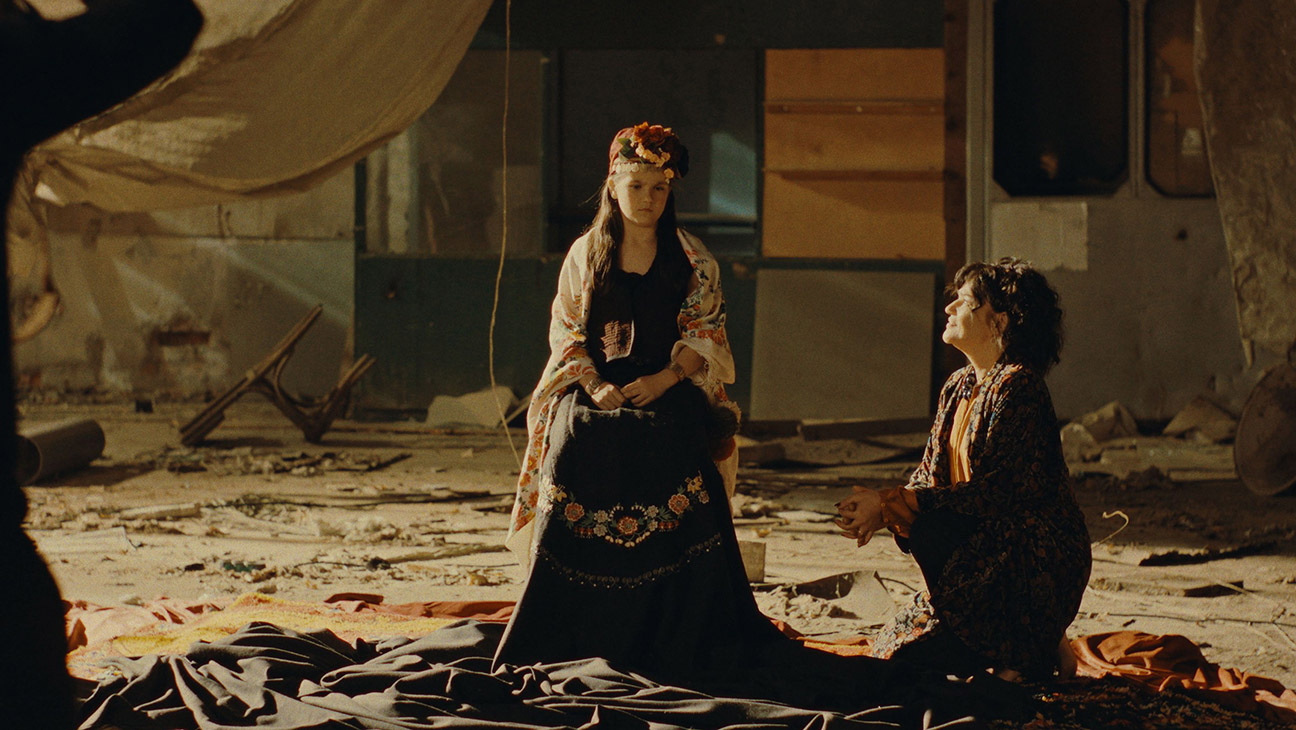
The director merges Mihail’s trajectory with that of the precocious Nina, who’s been picked up by an Italian gallerist (Chiara Caselli) planning to relocate the painter and her mom to Rome, where they could thrive in a well-funded art scene. But Nina is more attached to her heritage than Mihail ever was, even if she’s offended by a photo session in which she’s forced to wear a traditional Bulgarian costume. She may be a little genius; family and community still matter more to her than success.
Nina Roza (whose title combines the young prodigy’s name with that of Mihail’s daughter) artfully questions the value of holding onto your origins versus giving them up for a better life. It’s a dilemma for which there’s no easy answer: You can choose to stay put and miss out on a major opportunity, or move abroad and risk losing part of yourself in the process. Either way, you wind up paying a price.
Mihail already made his choice, and much of the film is about him coming to terms with it. Stoev’s touching turn reveals a man who blocked out his past for so long, he seems half-alive at first, until gradually awakening to the world around him. Even if he’s returning to a land he knows well, Mihael’s trip to Bulgaria is actually an initiation journey — a pilgrimage to that lost place known as the self.
Disclaimer: This content was automatically imported from a third-party source via RSS feed. The original source is: https://www.hollywoodreporter.com/movies/movie-reviews/nina-roza-review-a-bulgarian-exile-returns-to-his-roots-in-this-insightful-lyrically-crafted-drama-of-art-and-estrangement-1236505548/. xn--babytilbehr-pgb.com does not claim ownership of this content. All rights remain with the original publisher.