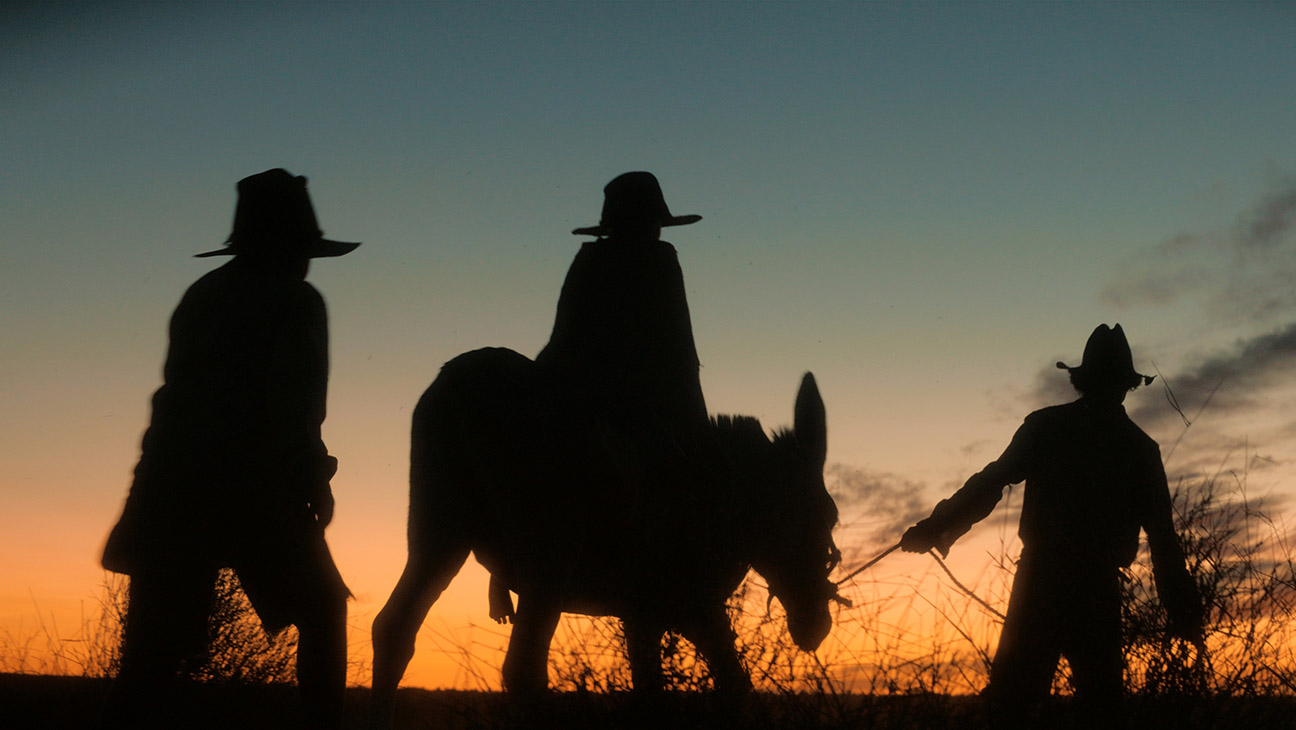
An experienced cinematographer before he turned to directing, Warwick Thornton has a feel for the Central Australian desert and the craggy MacDonnell Ranges that’s both epic and intimate. His refined sense of composition is directly informed by the landscape around Alice Springs where he grew up and his subcutaneous connection to it imbues his films with soulful beauty. Wolfram is no exception. A four-chapter saga of escape, pursuit and survival, the film, for all its brutality, ultimately becomes less a lament for stolen lands and stolen children than a stirring account of endurance.
Family and community are the thematic foundation of this sequel of sorts to Thornton’s 2017 drama Sweet Country, again co-written by Steven McGregor and David Tranter. It picks up a few years after the events of the earlier film in and around the same fictional Northern Territory town of Henry, though all but two of the principal characters here are different. That gives the two movies the feel of a shared ancestral map, marked by overlaps and diverging tangents.
Wolfram
The Bottom Line
Not without flaws, but equal parts haunting and healing.
Venue: Berlin Film Festival (Competition)
Cast: Deborah Mailman, Erroll Shand, Joe Bird, Thomas M. Wright, Matt Nable, Pedrea Jackson, Eli Hart, Hazel May Jackson, Ferdinand Hoang, Jason Chong, Aiden Du Chiem, John Howard, Anni Finsterer, Luka May Glynn-Cole, Gibson John, Natassia Gorey-Furber
Director: Warwick Thornton
Screenwriters: Steven McGregor, David Tranter
1 hour 42 minutes
The nominal center this time is Pansy, played with an expressive gaze and few words by the invaluable Deborah Mailman, first seen clutching her newborn and hacking off locks of her hair with a rusty knife. With minimal preamble or exposition, Pansy and new partner Zhang (Jason Chong) set off on a horse and cart for Queensland, their last shot at finding her lost children. She beads the braids of hair with seeds, hanging them on shrubs to mark the way, like a trail of breadcrumbs.
Meanwhile, Indigenous child laborers Max (Hazel May Jackson) and Kid (Eli Hart) chip away at the walls of a tight mine shaft, removing chunks of the ore used to make wolfram (now more commonly known as tungsten) for their ill-tempered boss Billy (Matt Nable).
A separate thread follows the arrival in Henry of criminals Casey (Erroll Shand) and Frank (Joe Bird), all mean attitude and swagger as they look to stake a claim in the area and prospect for gold. Ignoring the advice of the local storekeeper (John Howard) to avoid the back trails where they are likely to encounter “wild Blackfellas,” they head off in that direction. When they come upon young Max, left behind to keep an eye on Billy’s camp, Casey and Frank rob the camp and forcibly take the child with them.
Once Kid discovers his sibling is gone, he steals a donkey from the mining site and goes after him, his exit timing helped by a convenient snake bite.
Further off the dusty track on a run-down cattle station, belligerent drunk Kennedy (Thomas M. Wright) benefits from the virtual slave labor of his 18-year-old mixed-race son Philomac (Pedrea Jackson), the two main characters carried over from Sweet Country. (Philomac, then 14, was played by twins Tremayne and Trevon Doolan.)
When Casey and Frank roll up, they pretty much take over, claiming they found Max wandering alone. Kennedy is oddly deferential to the strangers as they start antagonizing Philomac, whose suspicions about them are confirmed when he talks to Max alone.
Just as he did in Sweet Country, Thornton evokes the Old West-style lawlessness of the time and place, particularly as sneering villain Casey and cocky dope Frank go from vaguely menacing to outright ruthless. Their heartless treatment of Black petty thief Archie (Gibson John), another Sweet Country holdover, shocks Philomac into action as the movie shifts gears into a chase thriller. Blood is shed in killings both horrific and gratifying. In the latter case, Thornton reclaims the dignity of First Nations Australians with a rousing image of strength.
Much of the story comes from oral history passed down by his great-grandfather to Tranter, whose family roots on both sides — Indigenous and Chinese — come into play. That said, the narrative feels a tad shapeless at times and the plot turns — one surprise revelation in Part Four aside — often familiar.
The number of significant characters and story strands makes it a challenge for the director and writers to settle on a focus and maintain it until the threads are stitched together. But even when it ambles along rather than races, the movie’s heart and integrity keep Wolfram engrossing, buoyed by sterling work from the entire cast.
Pedrea Jackson, sporting an excellent mustache, is a standout as Philomac, contemplative, observant, simmering with indignation and longing to be with his people; Shand makes Casey chillingly contemptible, treating the Aboriginal characters like animals; despite her role being largely symbolic, Mailman is enormously touching, her grace and quiet fortitude standing in for countless mothers whose children were taken from them; and the young actors playing Max and Kid are terrific.
Two Chinese gold prospectors introduced toward the end, Shi (Ferdinand Hoang) and Jimmi (Aiden Du Chiem), indicate the sense of solidarity among victims of discrimination. They become a key part of an affecting conclusion, which maybe ties up the story too neatly, but few will be unmoved by seeing people so dehumanized by colonial rule show their resilience.
Thornton once again serves as his own DP, drawing texture from the rich palette of reds, oranges, golds and browns in the sun-blasted landscape. The movie has no original score as such but makes distinctively atmospheric use of Charlie Barker’s saw playing. The director has still not surpassed the poetic simplicity of his lauded 2009 debut, Samson & Delilah. But Wolfram represents a very solid entry in his impressive body of work and a return to form after his more uneven last feature, The New Boy.
Disclaimer: This content was automatically imported from a third-party source via RSS feed. The original source is: https://www.hollywoodreporter.com/movies/movie-reviews/wolfram-review-warwick-thornton-australian-western-1236511762/. xn--babytilbehr-pgb.com does not claim ownership of this content. All rights remain with the original publisher.