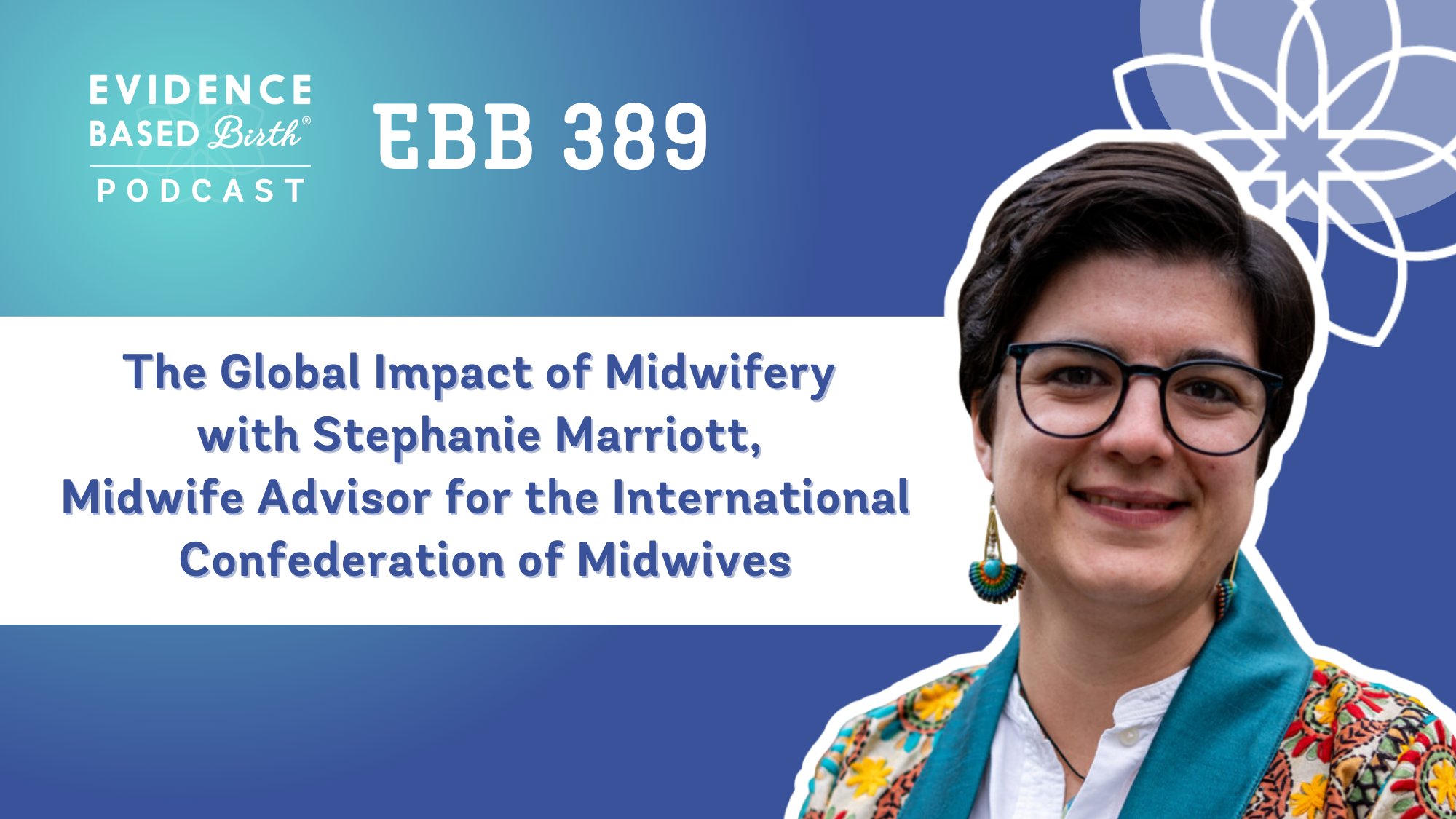
Stephanie Marriott – 00:00:00:
We’re seeing the Cesarean rate as high as 90%.
Dr. Rebecca Dekker – 00:00:03:
Nine-zero? 90%.
Stephanie Marriott – 00:00:06:
The national Cesarean rate was 52%. So, it’s tripled, more than tripled. For non-clinical indications, we know from the research shows us that women and families have better outcomes if you had the same trusted person all the way through.
Dr. Rebecca Dekker – 00:00:20:
Hi, everyone. On today’s podcast, we’re going to talk with midwife Stephanie Marriott about the global impact of midwifery care. Welcome to the Evidence Based Birth® Podcast. My name is Rebecca Dekker, and I’m a nurse with my PhD and the founder of Evidence Based Birth®. Join me each week as we work together to get evidence-based information into the hands of families and professionals around the world. As a reminder, this information is not medical advice. See ebbirth.com/disclaimer for more details. Hi, everyone, and welcome to today’s episode of the Evidence Based Birth® Podcast. Today, we have a special guest from the International Confederation of Midwives. Steph Marriott is a midwife with a master’s in public health from the Liverpool School of Tropical Medicine and has served as a midwife advisor for the International Confederation of Midwives, or ICM, since 2024. In her role at ICM, Steph provides technical guidance to midwives, midwives associations, United Nations agencies, partner organizations, and governments on how to strengthen midwifery globally. Steph began her career as a midwife in the United Kingdom, working across the full continuum of care, including within a continuity of midwife care model, before moving into academia as a lecturer in midwifery. She later transitioned to global health, working across Asia and Africa with a range of non-governmental organizations. Steph’s global work has focused on strengthening midwifery education and advancing the critical role of midwives in humanitarian and fragile settings. Stephanie, welcome to the Evidence Based Birth® Podcast.
Stephanie Marriott – 00:02:51:
Thank you for having me. Great to be here.
Dr. Rebecca Dekker – 00:02:53:
Before we get into like the more global aspect of midwifery work, I was wondering if we’d start off by having you share with our listeners what first drew you to midwifery as a career. I think I had an interest from being very young in health and had really always considered that I would want to work in health care and then took quite an interest in feminism. And they feel like a perfect match. And that ability to support women and other birthing people kind of across their reproductive life course, it seemed like the perfect combination. And almost 20 years after making the decision, I still agree. So even as a child, were you interested in helping people who were sick or injured? Or when did you first notice that you were really into that kind of healing calling?
Stephanie Marriott – 00:03:40:
I was brought up around health care. My mom is a pharmacist. So from a very young age, talk about health care was at home and I was starting to learn about the body and really understand that. And there is a photo somewhere of me when I was less than three holding and poking my five-day-old little brother. I’m not so sure I would have been able to tell you age two that I wanted to be a midwife, but there’s photographic evidence that that’s what I wanted to do.
Dr. Rebecca Dekker – 00:04:09:
Yeah. So from the very beginning, you were interested in babies and birth. And then as you went into it, like becoming educated as a midwife, did you feel like affirmed, like this is where I’m supposed to be? And how did you know that?
Stephanie Marriott – 00:04:24:
Yeah, I did my pre-service midwifery education in the UK at the University of York. And I could really see that I was able to work in healthcare and use the part of my brain that really enjoyed science, but also use the part of my brain that loved connecting with people and understanding communities. And later I’ve gone into education. And I think maybe that was clear at the beginning as well, because a lot of being a midwife is about providing education to women and their families and communities more broadly.
Dr. Rebecca Dekker – 00:04:58:
Where I live in the United States, they don’t understand is the continuity of care model, and particularly the continuity of midwife care model. Because a lot of people here go to these very large clinics where they don’t know who will be at their birth. And there’s so many providers that they might not get to meet every provider. Can you tell us a little bit about how the continuity of midwife care model is different? And how does that shape the quality of care and birth outcomes?
Stephanie Marriott – 00:05:25:
I can. And I wonder if even it’s worth going back a step behind that. So when we talk about what is a midwifery model of care? So a midwifery model of care is when the main care provider is a midwife. And so they care for a woman and later a newborn starting in pregnancy, continuing through the birth and into the postnatal period. And this care is provided by an educated, regulated midwife. They can work autonomously providing appropriate, respectful maternity care that is. Grounded in the philosophy of midwifery care. ICM have a lot of these philosophies. A continuity of midwife care model is an example of a midwifery model of care.
Dr. Rebecca Dekker – 00:06:12:
Okay.
Stephanie Marriott – 00:06:12:
And so that’s when we have care provided by a single or maybe a small group of midwives. Generally, we would say that small group is no more than three.
Dr. Rebecca Dekker – 00:06:22:
Okay.
Stephanie Marriott – 00:06:23:
So throughout that pregnancy, birth and postnatal period. A woman is only seeing that one midwife or that small team of midwives. And that enables a really important thing to grow, which is a relationship based on trust, based on equity and a partnership and kind of shared responsibility between them. Which we know from the research shows us that women and families have better outcomes. And this isn’t just in high resource settings. We have good evidence from high resource settings where we’re seeing. Reduced incidence of Cesarean sections, some evidence surrounding preterm birth being reduced and women, very importantly, having positive experiences of the whole perinatal period, but particularly birth. But we’re also starting to see evidence in low resource settings as well. Even in settings where well-functioning midwifery systems might not be functioning, we see that we can at the same time introduce midwives and introduce quality maternity services that have continuity of midwife-led care. Excellent global evidence when we can prove that in all countries. Midwives and seeing the same midwife is really beneficial to health outcomes and to the experiences of women.
Dr. Rebecca Dekker – 00:08:00:
I feel like we can’t underscore that importance enough of the relationship. Because when you mentioned that, it just really struck me as that seems to be the most protective part of the whole model of care is the fact that you have a trusting relationship with your midwife. Can you give like maybe a little bit more of an example? It can be fictional or something like that of how that might impact someone’s. Not only their experience, but their birth outcomes, if you have a trusting relationship with, you know, one, two or three midwives who are caring for you?
Stephanie Marriott – 00:08:35:
I think the relationship is really valuable to all women. But one group of women that we particularly see it’s beneficial for is women who have a history of abuse or violence. So maybe they are not wanting to have people that they don’t know perform intimate examinations. Maybe they want to disclose a history or ongoing incidents of gender-based violence. And if every time you go to, as you described, a large clinic and you see a different face or you just don’t know who you’re going to see. How would you ever build up a relationship that allowed you to say what your needs were, that allowed you to say, I accept this intervention, but I want it to be with this midwife in this way and this is why. And actually we see that, when women don’t have continuity of care, they might be less trusting of a health system. So they might not access care at all, or they might not access care when they really need it. Or they might actually start to decline some aspects of care that would be really beneficial for them and their family. And the likelihood is if you had the same trusted person all the way through, you would start to share some of that. Like I mentioned before, kind of a shared decision-making process goes on. A midwife says, I hear you. How can we make this care work for you? And then you adapt together to make it meet the needs of that woman, that person, as opposed to you’re in a large system. Now hurry up and fit within the large system.
Dr. Rebecca Dekker – 00:10:27:
Right. And I imagine the time has an impact as well, like the time you’re able to spend with the provider. In the continuity midwife model, how long are the typical prenatal visits?
Stephanie Marriott – 00:10:41:
And that would really depend on context. I would love to say that all continuity of carer midwives have longer appointments and that they’re able to provide services to only a, select number of families each month or each gestational period. But actually in some settings we see that the workload of midwives is very high, even though they’re able to provide. They will, a community might be served, you know, you think of a remote village with very few other health care providers around. We might only see one midwife providing care to every pregnant woman within a large distance. And in that case, you wouldn’t necessarily get longer. Remembering that that midwife needs to be on call for births. That’s nights, that’s weekends, that’s Christmas Day. But what we do try to encourage where we’re at a health system design level is that when we’re talking about continuity of care models, that we have an appropriate ratio for exactly that point. So that a midwife has enough time to be on call, to attend birth, to provide sufficient length antenatal appointments. But also to have enough rest so that the midwife isn’t becoming burnt out because that then impacts them and their colleagues.
Dr. Rebecca Dekker – 00:12:08:
Mm-hmm. So having rest and time off and the midwives being able to have their own lives as well is important in that model.
Stephanie Marriott – 00:12:16:
For midwives, it’s important for women, families, communities.
Dr. Rebecca Dekker – 00:12:20:
Exactly. And then when you were talking about the relationship, I was also thinking how, you know, it impacts. Maybe you have a complication developer, you’re having a symptom and you’re nervous to tell a provider because you feel like you haven’t built a trusting relationship. But if you have a trusted relationship with the midwife, you might disclose to them that you’re having a strange symptom that, you know, might indicate preeclampsia and they don’t realize that. But also when you get to the birth itself, how does it impact like the experience of labor and birth when you’re with somebody’s with you, attending you that you really know and have built that relationship with, as opposed to somebody coming in the room that you’ve never met before?
Stephanie Marriott – 00:13:01:
Makes a huge difference to women and families, actually. We’re not just talking about the birthing person, but the… Partner the supporters around them. If you attend, say you attend a birth center. Where you’ve not had continuity of carer, you spend the period of time that you should be concentrating on your body and being in labor and… Communicating really only with you. Birth partner or partners. Instead, what you end up doing is needing to communicate your needs to the new midwife. And maybe your labour lasts more than one shift of the midwife. So, you know, suddenly you’ve had a labour that lasts 24 hours, but in fact has also spanned three, four midwives-
Dr. Rebecca Dekker – 00:13:54:
Who are new to you, perhaps.
Stephanie Marriott – 00:13:55:
All new to you and to every six hours or every eight or however long that the shift is for those midwives, you’re needing to, to some extent, re-establish your relationship. Whereas if when you attend a health facility or even have a home birth, if the midwife that you’re seeing… Is the same midwife that you’ve all. Two or three midwives that you’ve already met. You don’t need to tell them that I’m being silly, but that the cat’s called Bob and this is my partner and I’ve got two other children and I really, really don’t want you at any point to touch my back, all these things. That doesn’t have to happen. And so that we see that women are calmer. And that’s probably why we start to see some of these. Really well established in research. Outcomes that we see that women have a more positive experience. That doesn’t surprise us, but we also see an increase in the number of spontaneous vaginal births. So women are able to be in a headspace that that can happen, that they’re not afraid. Also, what’s important to note is that a continuity of care midwife is also really important when birth doesn’t go to plan, in inverted commas, because women are still having positive experiences when they need intervention, when things become complex, when women, for example, need. A Cesarean, or you mentioned before about preeclampsia, women are still having positive experiences. Then this isn’t just about… I had a spontaneous birth. This is… I had a positive experience, irrelevant of the birth outcome, which is what’s really important. We want women and their families to be safe and to have a good experience, not be traumatized by birth.
Dr. Rebecca Dekker – 00:15:53:
So in the continuity midwife care model, are you saying that even if you are referred to an obstetrician gynecologist, that your midwife still continues to support you? Is that part of that model as well?
Stephanie Marriott – 00:16:06:
Yes, we would. Generally, that’s what we would say on paper. That’s what we want to happen. And in many settings, that’s still possible because a midwife and an obstetrician would work together in partnership. Both throughout the continuum, antenatal labour and post-nate. There may be some countries where that’s slightly different, where, for example, you might have continuity of carer if all is well, but actually referral might involve a different team of midwives. But that isn’t ideal. We would like it to be the same midwife for all the reasons we’ve just discussed.
Dr. Rebecca Dekker – 00:16:48:
One of the reasons we’re having you on the podcast is because the team at the International Confederation of Midwives reached out to us and, you know, really wanted to talk about their work. So I was wondering if you could educate our listeners on like, what is the International Confederation of Midwives and what role are you all playing in maternity care around the world?
Stephanie Marriott – 00:17:07:
So ICM or the International Confederation of Midwives. So we’re an accredited non-governmental organization and we’re currently registered in the Netherlands, which is where the head office is. And we’ve been the global voice of midwives and midwife associations for more than 100 years. This data changes frequently, but we currently represent 136 midwives associations in 117 countries, which means with a voice for more than 1 million midwives. So for those of you that don’t know, a midwives association is a professional association of midwives, usually national, but they can be subnational and they are the voice of midwives in that country or region. So they support midwives, they build professionalism, they represent the interest of midwives to the governments and other stakeholders. And in some cases, they might be contributing to things like professional development of midwives. And in rare cases, be contributing to the regulation of midwives. Although this is the kind of main focus of what ICM does. We also are a trusted partner for technical expertise on midwives and sexual reproductive maternal newborn health more widely. So to national governments, the UN, international non-governmental organizations. Anyone that’s part of maternity care and… And reproductive health and rights globally. And we do this in a few ways. So one of them is that we set global standards. So we define what is a midwife, what is their scope of practice, what are the essential competencies to be a midwife. We also set standards for the education of midwives, so where a midwife should be educated. And what that course would look like. We have standards for faculty, so that’s who teaches a midwife. And we also have standards for midwifery regulation. So the law that… Supports and monitors midwives at a national level. We support the member associations also with their operations. Maybe we support them with governance. And then through MAs and also directly ourselves, we support the role of midwives as leaders. So one program we have running at the moment is the Midwife Leaders Executive Sponsorship Program, which pairs senior executive leaders with midwives who aspire to be leaders in their country or neighboring countries together as a form of mentorship. And I mean, we’re on the second. Recruitment of this now and it’s been really globally well evaluated. And then we also create. Collaborations, alliances with other partners. So, for example, we work with the United Nations Population Fund, the arm of the UN that look at, among other things, women’s reproductive health and rights. And that enables us to meet the needs of midwives in all settings and also look at. The acceleration of the implementation of midwifery models of care. Both in… Well-established health systems and also in health systems that are more fragile.
Dr. Rebecca Dekker – 00:20:44:
So it sounds like ICM is kind of like an umbrella organization that supports… The midwifery associations around the world and kind of links everyone together because even though every country has its differences, there’s also similarities and ways that you can collaborate and share information and resources and that sort of thing.
Stephanie Marriott – 00:21:05:
Yeah, exactly. And sometimes we do some work with twinning, which is where we might match two member associations together. So that maybe one is making progress and it can support with the other. And then we also have conferences and congresses where member associations from around the globe can all meet together. So the next ICM Congress is in Lisbon, in Portugal in June this year, where we’ll hope to have thousands of midwives from across the world and hopefully representatives from every member association that we have, which is a great opportunity for shared ideas. Usually lots of dancing.
Dr. Rebecca Dekker – 00:21:52:
It sounds like an incredible opportunity for people to meet in person with people from different cultures and areas of the world, but they’re all share this common passion for midwifery care.
Stephanie Marriott – 00:22:05:
Yeah.
Dr. Rebecca Dekker – 00:22:05:
So Steph, what are some of the biggest challenges or opportunities when it comes to strengthening, let’s say, midwifery education around the world?
Stephanie Marriott – 00:22:14:
So I think I talked a little bit when I was saying about the standards that we set about faculty. So this is the people that teach midwives. And we know that when a student midwife is being educated, they… They learn best when predominantly taught by other midwives. But this is a challenge when mid- A challenge generally, but this is really a challenge when midwifery is new in a country. Because who provides education to the first midwife if there wasn’t a midwife before them? And we need midwife faculty in multiple places. So we need them to work in education institutions. You might have heard them referred to as lecturers in midwifery, but many other titles. So they’re providing theory and simulation-based learning. And we also have faculty that primarily work in health facilities. So a student midwife goes into, well, maybe into a health facility or into the community, is paired or grouped with a midwife. They might be known as a clinical preceptor, but they use lots of different titles. They learn how to do hands-on midwifery because they’re there providing care with the midwife. But how do we ensure that those groups of faculty have the preparation, the development that they need to be both maintaining their midwifery practice and to be educators. ICM have recently produced the global standards for midwife faculty development. Briefly, that covers what do you need to do to be classified as midwife faculty? What education do you need? What opportunities do you need? What supervision do you need? But we also need to see that there is, through partnerships that we do at ICM, other opportunities. So for example, simulation-based training. So that’s where you’re learning to do clinical skills, but not on a real, in a real scenario, maybe on a mannequin, maybe with actors. To be able to facilitate that, you need… Quite a lot of training as an educator. So, we have partnerships to try and overcome some of these challenges where we might support with training faculty in simulation, whether that’s in-person training through apps. And also providing some of the equipment, the mannequins and things. The other challenge we see in midwifery education is that the education programs do not always adequately prepare midwives for practice. So it might be that the content of the course is… It’s not covering all the knowledge we want them to have. Or there’s not enough opportunities for the students to have. To gain the skills that they need in clinical practice. Try and overcome this, ICM have been working with UNFPA to create sample curricula. So this is non-contextualized, but a global curricula that can be used either if a midwife is direct entry. Or post-nursing, so they were previously a nurse and now going to become a midwife, that sets out all the things that midwife should learn. So that they meet the ICM essential competencies for midwifery practice. And our hope for this is that where we’ve seen these inconsistencies in countries, regions, institutions, they can use this tool to… Align their curriculum to that so they’re sure that their graduates meet the standards. And hopefully, with strengthened faculty and strengthened curricula, we’ll see that some of these challenges with education are overcome. Time will tell.
Dr. Rebecca Dekker – 00:26:16:
The faculty shortage, that really struck me because I know there’s also nursing faculty shortages around the world. Do we know why there’s a shortage of midwife, both the clinical preceptors and academic lecturers?
Stephanie Marriott – 00:26:30:
In some settings, the reason that there’s a shortage in faculty’s funding, there might be a recommended ratio for the number of students to midwife faculty, but this is not being met. The ratios are usually set at a national level. So that’s how we’d say that there was a shortage.
Dr. Rebecca Dekker – 00:26:51:
Okay.
Stephanie Marriott – 00:26:52:
Because if we do not have enough funding for an education, we should pay them, then they won’t be there. And in countries where midwifery is really new, who will be the faculty? Because there are no midwives already educated to educate the first batch of faculty. So the first batch of student midwives, sorry. So what we see sometimes in these settings is that faculty might come from another country. So you might have midwife faculty from overseas educating midwives in one country, or you might have faculty from overseas training nursing faculty to become midwifery faculty. And also what we see sometimes is that we have the faculty of other professions providing the education of midwives. And that’s where we start to sometimes see a challenge with quality, because maybe that philosophy of midwifery care that we were talking about before starts to be lost. Because if the person teaching you is not a midwife, how easy is it? For them to get across the importance of a philosophy that they themselves have not. Being educated on.
Dr. Rebecca Dekker – 00:28:13:
That makes sense. So I just wanted to clarify one thing you said when midwifery is new, but I imagine in those countries, you know, midwives have always been a part of every culture. They’re called something different. Was it in those cases maybe that they were, they faced oppression and were eliminated through government or other entities, and now it’s trying to like reintroduce midwifery to those countries? Is that correct?
Stephanie Marriott – 00:28:40:
So in some cases yes, it may be that midwives existed. Under a different title or even called midwives. What we often would see with midwifery education formally is that it might have been that midwives historically were trained more in an… An apprenticeship style model. So the. There may be a midwife in a community she would identify, usually a young woman who might also be interested to be a midwife. They would work together for a while with no particular set standards. There wasn’t a curricula, there wasn’t. Set of standards for what the education institution needed to provide.
Dr. Rebecca Dekker – 00:29:29:
The quality kind of depended on the quality of the senior midwife.
Stephanie Marriott – 00:29:32:
Exactly.
Dr. Rebecca Dekker – 00:29:34:
Yeah. Okay.
Stephanie Marriott – 00:29:34:
And in some countries also, there were historical programs that did meet many of these standards that were stopped for whatever government reason and now need to restart. And then that still often not always leaves the gap for the faculty, because if it’s been a long enough period of time, there remains nobody actually qualified to undertake the role.
Dr. Rebecca Dekker – 00:29:59:
It’s like the knowledge has been lost and has to be regained again.
Stephanie Marriott – 00:30:03:
Exactly.
Dr. Rebecca Dekker – 00:30:04:
Okay. Could you highlight a few countries or parts of the world where investment in midwifery care and education is growing and making an impact on maternal health or newborn health?
Stephanie Marriott – 00:30:15:
We could talk about almost every country in the world. But if we look at maybe Asia to begin with, so. A good example of where midwifery is doing really well is in Indonesia. So Indonesia has almost three quarters of a million midwives, which is incredible. I think the highest number of midwives in a single country. And their government has made a real concerted effort to invest in strengthening midwives. To achieve the reduction they need in their maternal mortality ratio to meet the sustainable development goals, which need to be achieved by 2030. And one of the ways they’ve done this is… Actually, like we were discussing before, where midwives maybe have had different education at different points in history. So they created regulation. It was called the Midwives Act in 2019, which means that the midwives can self-govern. And they started to say, so this is what the education of a midwife will be. This is what the scope of practice of a midwife will be. So this has added consistency to the profession and therefore has improved the access and the quality for women and their families. And what we hope is that that will have the maternal mortality ratio. Reduced below 75 per 100,000 by 2030. And then another country in Asia, which is, so Indonesia has a long history of midwives. Is the opposite end of the spectrum is Bangladesh, which has, although a history of traditional birth attendance, not really a history of educated, regulated midwives. So a decision was made. Well over a decade ago now by the prime minister at the time to invest in the education, regulation, and importantly, deployment of midwives into the national health system. Although at that point, they were encouraging women to attend health facilities to give birth as opposed to being the community unattended by a skilled birth attendant, they were not being attended in health facilities by midwives. What we now know, so I think the most recent data is that with almost a decade of educating midwives in Bangladesh and deploying them, we now have 95% of sub-district hospitals being staffed by midwives. And those midwives are facilitating at least 75% of the normal births in those facilities, which when we compare to just over a decade ago, there being no midwives? Is incredible. And we’re seeing that midwives are enabling improved access to quality services. So maybe before at that small hospital, there was nobody actually educated and regulated in providing. Sexual and reproductive health, or they were, but a bit like the model of care we discussed before. It might be fragmented. It might be medicalized. There’s no continuity of carer. And we also see in Bangladesh the role of midwives more broadly in sexual and reproductive health and rights. So midwives are providing things like cervical cancer screening. So we’re not only seeing improved access to quality maternity care, but improved access to broader reproductive health care. We’ve also seen a significant increase in the number of evidence-based practices in Bangladesh. So increased immediate skin-to-skin, women being upright and mobile in labor, fewer routine episiotomies. The list goes on, but the list of WHO evidence-based practices were all seen to increase for women when midwives were deployed. What we do need to think of when we talk about Bangladesh is their… Cesarean rate. So in 2025, the national Cesarean rate was 52%. So it’s tripled, more than tripled, I think in 13 years and in private hospitals. Interestingly, midwives are not usually deployed. We’re seeing the Cesarean rate as high as 90%.
Dr. Rebecca Dekker – 00:34:53:
Nine-zero? 90%.
Stephanie Marriott – 00:34:57:
Yeah. This is terrifying because we know that when Cesarean rates are too high, so by too high, generally we would say the World Health Organization recommend. Cesarean rate between 10 to 15% results in the best outcomes because we’re having Cesareans necessary for medical reasons. Therefore improving outcomes, but beyond that, they tend to be unnecessary. When Cesareans are done for non-clinical indications, we get new risks. So an example of this is that… When women have one or multiple caesareans, they can have placental adherence issues. You might have heard of placenta recreata. This is where the placenta is more ideated than it should be. To the wall of the uterus. And what this results in is that women are more likely to have hemorrhages, they’re more likely to lose their uterus and sadly more likely to die. In childbirth. So we’re kind of providing Cesareans thinking there’s no implication of this, but actually, just to name one issue, we also have concerns about newborn health as well. It is not without risk. So what we hope globally, but Bangladesh is a great example, is that as the status of midwives in Bangladesh increases and the number of midwives increase, so access increases. Women are able to access these midwifery models of care and in turn choose the births that they want instead of having clinically non-indicated Cesareans. And these are also clinically not indicated, but not necessarily maternal choice Cesareans either.
Dr. Rebecca Dekker – 00:36:44:
You mentioned traditional birth attendance. What is ICMs? How are they including traditional birth attendance in resources and education?
Stephanie Marriott – 00:36:56:
So one of the ways that we talk about traditional birth attendance is looking at their role outside of midwifery. So for example, in communities where… Women may be fearful of health services. Traditional Perth attendance can be a very critical community outreach. So maybe women live rurally or in places like refugee camps where access is difficult. And traditional birth attendants often receive additional training to be community health workers. And then the community health workers are provided with a really detailed understanding of the health system. They can support women in labor to, not just in labor, also antenatal, postnatal, for other sexual and reproductive health needs to access health systems.
Dr. Rebecca Dekker – 00:37:53:
Mm-hmm.
Stephanie Marriott – 00:37:55:
And then the other thing that we sometimes talk about with traditional birth attendances Many traditional birth attendants have. A huge amount of knowledge about community’s health, pregnancy, labor, birth, and many other aspects of women’s health. And actually, just like the educational opportunity to be a midwife, so there’s a mechanism called recognition of prior learning where… Previous recognition is given to knowledge and other education. So by instead of a traditional birth attendant being told you’re not a midwife. In fact, they’re told if you do… These education courses. Will enable you to meet the competencies of a midwife. And then you can work as a midwife in your community. So sometimes we have to be careful when we talk about recognition of prior learning that we acknowledge that we expect someone to be literate in the language in which they’re practicing, to be able to engage with the importance of research and how healthcare practices change. But beyond that, we should be able to provide pathways for many people who are already working in sexual and reproductive health to become midwives if that’s what they want and that’s what their community needs.
Dr. Rebecca Dekker – 00:39:26:
You mentioned refugee camps. Could you talk a little bit about why midwives are essential health care workers in humanitarian contexts?
Stephanie Marriott – 00:39:36:
What’s important to remember is that when there’s a humanitarian setting, there will almost always be midwives there. And that’s because midwives are based usually in communities. So when there is a displacement of people caused by conflict or… Disaster caused by climate on that front line of response, there will likely be midwives that were working in that community before that happened.
Dr. Rebecca Dekker – 00:40:03:
This is their people, so they’re with their people.
Stephanie Marriott – 00:40:06:
Exactly. And they are the best people to provide. Sexual and reproductive, maternal and newborn health in those settings because they know how the health system works in the community. They know the community members. They know the context around them, whether that’s social, geographical, financial, that will impact the community. And they can assess the actions that are needed to ensure that services are provided. And often what we talk about at ICM is that it’s… Midwives respond to crisis, but actually we could- We advocate strongly for this with member associations is that midwives should be part of the preparation for crisis as well. So when there is an emergency response plan being created in a country, there should be a midwife at that table, whether that’s national, subnational, local plan, because that midwife will be able to tell you where it’s best to pre-position equipment in case of a flood. Where it’s where the women who are currently pregnant live and what would be needed to… Help them be transported to, say, cyclone shelters. They’ll know where. The oxygen cylinders are in health facilities when there’s a wildfire and those that need to be removed. The knowledge that midwives hold about their community is critical for response. It saves lives, but it’s also… Even more critical at the point of preparation for these emergencies. And we also see that there’s a role for midwives as leaders in humanitarian settings. So maybe they’re leading the large humanitarian crises. We see networks being made that enable the right resources to get to the right people at the right time. And when we’re talking about sexual and reproductive health overall, midwives would be great leaders for these clusters. Because midwives, even if they’re not working in their own community, they know what that could be. What overall is needed to serve that community. And so we want to see, at ICM, we work on having midwives in humanitarian settings in response, in preparation, and in leadership.
Dr. Rebecca Dekker – 00:42:35:
Steph, you’ve shared a lot with us today about the global state of midwifery. Is there anything else you wanna talk about?
Stephanie Marriott – 00:42:41:
The huge amount of work that midwives do. So we know that midwives provide about 90% of sexual and reproductive, maternal, and newborn health services. And I mean, they’re often the only people available in hard to reach rural, we just said humanitarian affected settings. They’re improving health outcomes, they’re cost effective, and they have this focus on trusting relationships, so rights-based care. But we know that there’s a shortage of midwives around the world. And that has a direct impact on women and women’s health. So we actually estimate that the global shortage of midwives at the moment is 1 million midwives. So that means that the world needs 1 million more midwives. So those midwives need to be educated, regulated and working as midwives. Leading up to the Congress that we… That ICM have in June 2026. We have a petition running at the moment called One Million More. And what we’re asking everyone to do, including your listeners, is to sign the petition and share it with your networks. And what we’re going to do with this petition is use the data from it at global and national levels to call governments to grow, support and sustain their midwifery workforces. And hopefully that enables the experiences of midwives in practice and the women and families that they support to increase. Because as we have more midwives, we have more. Of everything, of all the good that they can do.
Dr. Rebecca Dekker – 00:44:25:
One million more midwives. That sounds like incredible.
Stephanie Marriott – 00:44:30:
Yes.
Dr. Rebecca Dekker – 00:44:30:
Where can people go to sign the petition?
Stephanie Marriott – 00:44:33:
So, millionmore.org is the web link.
Dr. Rebecca Dekker – 00:44:37:
Where can people go to learn more about ICM and the resources you have there?
Stephanie Marriott – 00:44:42:
You can go on to the International Midwives website. We can share the link with you as well. You’ll find resources about all the different aspects of midwifery that I’ve talked about today, our news, our events, and the contact details of every single one of our member associations. So if you want to know more about the member association in your country or neighboring countries, you’ll find it there.
Dr. Rebecca Dekker – 00:45:08:
That’s amazing. Thank you so much, Steph, for sharing all your knowledge with us and educating us about the global impact of midwives. And I definitely encourage our listeners go to internationalmidwives.org, check out the resources there, and also the One Million more petition, which we’ll include a link in the show notes. It’s an easy way for you to support the work of global midwifery. Thanks again, Steph, for joining us today.
Stephanie Marriott – 00:45:34:
Thank you.
Dr. Rebecca Dekker – 00:45:36:
Today’s podcast episode was brought to you by the online workshops for birth professionals taught by Evidence Based Birth® instructors. We have an amazing group of EBB instructors from around the world who can provide you with live, interactive, continuing education workshops that are fully online. We designed Savvy Birth Pro workshops to help birth professionals who are feeling stressed by the limitations of the healthcare system. Our instructors also teach the popular Comfort Measures for Birth Professionals and Labor and Delivery Nurses workshop. If you are a nurse or birth professional who wants instruction in massage, upright birthing positions, acupressure for pain relief, and more, you will love the Comfort Measures Workshop. Visit ebbirth.com/events to find a list of upcoming online workshops.
Disclaimer: This content was automatically imported from a third-party source via RSS feed. The original source is: https://evidencebasedbirth.com/ebb-389-the-global-impact-of-midwifery-with-stephanie-marriott-midwife-advisor-for-the-international-confederation-of-midwives/. xn--babytilbehr-pgb.com does not claim ownership of this content. All rights remain with the original publisher.