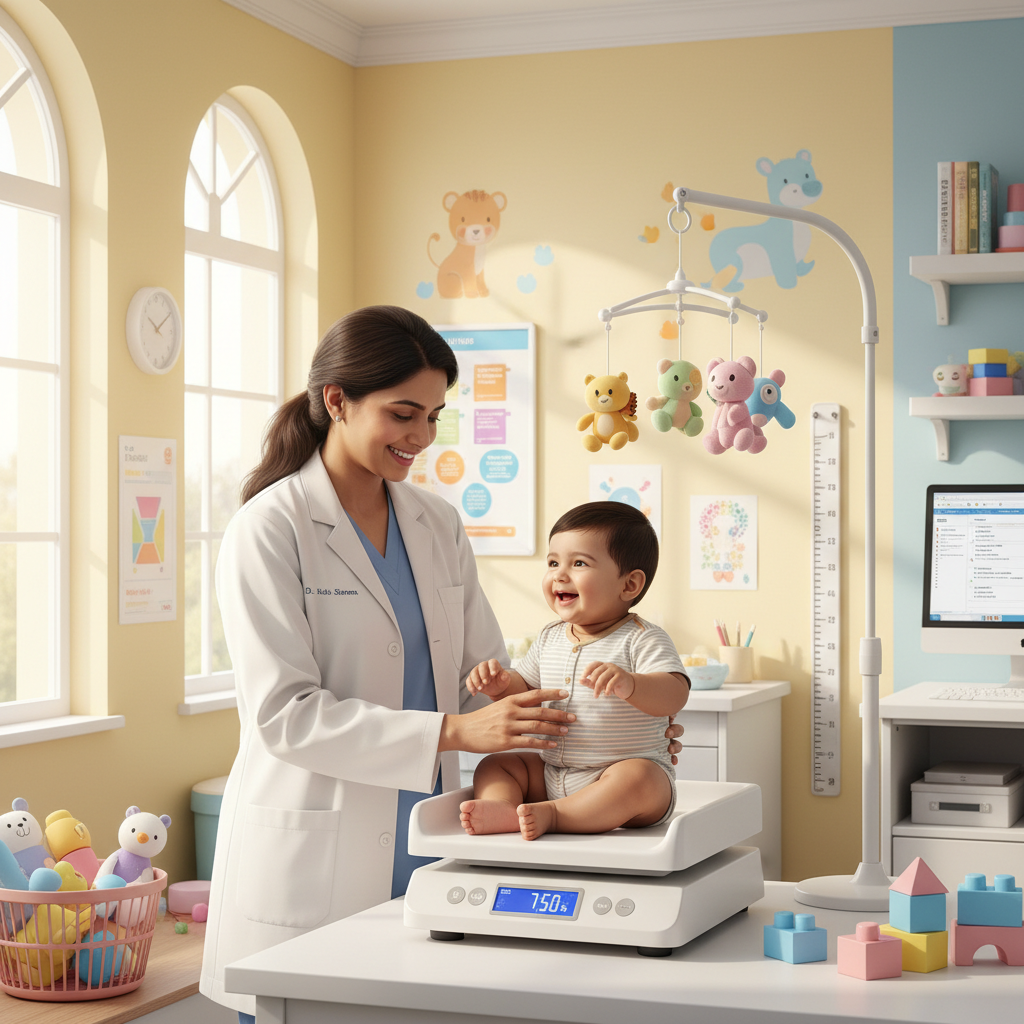
We’ve all been there. You’re at the clinic, holding your breath as the nurse places your little bundle of joy on the weighing scale. The digital numbers flicker, and for a split second, the world stops. Is she eating enough? Is he growing fast enough? As new parents, we obsess over every gram. It’s only natural! In those early days, weight feels like the only report card we have for how well we’re doing. If you are constantly Googling “is my baby’s weight normal,” take a deep breath. You are doing a great job.
To help put your mind at ease, we’ve compiled a comprehensive guide and a handy baby weight chart 0 to 12 months. This guide will help you understand what to expect, how to track healthy growth, and when you might actually need to worry (spoiler: probably less often than you think!).
Why Tracking Baby Weight Matters
While we shouldn’t fixate on numbers, tracking your baby’s weight is indeed one of the most vital health indicators during their first year. It acts as a roadmap for your pediatrician to ensure your little one is developing correctly.
Regular weight checks serve several crucial purposes:
- Health Indicator: Consistent weight gain is a primary sign of good health and proper nutrition.
- Early Detection: It helps identify potential feeding issues, such as latching problems in breastfed babies or formula intolerance, before they become serious.
- Reassurance: For anxious parents, seeing that upward curve on the chart is the ultimate validation that their baby is thriving.
Medical professionals worldwide rely on the World Health Organization (WHO) standards to monitor growth. These standards describe optimal growth for healthy children and are the benchmark for our baby weight chart 0 to 12 months below.

Comprehensive Baby Weight Chart (0-12 Months)
Below is a month-by-month breakdown of average weights for boys and girls based on WHO data. Remember, “average” doesn’t mean “perfect.” It’s just the middle point.
| Age | Boys Weight (Average) | Girls Weight (Average) |
|---|---|---|
| Birth | 3.3 kg (7 lb 6 oz) | 3.2 kg (7 lb 2 oz) |
| 1 Month | 4.5 kg (9 lb 15 oz) | 4.2 kg (9 lb 4 oz) |
| 2 Months | 5.6 kg (12 lb 4 oz) | 5.1 kg (11 lb 5 oz) |
| 3 Months | 6.4 kg (14 lb 1 oz) | 5.8 kg (12 lb 14 oz) |
| 4 Months | 7.0 kg (15 lb 7 oz) | 6.4 kg (14 lb 3 oz) |
| 5 Months | 7.5 kg (16 lb 9 oz) | 6.9 kg (15 lb 3 oz) |
| 6 Months | 7.9 kg (17 lb 8 oz) | 7.3 kg (16 lb 1 oz) |
| 7 Months | 8.3 kg (18 lb 5 oz) | 7.6 kg (16 lb 14 oz) |
| 8 Months | 8.6 kg (18 lb 15 oz) | 7.9 kg (17 lb 8 oz) |
| 9 Months | 8.9 kg (19 lb 10 oz) | 8.2 kg (18 lb 2 oz) |
| 10 Months | 9.2 kg (20 lb 3 oz) | 8.5 kg (18 lb 11 oz) |
| 11 Months | 9.4 kg (20 lb 12 oz) | 8.7 kg (19 lb 4 oz) |
| 12 Months | 9.6 kg (21 lb 4 oz) | 8.9 kg (19 lb 12 oz) |
Note for Indian Parents: Indian babies might sometimes weigh slightly less than the global average due to genetic differences. As long as your baby follows their own curve on the baby weight chart 0-12 months, they are doing just fine!
Understanding Baby Weight Percentiles
When you visit the pediatrician, you’ll often hear about “percentiles.” It sounds like a test score, but it isn’t!
If your doctor says your baby is in the 50th percentile, it simply means they are right in the middle—average weight. If they are in the 85th percentile, they weigh more than 85% of babies their age.
Crucially, anywhere between the 5th and 95th percentile is considered normal. A healthy baby weight chart isn’t about being at the top; it’s about consistency. What matters most is the growth pattern. If your baby stays steadily around the 15th percentile, that is their normal. If they suddenly drop from the 50th to the 5th, that warrants a check-up.

Key Baby Weight Milestones
While every child is unique, there are some general rules of thumb for weight gain in the first year:
- The First Week Dip: Don’t panic! It is perfectly normal for newborns to lose up to 10% of their body weight in the first few days after birth as they shed excess fluid.
- Back on Track: Most babies regain their birth weight by the time they are 2 weeks old.
- Doubling Up: A major milestone usually happens around the 4-month mark, when many babies double their birth weight.
- The Triple Crown: By their first birthday (12 months), most babies will have tripled their birth weight.
Keep in mind that growth isn’t linear. Babies have “growth spurts” where they might eat constantly and gain weight rapidly, followed by plateaus.
Factors Affecting Baby Weight Gain
Your neighbor’s baby might be chunkier than yours, and that’s okay. Several factors influence where a child falls on the infant weight chart 0-12 months:
- Feeding Method: Breastfed babies often gain weight faster in the first 3 months and then slow down, while formula-fed babies may gain weight more steadily throughout the first year.
- Genetics: Look in the mirror! Tall, slim parents often have tall, slim babies. Family history plays a huge role.
- Premature Birth: Preemies have their own catch-up growth charts and milestones.
- Mother’s Health: Nutrition during pregnancy and maternal health conditions can influence birth weight and early growth.
- Sleep & Activity: Believe it or not, babies grow when they sleep! An active crawler might also burn more calories than a calm observer.
When to Consult Your Pediatrician
While slight fluctuations are normal, there are certain red flags regarding baby weight gain chart trends that warrant a doctor’s visit:
⚠️ Watch Out For:
- Your baby has not regained their birth weight by 2 weeks of age.
- Your baby crosses two major percentile lines downward (e.g., dropping from 75th to 25th).
- Weight gain is less than 20g per day between 3 to 6 months.
- Your baby seems lethargic, refuses to feed, or is missing developmental milestones.
- Sudden, excessive weight gain that pushes them far above their previous curve.
Tips for Healthy Baby Weight Gain
If you are worried about your little one’s growth, here are some proactive steps:
First, establish a responsive feeding routine. Feed on demand, especially for breastfed babies. Track wet diapers—6 to 8 heavy wet diapers a day is a great sign they are getting enough milk. Monitor your baby’s alertness and activity; a happy, active baby is usually a well-fed baby. Lastly, keep up with regular pediatrician visits to keep your baby weight chart by month updated and accurate. Trust your instincts, mama!
Faq’s
Tracking your baby’s weight helps monitor their health, detect feeding issues early, and provides reassurance that they are growing as expected.
A healthy weight range varies by age and gender. Refer to the baby weight chart (0-12 months) for average weights, but remember, consistency in growth is more important than hitting exact numbers.
Ensure a responsive feeding routine, monitor wet diapers (6-8 per day is a good sign), and consult your pediatrician if weight gain is consistently below 20g/day between 3-6 months.
Consult your pediatrician if your baby hasn’t regained birth weight by 2 weeks, drops two major percentile lines, or shows signs like lethargy, feeding refusal, or missed developmental milestones.
Disclaimer: This content was automatically imported from a third-party source via RSS feed. The original source is: https://thechampatree.in/blog/parenting/baby-weight-guide/. xn--babytilbehr-pgb.com does not claim ownership of this content. All rights remain with the original publisher.