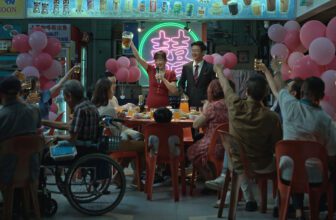
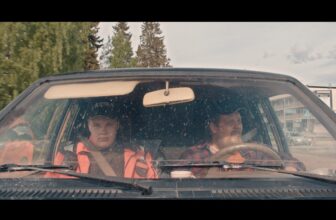
‘Christiania,’ courtesy of Tambo Film
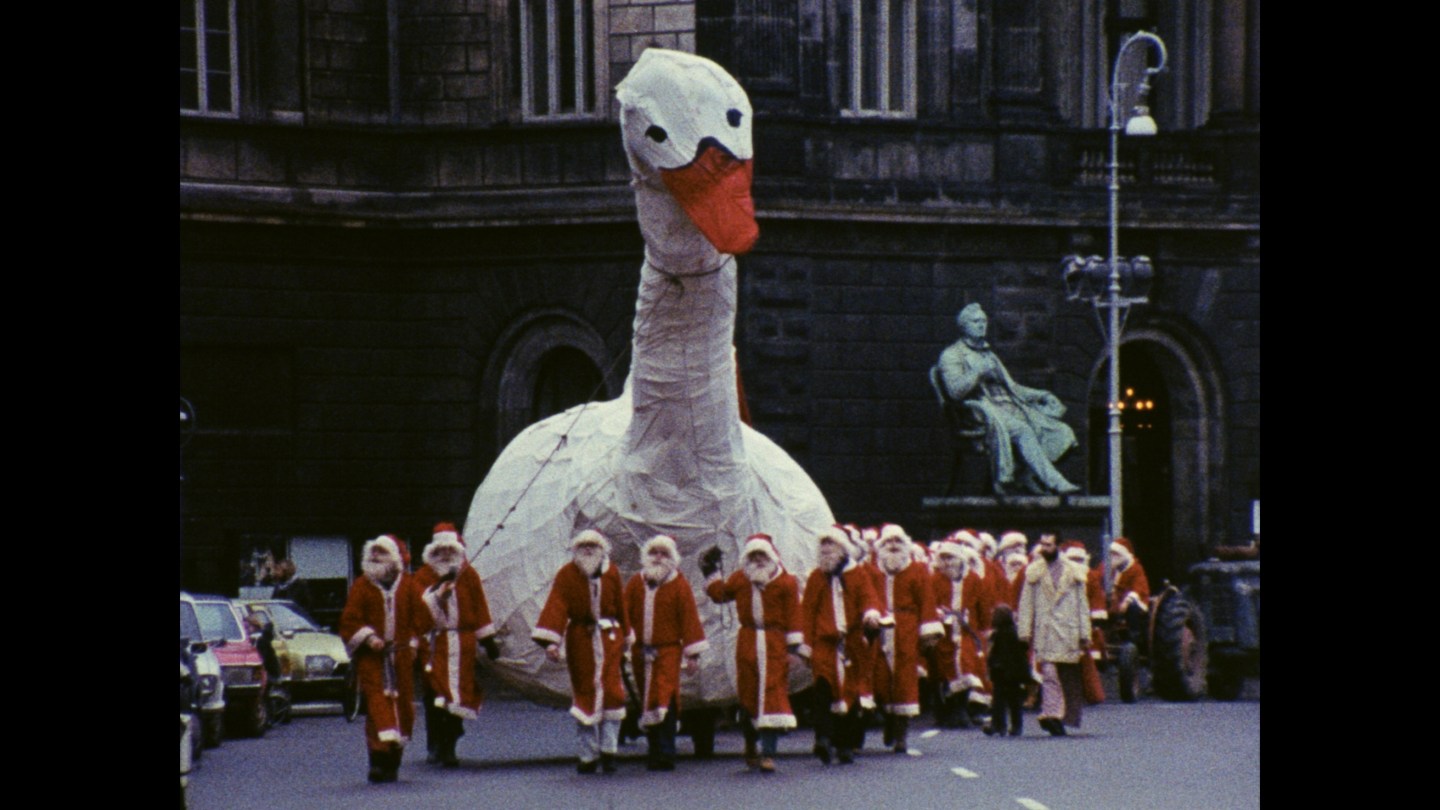
What do you get when you let hundreds of people create their own alternative society in the middle of a European capital? Copenhagen, Denmark has an answer. Its name: Freetown Christiania, widely known as simply Christiania, an anarchist commune created in 1971 via the occupation of abandoned barracks in the city’s Christianshavn neighborhood.
Now, 55 years later, Danish director Karl Friis Forchhammer, who was born in the commune, goes inside its history in his documentary Christiania, produced by Rikke Tambo via her Copenhagen-based Tambo Film. The film explores the heart and soul of Christiania, including various aspects of the 32-hectare commune, which has been called one of the world’s most iconic social experiments. They include its anarchic hippie culture, its governance by consensus democracy, a biker gang attack, and the efforts to shut down Pusher Street, Christiania’s cannabis market, which became “Denmark’s most violent area,” as the press notes explain.
CPH:DOX calls the film “a story told from the inside about radical democracy and free creativity, but also about violence, drugs and pressure from the outside world. About the idealism of the new settlers, the hippies, a religious doomsday sect, an alcoholic bear and consensus democracy.”
Christiania world premieres in the main competition of the 23rd edition of CPH:DOX, the Copenhagen International Documentary Film Festival, on Friday, March 13. It is also one of the six films featured in the second edition of Europe Docs!, an online showcase jointly curated by European Film Promotion and CPH:DOX that is designed to put a spotlight on outstanding European documentaries and improve access to the North American market.
Friis Forchhammer and Tambo talked to THR about how the director brings inside and outside views to the doc, how it makes for a colorful dive into history, why now was the time to make the film, and why it feels so universal and timely.
Can you share a bit about how your parents ended up in Christiania and how you decided to make a film about it?
Friis Forchhammer My mother saw my father at the Central Train Station here in Copenhagen, and she thought, “I want to marry this person.” So, she went home and told her friends, “I want to marry this guy. I don’t know his name. I don’t know anything about him. The only thing I know is that he had a rainbow-pattern sweater on.” And her friends told her: “Well, that’s the Rainbow Army, Christinia’s defense group.” So she went to Christiania and found him painting a house. And they got together and had two kids there. And when they got the third kid, me, they moved away from there.
They would tell me all sorts of stories when I grew up – about an alcoholic black bear called Rikke who would break into the room where they had their wine and get drunk and go to sleep, and about a guy who would jump into the river and breathe through a straw, hiding from the police. So the myths of Christiania had always been a central part of my life.
But it was a life that I didn’t live, and a life that I could only imagine. And as I got older, I thought I could make a fantastic film. After film school, I thought it would be a very complicated film, because it’s a complicated place, so I thought I would wait. But when one of my parents’ friends visited, he told me that all the old Christianites were dying. So I thought, if I want to tell the story, I have to tell it now.
I love that the doc combines the insider’s understanding and the outsider’s view. How did that approach work, and how much do people in Denmark know about Christiania?
Tambo Everyone in Denmark knows what Christiania is and has an opinion about it. Most likely, you love it, or you hate it. Even if they haven’t been there, people have an opinion, because it’s something that’s been part of the Danish cultural [experience].
It’s a place that many people have tried or wanted to make a film about. But the approach that Karl had, being an insider and an outsider at the same time, was really good. He’s tried to make a film that’s balanced, and I think he did that very well, so it’s not only focusing on the positive or the negative. He even has this humorous approach that I saw from the very beginning. He is an amazing storyteller and just has this amazing energy. By the way, my office is very close to Christiania.
Friis Forchhammer A lot of Christianites actually recognized it, because it used to be the social offices where they used to get their welfare checks.
‘Christiania,’ courtesy of Tambo Film
Karl, since you understand the spirit of the community, but also have a little bit more emotional distance, how challenging was it, for example, to talk about the challenges related to Pusher Street and not make people in the commune feel like you are pointing fingers?
Friis Forchhammer I found that many Christianites weren’t that nervous about criticism, because they really wanted nuanced storytelling. If you told somebody that Christiania was totally perfect, and this was a hippie paradise, they would say, “No, it’s not like that.” If you ask a Christianite about Christiania, they will criticize it for 45 minutes, but their love for the place will come through. It’s important for them to have the nuances.
And I felt that was key because it’s such an important story to tell. It is 32 hectares of land, which is an enormous amount of land. About 1,000 people created a parallel society 50 years ago. In the beginning, it was drug addicts, poor homeless people, but also people with resources – all kinds of people created a parallel society in the middle of your capital, where everyone had to agree to make a decision, even though they were so different. Some of them were at the bottom of society, some of them were at the top of society. Some of them disagreed vehemently, but they still had to agree on everything since it was built on unanimous decisions. It was never a 50 percent plus one vote. They all had to have a consensus to decide everything in this society.
So, I think that it is a really interesting democratic project, and probably one of the world’s largest social experiments. So I really wanted to try to zoom out and look what this place is really about. And actually, I think it is the second-most-visited tourist attraction in Denmark, behind the [Copenhagen amusement park and pleasure garden] Tivoli.

Karl Friis Forchhammer, courtesy of Karl Friis Forchhammer
Your focus on the democratic aspects of Christiania reminds me of how timely and universal your film feels, especially at a time when democratic values seem under attack in many parts of the world.
Friis Forchhammer I really wanted to tell a grand story, which is also a story about democracy. I feel that we have a lot of democratic challenges in the world and that people have a hard time disagreeing [when it comes to] making decisions together. We have a democratic problem when we are not able to work with people we disagree with.
In Christiania, you have to reach an agreement with someone you really disagree with. You have to sit down together and decide, for example, what to do with the guy who doesn’t pay rent. There’s something quite interesting in how this is a democratic project. And I think it is something that the world can learn from. Sometimes it’s okay to be around people who annoy you and you disagree with. And it’s good to be forced to be with them and be able to agree and make decisions on something.
Even though it’s difficult and painful…
Friis Forchhammer There are things on which you alienate each other, and I think that’s probably enhanced by these trench wars going on in social media these days. But when you actually sit in a meeting and have to agree to make decisions with other people, they become humans, and that means that it is harder to see them as enemies.
Are you planning to screen Christiania for the commune?
Friis Forchhammer I showed it to the Christianites a few weeks ago. I was so nervous. I’ve never been nervous before. The day almost started with a fire in the building, but everything went well. Everyone was so happy, and you could see that it was a film that brought them together a little bit more. Even though there were people who agreed with the closing down of Pusher Street, which the film shows, and people who disagreed, they found that they could agree on something. And it was beautiful to see some of the old Christianites who have lived there their whole life. Some of them were crying because they saw their whole life and all these experiences playing out.
‘Christiania,’ courtesy of Tambo Film
Christiania seems like a film that would be perfect for social impact initiatives and discussions. Any plans for that?
Tambo Yes, it will be shown in schools, and there will be some educational material. And after the Friday screening of the film, Karl will do a talk and Q&A, and school kids are coming in for that.
Is there anything else you’d love to share about Christiania? Or do you have any new film project in the works?
Friis Forchhammer I wanted to make a film that could be viewed on both the right and the left in Denmark and in the world, and not only by a certain part of the political spectrum. Telling a story with nuances about the hard parts of idealism and democracy might be difficult and imperfect, but it still has value.
I worked on this film for six years, and one of the things I started thinking about was that Christiania was created during the most tolerant period of the Danish welfare state. As you see in the film, the Danish Minister of Defense actually helped the Christianites. How insane is it that the Minister of Defense helps squatters to create an alternative society?!
We now have a lot of racist politics, but there’s also still a lot of tolerance in the Danish welfare state. For people without jobs, we have benefits. But I thought: Just imagine what the welfare state was like back then. So it would be interesting to maybe make a similar film about the Danish or the Scandinavian welfare model, because these topics are being discussed a lot in politics all around the globe. What is really essential is that we are at the top of the happiness index, together with other Scandinavian states. But that is being challenged right now. And I think it needs a film like Christiania. This needs a film where we look into what has defined us Scandinavians as people, and what’s challenging that in the future? I think it would be beautiful to remind us where we are, and also look at what we once were.
Disclaimer: This content was automatically imported from a third-party source via RSS feed. The original source is: https://www.hollywoodreporter.com/movies/movie-news/christiania-copenhagen-commune-doc-film-cphdox-drugs-bear-1236525055/. xn--babytilbehr-pgb.com does not claim ownership of this content. All rights remain with the original publisher.