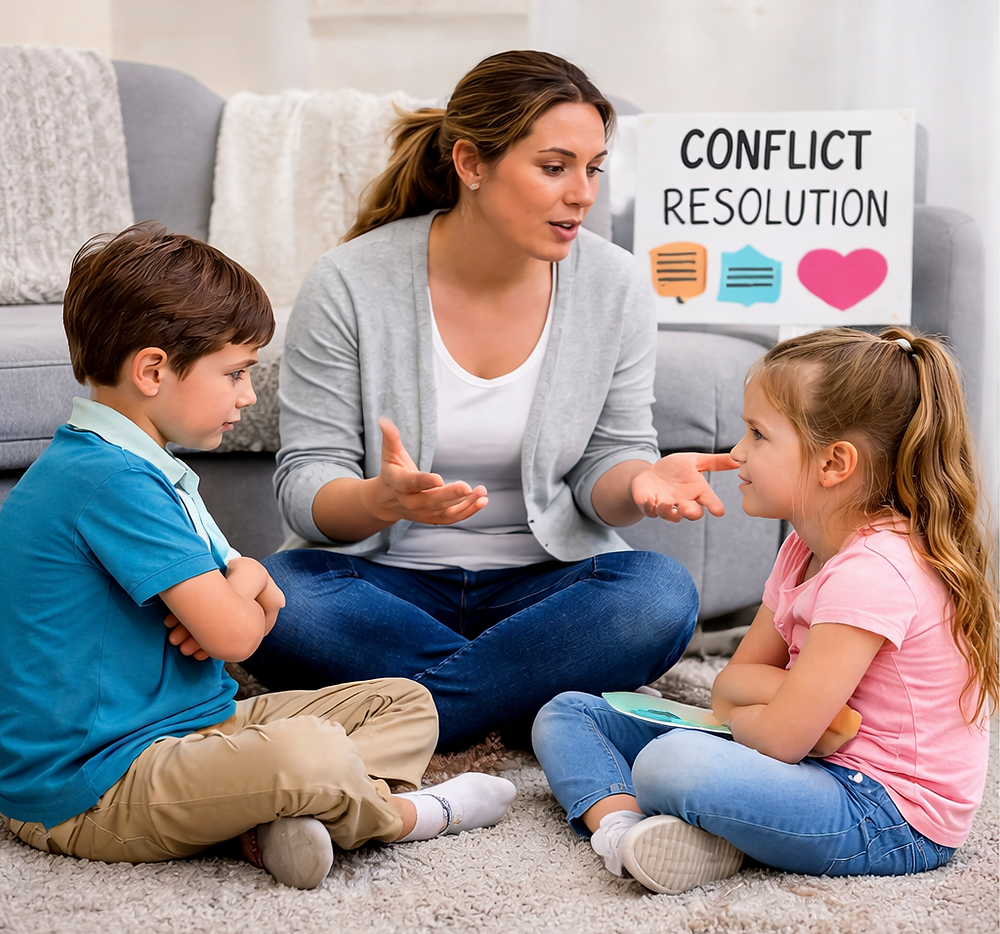
Healthy conflict resolution skills for kids are one of the most valuable life lessons you can teach your child. Disagreements are a normal part of childhood. Your child might argue with a sibling over toys, clash with a friend during a game, or feel frustrated when things don’t go their way at school. When you teach healthy conflict resolution skills for kids, you give them tools to manage these situations calmly, communicate their feelings, and build stronger relationships.
While it may feel natural to step in and fix every disagreement, children benefit most when they learn how to work through conflicts themselves with your guidance. Over time, they begin to understand how to listen, express their feelings respectfully, and search for solutions that work for everyone involved. When you consistently model and teach healthy conflict resolution skills for kids, you are helping your child build emotional intelligence, resilience, and confidence that will serve them for the rest of their lives.
Below are five practical ways you can help your child develop strong and respectful conflict resolution habits.
1. Focus on Communication Skills
Clear communication is the foundation of healthy conflict resolution. When kids struggle to express their feelings, frustration can quickly turn into yelling, blaming, or shutting down.
Start by helping your child learn how to describe their feelings in a calm and respectful way. Encourage them to use “I” statements rather than blaming language. For example:
Using “I” statements helps children explain their feelings without accusing the other person. This lowers defensiveness and keeps the conversation more productive.
Listening is just as important as speaking. Teach your child that listening means trying to understand what the other person is feeling, not simply waiting for their turn to talk. You can practice this skill through simple role-playing exercises at home. For example, you might act out a situation where two kids want the same toy and practice taking turns explaining how each person feels.
Another important part of communication is tone of voice. Remind your child that yelling or using harsh words usually makes a conflict worse. A calm voice helps everyone stay focused on solving the problem instead of escalating the disagreement.
Children learn these skills best by watching you. When you communicate calmly during stressful moments, your child begins to see what respectful communication looks like in real life.
2. Teach Problem-Solving and Compromise
When children argue, they often focus on proving that they are right. Helping them shift their focus toward problem-solving is a powerful step in learning healthy conflict resolution.
Instead of immediately offering a solution, ask open-ended questions such as:
-
“What ideas do you have to fix this?”
-
“What could both of you do so this feels fair?”
-
“What would make this better for everyone?”
These questions help children think creatively and recognize that most conflicts have more than one possible solution.
Next, introduce the idea of compromise. Kids sometimes assume that compromise means losing. In reality, compromise simply means finding a solution where both people feel respected.
-
Two children want the same toy → They take turns.
-
Two friends want different games → They agree to play one now and one later.
-
A sibling wants quiet while another wants music → They choose headphones or another room.
Explain that fairness doesn’t always mean everyone gets exactly what they want. Instead, fairness means everyone’s feelings are considered.
You can also teach your child that sometimes the best solution is to take a short break. When emotions run high, stepping away for a few minutes allows everyone to calm down and think more clearly before continuing the conversation.
Learning to pause, reflect, and brainstorm solutions helps kids develop critical thinking and emotional control.
3. Model Healthy Conflict Resolution at Home
Children learn more from what they observe than from what they are told. That is why modeling healthy conflict resolution skills for kids is one of the most powerful teaching tools you have.
When disagreements happen in your home, your child is watching how you respond. If conflicts are handled with yelling, blaming, or silent treatment, children may begin to copy those patterns.
Instead, demonstrate healthy ways to manage disagreements.
Try to show your child how to:
-
Stay calm when emotions rise
-
Listen to the other person’s perspective
-
Speak respectfully even when frustrated
-
Focus on solving the problem rather than assigning blame
Another important lesson is taking responsibility for mistakes. When you handle a situation poorly, acknowledge it openly.
“I’m sorry I raised my voice earlier. I was frustrated, but I should have handled that differently.”
Moments like this teach your child that mistakes are normal and that repairing relationships is an important part of conflict resolution.
Your willingness to reflect and apologize models humility, accountability, and emotional maturity.

4. Build Empathy and Perspective-Taking
Empathy plays a critical role in preventing and resolving conflicts. When children learn to consider how someone else feels, they are less likely to act impulsively or say hurtful things.
You can help build empathy by asking simple questions during conflicts:
-
“How do you think your friend felt when that happened?”
-
“What do you think they were trying to say?”
-
“What would help them feel better right now?”
These questions gently guide your child to think beyond their own perspective.
Stories and books can also be excellent tools for teaching empathy. When reading together, pause to discuss how characters might be feeling and why they reacted a certain way. This helps children practice identifying emotions and understanding different viewpoints.
Role-playing is another effective strategy. You might ask your child to act out both sides of a disagreement so they can see how their words and actions affect others.
When kids begin to understand another person’s feelings, conflicts often become easier to resolve. Empathy encourages kindness, patience, and thoughtful communication.
5. Emphasize Respect and Fairness
Respect is at the heart of every healthy relationship. Teaching your child that disagreements should still include kindness and fairness helps prevent conflicts from becoming hurtful.
Start by establishing simple family expectations for respectful communication. For example:
You can remind your child that disagreements are not about winning or losing. Instead, the goal is to find a solution that works for everyone involved.
For example, if siblings are arguing about which game to play, you might suggest taking turns choosing the activity. This reinforces the idea that fairness often means sharing opportunities rather than getting your way every time.
Children who understand respect and fairness are more likely to maintain healthy friendships and navigate social situations successfully.
Why Healthy Conflict Resolution Skills for Kids Matter
Teaching healthy conflict resolution skills for kids helps children develop important life skills that extend far beyond childhood disagreements.
Kids who learn to resolve conflicts effectively tend to:
-
Communicate their feelings clearly
-
Build stronger friendships
-
Handle frustration more calmly
-
Solve problems more independently
-
Develop empathy and emotional intelligence
These abilities support success in school, relationships, and future workplaces.
When children lack these skills, small disagreements can quickly escalate into ongoing conflicts, hurt feelings, and damaged relationships. By guiding your child early, you help them avoid these patterns and develop healthier ways of interacting with others.
As a parent, your role is not to eliminate every conflict but to guide your child through it. Each disagreement becomes an opportunity to practice communication, empathy, and problem-solving.
Over time, these experiences help your child feel more confident navigating challenges with friends, classmates, and family members.
Final Thoughts About Conflict Resolution Skills for Kids
Conflict is a natural part of growing up. With your guidance and support, these moments can become powerful learning opportunities.
When you consistently teach healthy conflict resolution skills for kids, you help your child build confidence, strengthen relationships, and develop lifelong communication skills.
By encouraging calm communication, modeling respectful behavior, teaching compromise, and building empathy, you equip your child with tools that will serve them well throughout their lives.
The goal is not to avoid disagreements but to help your child learn how to navigate them with patience, respect, and understanding.
Over time, these small lessons add up to something incredibly valuable: a child who knows how to work through challenges and maintain healthy relationships in every stage of life.
You may also like these related posts:
Enjoyed this post?
Sign up to be notified when new articles are published.

All blog content shared through HealthSmart! Kids is for informational purposes only and not to be construed as medical advice. Always talk with your qualified health care provider for managing your health care needs.
Disclaimer: This content was automatically imported from a third-party source via RSS feed. The original source is: https://www.healthsmartkids.net/post/5-tips-for-teaching-kids-to-manage-conflict-in-healthy-ways. xn--babytilbehr-pgb.com does not claim ownership of this content. All rights remain with the original publisher.