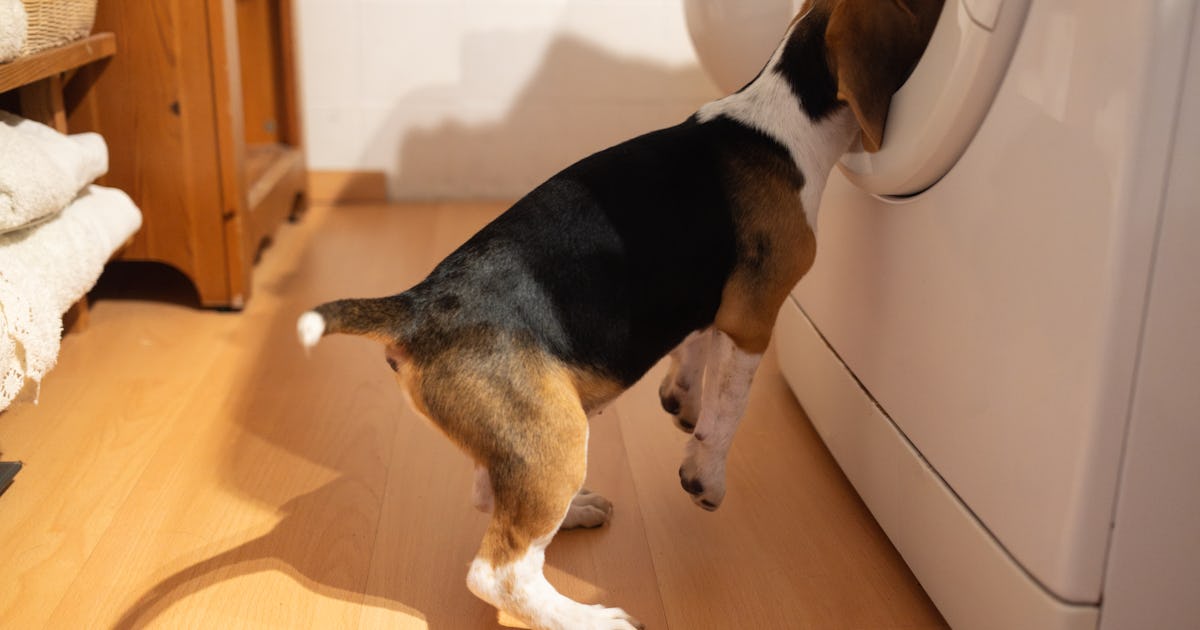
You just finished some cleaning and you’re resting on the couch for a minute when… hey! Are those your favorite underwear? Zoom. There goes the dog with a pair of your undies in his mouth, stolen straight from the hamper. Cue another game of “give those back!” as you both dart around the living room, fighting over some Fruit of the Loom. If your pet is a laundry lover, then this scene is all too familiar — but seriously, why are dogs obsessed with dirty underwear?
We asked two experts what’s up with this odd fascination, and they explain why it’s important for pet parents to keep their delicates out of their dog’s reach.
Why are dogs obsessed with dirty underwear?
While you might think your dog is being a little freak running through the house with a stolen pair of panties in tow, the reason they do this might actually be kind of sweet.
“It’s very common for dogs to seek out dirty underwear and other worn clothing because those items carry a strong concentration of their owner’s scent,” says Dr. Carly Fox, senior veterinarian in the Schwarzman Animal Medical Center’s Emergency & Critical Care Service. “Dogs experience the world primarily through smell, and heavily worn items — especially underwear — contain pheromones and body odors that are particularly compelling. For many dogs, this behavior is a form of comfort-seeking or curiosity rather than anything weird.”
“Dogs are drawn to scent first and foremost, and dirty laundry is basically a concentrated ‘you’ in fabric form,” agrees Ali Smith, professional dog trainer, behavior consultant, and founder of Rebarkable. “It’s not just underwear, either. Socks, leggings, and anything worn close to the skin tend to top the list. Underwear, socks, and worn t-shirts carry particularly strong human scent, which makes them highly reinforcing to investigate, carry, and sometimes chew.”
For some dogs, stealing your undies can also be a form of attention-seeking if they’ve learned running by you with some contraband panties gets a reaction out of you, Fox says. Small clothing items are light and easy to run with — a game of cat and mouse is extremely rewarding from a playful dog’s perspective, Smith says.
Are some dogs bigger laundry thieves than others?
If you’ve ever had a puppy or adolescent dog, you know they put everything in their mouths, so they’re very likely to dive headlong into the laundry pile at some point. Dogs with anxiety or strong attachment to their owners may also be “drawn to scent-heavy items as a form of self-soothing,” says Fox.
Your dog’s breed could also play a role in why they steal undies, Smith notes. For example, hounds and scent-driven breeds who naturally follow their noses will be drawn to dirty clothes that are full of interesting smells.
“Labradors and other retrievers are also frequent offenders, in part because they’re opportunistic and highly food-motivated. If something smells like it might have been food-adjacent at any point, it often gets classified as edible,” she says. “Retrievers add another layer. They’ve been selectively bred to pick things up and carry them without consuming them — essentially interrupting the “eat” portion of the predatory sequence. But when that inhibition isn’t strong or breaks down, you can see the opposite happen: instead of holding the item, they ingest it. In those dogs, you often see a combination of ‘must pick it up’ and ‘might as well eat it.’”
How To Stop A Dog From Stealing Clothes
That’s the rub, really. The problem with your dog’s little game of capture the undies is that it could escalate into actually chewing up or ingesting fabrics, and this can cause medical emergencies, like an intestinal blockage. If you suspect your dog has swallowed a clothing item, contact your vet right away.
“This can quickly turn into a medical issue — foreign body ingestion is a very real concern and can lead to obstruction requiring surgery,” says Fox. “If a dog does ingest fabric, signs like vomiting, lethargy, and decreased appetite should raise concern for an obstruction and warrant prompt veterinary evaluation.”
Pet owners should use laundry hampers that close with a zipper or lid, and ideally keep them behind a closed door, Smith says. Be diligent about keeping laundry out of reach, especially things like socks that tend to get stuffed into sneakers upon returning home. Lastly, if your pup finds a clothing item anyway, Smith says it’s important not to accidentally reinforce the behavior while taking it away.
“Avoid turning it into a game — this is very commonly reinforced by accident when owners chase, react, or try to grab the item back. Trade calmly for food or another item rather than trying to pull it away,” she says.
If your dog tends to seek out the laundry pile, try adding other forms of enrichment to their life. Make sure they’re mentally stimulated and get enough physical exercise, Fox recommends.
While it might be a little inconvenient to have to police the socks in your house, Smith says stealing laundry is a pretty normal behavior for dogs. They don’t mean to be naughty, so your goal should never be to punish them.
“The goal isn’t to correct the dog, but to reduce opportunity and give them appropriate outlets for the underlying drive. Redirection is key. For scent-driven dogs like hounds, scent games — especially simple hide-and-seek style searches — can be incredibly effective. For retrievers, structured retrieval games using a dummy or a favorite toy can help channel that ‘pick it up’ instinct appropriately.”
If your dog keeps stealing the same category of item, that’s useful information, she adds — it tells you what they find most reinforcing, and where you need better management. So pay attention to what your fuzzy little bandit finds most steal-able, and work backwards from there to keep them safe and mentally stimulated.
Disclaimer: This content was automatically imported from a third-party source via RSS feed. The original source is: https://www.scarymommy.com/lifestyle/why-are-dogs-obsessed-with-dirty-underwear. xn--babytilbehr-pgb.com does not claim ownership of this content. All rights remain with the original publisher.