Dr. Rebecca Dekker – 00:00:00:
Hi, everyone. On today’s podcast, we’re going to talk with Ms. Charlotte Shilo-Goudeau and Chanté Perryman about being both a doula and a midwife. Welcome to the Evidence Based Birth® Podcast. My name is Rebecca Dekker, and I’m a nurse with my PhD and the founder of Evidence Based Birth®. Join me each week as we work together to get evidence-based information into the hands of families and professionals around the world. As a reminder, this information is not medical advice. See ebbirth.com/disclaimer for more details. Hi everyone, and welcome to today’s episode of the Evidence Based Birth® Podcast.
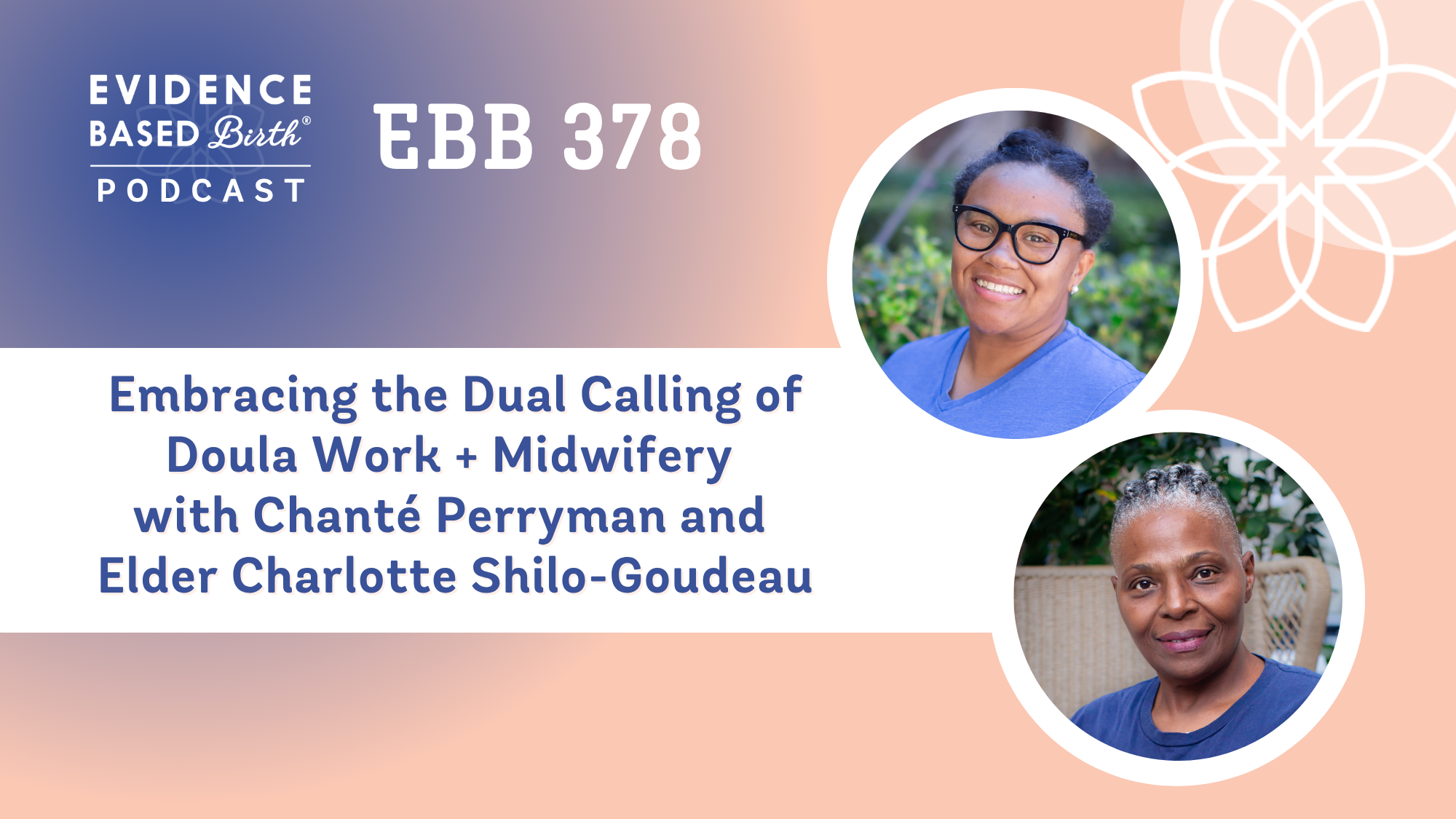
Today I am so excited to welcome our two guests, Elder Charlotte Marie Shilo-Goudeau and Chanté Perryman. Ms. Charlotte is a licensed certified professional midwife and the founder of Pick Your Own Birthing Experience, P-Y-O-B-E, with Mama Char’s Birthing Service based in Mariguen, Louisiana. A respected leader in maternal health, she brings more than 40 years of combined personal and professional experience to her work in midwifery, education, and community care. Elder Charlotte holds numerous titles and roles, including instructor for Community Birth Companion doula training in Opelousas, Louisiana. International maternal support instructor for Babomia, Inc., of Canada. An Evidence Based Birth® instructor, certified breastfeeding specialist, perinatal birth specialist, National Perinatal Task Force ambassador for the Opelousas branch, maternal health advisor, a NARM preceptor, a certified adult mental health first aid USA provider, and a mentor with Commonsense Childbirth School of Midwifery. Above all, Ms. Charlotte treasures her roles as a devoted mother and wife. Her academic journey includes earning various degrees and certifications from LSU in Eunice, Alexandria, and in South Louisiana Community College in Lafayette, and the University of New Orleans. Deeply committed to holistic and culturally literate care, Elder Charlotte continues to serve her community through birth work while also mentoring and educating the next generation of midwives, doulas, parents, and healthcare advocates. For Elder Charlotte, midwifery is more than a profession. It is a calling rooted in being mindful, intentional, determined, wise, impactful, faithful, equipped, resilient, and young at heart. She is deeply grateful for the trust, prayers, and encouragement from her community who honor her as a Black elder midwife.
Chanté Perryman is also here with us today. She is the Director of Programs at Evidence Based Birth® and has been supporting, educating, and advocating for birthing families for more than a decade as a certified doula, childbirth educator, and community birth organizer. Chanté is currently in her final year of school as a student midwife at Mercy In Action College of Midwifery. She believes in informed birth choices along with respectful care and evidence-based education. Chanté volunteers with the Kentucky Birth Coalition, advocating for legislative advances for midwives, birthing families, and freestanding birth centers and communities. Her newest endeavor is sharing awareness about period poverty and helping to supply menstrual products to local middle and high schools. She aspires for a world where birth can happen without politics, persuasions, or propaganda, but instead where consumers are being heard, treated with respect, and valued.
Charlotte and Chanté, welcome both of you to the Evidence Based Birth® Podcast.
Charlotte Shilo-Goudeau – 00:03:41:
Thank you.
Dr. Rebecca Dekker – 00:03:46:
Can each of you share with our listeners how you first entered birth work and what drew you into this path of being both a doula and a midwife?
Chanté Perryman – 00:03:56:
Sure. I can go first. What drew me into birth work was actually the birth of my first daughter. So with the birth of my first daughter, I ended up having an emergency Cesarean. And after that, I went to see my provider and I was like, why did I have this? And what can I do to prepare myself for a VBAC the next time? And he basically brushed me off. So that is what literally drew me into birth work because I was like, I want to know why I had to have a Cesarean and how can I make sure that this doesn’t happen to me again. And in that I found out what a doula is. And I was like, oh my goodness, this is amazing. I need to become a doula to be able to like share information and to be able to support families. And so that they can now have like the information and the tools to be able to make better decisions when it comes to their healthcare. And then just in that course, I was like, oh my goodness, there’s also midwives, which I should say during my first pregnancy, I did see a midwife for like the first 12 weeks. But in my mind, I was like, no, I think I really need a doctor because, you know, like what society was always saying, you need to see a doctor. And so after that, I’ve really understood the differences in a midwife, in an OB and like the practice and care and just all the things. And I was like, yes, that is so what I need to become. And so that’s kind of how I ended up on this journey.
Dr. Rebecca Dekker – 00:05:25:
Yeah. And you ended up having four VBACs, right?
Chanté Perryman – 00:05:28:
Yeah. I did.
Dr. Rebecca Dekker – 00:05:28:
Natural births after Cesarean.
Chanté Perryman – 00:05:30:
I did.
Dr. Rebecca Dekker – 00:05:30:
Yeah. Were any of those with the help of a midwife?
Chanté Perryman – 00:05:32:
After my first daughter, the rest of my care was with midwives.
Dr. Rebecca Dekker – 00:05:37:
Yeah. Thank you for sharing that. Elder Charlotte?
Charlotte Shilo-Goudeau – 00:05:42:
Thank you, Chanté. For me, the calling on this journey, really became evident after I, you know, had a stillbirth in the hospital setting. And going through that experience as well as just always be, you know, something in the back of my mind and in my heart, like, oh, man, I got to go to a doctor. I have to have my baby in the hospital. When historically I knew within my community there were midwives at a time. There was individuals who came to the homes and so forth. But during that time, I didn’t know of anyone. You know, I just didn’t know of anyone. And I started, you know, thinking about, you know, why did I go through what I went through having a stillbirth? And there was no love. There was no care. There was just, you know, I’m sorry this happened to you. You can always have, you know, other children. But that was not something I needed to hear, nor did I want to hear. And at that time, it’s like it has to be something better. It just has to be something better. Then when I got pregnant again, as a matter of fact, I’m a mother of, you know, eight biological pregnancies. And I have three other children, so I’m a mother of 11. And, during my pregnancy, you know, it’s like, okay, somebody has to know something. And I just started searching around and someone told me about a midwife. And I do have permission to mention her name. I always do. By Ms. Kathy Acree. And when I met her, she said, you know, Charlotte. You know, you don’t have to have your baby in a hospital setting. You know, to hear her say that. And that helped me to realize that she was doing what many of my ancestors had always done. She was doing what other elders in the community had done, but those elders were now transitioned. And so after having that wonderful experience with her, it was like, okay, is this something that’s in me? You know, I’ve always had that urge for birth and wanting to do it a way that my body would tell me was okay to do it. And so along with having that wonderful experience along of having a childhood memory of the elders in my community, along with all of those things, you know, I started pursuing how to get involved. But there was no education at that time. Even though Ms. Kathy had education, there was no schools. And then my mother got really sick.
And when my mother got really sick, I decided, you know, when, I have to stay home and take care of my mother, but it was always in my heart, in my mind that this was a calling for me. And I just had to trust the timing, trust the timing. And on my mother’s deathbed, she looked at me. She said, you know, Charlotte. I’m freeing you to do what God has called you to do. And I want you to remember, you don’t need to be an OB. You don’t need to be, you know, a doctor to, you know, to help birth babies. If this is what you know you’re going to do, something is going to open up. And literally two days later, I got a call that a member free school was starting and I needed to attend an interview. But I did explain to them that I was going through some time at that moment. We was getting ready to, you know, put my mother to rest. And I needed to ensure that I spoke with them face to face because I’m a people’s person. You know, I like to see body language. But it just kept on echoing in my mind what my mother said. I’m freeing you to do what you have been called to do. And to me, that wasn’t a coincidence that I got that call and decided to have those interviews and, you know, getting to midwifery school. And to make it a point of navigating that pathway because it was a calling for me.
Dr. Rebecca Dekker – 00:09:52:
I feel like both of you have that in common in that you felt that calling, but it’s the journey was not a quick one. You had to wait for the right timing.
Charlotte Shilo-Goudeau – 00:10:02:
Yes, yes, it was not quick. Timing is everything. And when you’re truly called, I’m going to say this for me, when you’re truly called, sometimes we may run away from those things. Like, oh, no, I can’t be, you know, no, no, no. You sure you want me to be delivering babies? But when that calling is for you, there will be trials and tribulations. But we are persistent, you know, once we answer the call. And I want to say, I answer the calling. From what I just heard from Chanté, you know, it’s evident that she answered the call. So, answering the call and getting on this path and this journey, though not easy, it is a continuum of what we have been called to do.
Dr. Rebecca Dekker – 00:10:39:
I love today how we have both like a student midwife with Chanté and an elder midwife here, kind of on both ends of the spectrum. And Chanté, you worked for more than a decade as a doula, and then you started your midwifery studies. So how did your doula experience shape the way you’ve approached your midwifery studies and how you’re providing care?
Chanté Perryman – 00:10:59:
Absolutely. For me, I’ve always wanted to practice individual care. That person, that pregnancy, that baby, that birth. And so as a doula going into the hospitals, I could see like. The standard of care was literally the standard for everybody. Like everybody was treated the same. You have, we see you at 14 weeks. That’s what we’re doing. These are the questions that I’m asking. I see you at 28 weeks. Like everything is just like, there was no. Like there was no like, oh, well, how’s your family? Just there’s no differences in everybody’s care. It was just like straight across the board. And so for me, I was like, I really want to make sure that I know the people who I’m serving and that I know their background. And I know their family history. And so when I have other conversations with doulas and, you know, everybody’s like, yeah, I do like two to three prenatals. I’m like, oh my goodness. I’m meeting with families from the time you signed me on with you. We’re meeting at least once a month. And so when I started my midwifery studies, it was like, oh, I can see how when I was practicing as a doula, how some of those things were already crossing over onto that midwifery side with that individual care. Just making sure that. I really understood what people’s needs and desires were and that I was actively listening. And even if it’s just from a doula role, when we’re going into the births, making sure that I’m going over that plan with them again, making sure that I’m communicating with the provider. Be like, oh, I just want to make sure that you remember X, Y and Z. Remember that she stated this in her birth plan. Remember that the father wants to cut the cord or catch the baby. Just bringing in those small things, I feel like really makes the birth really special for that family.
Dr. Rebecca Dekker – 00:12:47:
And did that like have an impact on the type of midwifery path that you chose because you’re becoming a certified professional midwife as your career goal?
Chanté Perryman – 00:12:55:
It did. So my goal has always been to have a birth center. And I already had a degree. And I was like, I really just want at the time when I started middle free school, you know, here in Kentucky, we were still fighting for legislation just for midwives to get licensure. But my goal was always to have a birth center. And so I could just literally envision like a four room birth center and just making sure that those families were coming in and that I had that care for them from the beginning through postpartum and just making it like a family ordeal. Like bring in your children. You know, I’ve had providers in the hospital be like, no, you can’t bring your kids in. It’s like, but this is a family event. Like you want the kids to be part of it for it to be part of their memory as well. And so just having a birth center and being able to have that individual care, being able to have those childbirth classes, being able to just have families come in and converse with one another to share their experiences. That was really part of the reason of why I chose the CPM route.
Dr. Rebecca Dekker – 00:13:54:
Yeah, that makes perfect sense. And I share that vision with you. I can’t wait someday to see your birth center in Kentucky open. And as you know, you and I both know, this is not, and like Ms. Charlotte was saying, timing is everything and there are trials and tribulations and it doesn’t happen overnight. It can take many years to see that vision come to fruition. Elder Charlotte, as one of only four African-American licensed certified professional midwives in Louisiana, like how do you see the midwives in your community, such as yourself? How are you positioned to support the communities in Louisiana that are often underserved and don’t have access to quality care?
Charlotte Shilo-Goudeau – 00:14:34:
That is an excellent question. You use the term how. Am I in a position to give those individuals who lack access to care, care to us. Unfortunately, we are so spread out in only one of four African-Americans. And out of the four, three of us are, actively, still doing birth, and one is teaching and no longer doing birth. But the mindset, I think uniquely we have to first of all position ourselves mentally in order to make a sacrifice that we have to drive to those individuals because I am a home birth midwife. And even if I’m called to help someone in a birth center setting, especially for people of color, you know, the distance between where someone lives. And the place where they can have access to care is just a great distance. So making myself available. And again, one of four African-Americans in the state of Louisiana, I want to point this out, that is documented. That is documented because there are still other individuals who is practicing the art of midwifery but may have chosen not to be licensed and documented in the state of Louisiana. And in order to continue to support the community that is so often unserved, I had to remember historically why it was important in the first place for midwifery to be in those communities. And I had to understand and teach the clients that do seek out my service that we cannot repeat history. You know, we cannot repeat history. And in order to not to repeat history, we have to move forward of educating, you know, teaching, educating, advocacy, you know, all of those things.
So that’s how uniquely we have to continue to stay on this journey. And then there is the part of the legal issue. You know, what are the rules and regulations within the state that I live in? How do I function within the guidelines in order to continue, you know, helping someone? And I also want to point out there’s a spiritual aspect of what I do, you know. So for me, that spiritual aspect says a much higher power has put me in a position to man what has always been a part of history. We birthing, you know, babies and someone they are helping to birth babies. I say the word baby, but they’re baking in the womb too. Y’all, so, don’t know. That’s okay. And just reminding myself and reminding others that because I am Black and because there are few Blacks that we have to continue to reach out to, not just Blacks, those who are historically being marginalized due to racism. You know, within the community. So that we can continue to provide the service to those individuals that do look like us. And even to those individuals who want our services because we are accessible to them. So that’s how I think we continue to be unique within the community. Do we need more African-Americans and other individuals of color within the communities? Sure, we do. The only way that we can do that is for me to continue. You know, with midwifery care and passing a torch that is lit to the next person that’s going to continue to pass the torch.
Dr. Rebecca Dekker – 00:18:12:
Yeah. You mentioned some of the barriers, the distance and accessing care and long, long drives that I’m sure you spend a lot of time trying to drive to people and then regulations. And I know in our past conversations, you’ve mentioned, you know, one of the hardest things for you is when you make a bond with a family and, you know, you’re caring for them. And then something happens that according to the regulations or per your midwifery expertise, they’re risked out of a home birth and they have to birth in a hospital. And that’s when you kind of step more officially into a doula role. So can you talk about how you provide care as a doula? You’re a licensed midwife, but you’ll go with your clients to the hospital as a doula. Is that correct?
Charlotte Shilo-Goudeau – 00:19:01:
That is correct. One thing I would like to listen to the audience to remember that we have coined this term in our society as a doula. I believe we should focus on the service that we do and provide out of this respect for one another. So when I do have to transport and or transfer care to another health care provider and that mother may be or that birthing person may be birthing in a hospital setting, the role that someone has given me or that title, that title that someone has given me is just that title. The service that I provide is still the care being there, you know, the person that does advocate for that individual person that says, you know, hey, I’m here. And even though the title of me as a midwife in that hospital setting is no longer recognized as me being a midwife because I have transferred care to that institution, the service of being with a woman does not stop in terms of providing that care. Here in our culture, the term doula comes about as service. What do we do? You know, we offer them food. We offer them drink. We offer them, you know, information. We offer them all these things. And it comes down with offering them what they need to continue on their journey.
So, for me, the title for midwifery to the title that has been, you know, put up on us as doula, and may change based upon what other individuals in those settings are articulating, but the service. Doesn’t change. The service doesn’t change. We’re still there. You know, we’re still encouraging those individuals to do the very best that they can. We’re, you know, talking to the healthcare providers and also like Chanté said earlier, reminding them of the voice that that client has. And sometimes, you know, they don’t speak up, not because they are afraid, but because they’re having a contraction at that time, you know, and someone comes, asks them a question that, hey, I can’t talk to you. And so it’s those roles is a role that if we are truly called, it’s not hard to, you know, some people may say switch. Because you’re really not switching what you’re supposed to do. You’re being a servant. You know. So I hope that we come to understanding that society has given us titles. And yet we must activate and keep activating what we have always been called to do, service one another. So even though I may be in that hospital setting, the title for midwifery to the title of doula, you know, may change based upon how they define those terms. But the service that is provided. You know, the service I provide does not change.
Dr. Rebecca Dekker – 00:22:14:
It reminds me of a few years ago, for some reason, had the realization that. Like both doulas and midwives and nurses are all healers. And often doulas may not think of themselves in that way, but they really do heal with their presence, with their actions, with their words, with their hands. And that piece in common, and you’re right, Ms. Charlotte, the societal titles, you know, it’s like we’re trying to put people into boxes, but you can’t always put someone in a box.
Charlotte Shilo-Goudeau – 00:22:47:
No, you can’t. And I’m so thankful. And maybe she’ll take it. So don’t be mad when you say healing. And when we both talked about it, you know that it’s a lifelong journey. And just as much as we are seen as healers, we are also being healed. In the process. And unification within bringing these different genres in is important. Like I said, yes, there are titles, there are doctors, there are midwives, there are doulas, there are nurses. Yet when we can step aside the titles and embrace, you know, what we are uniquely, you know, designed to do, it makes for a better birthing outcome, you know. And what does that mean? Sometimes there are unfortunate events. Sometimes there are tests that you know, will occur. But when we come together and recognize the value of who we are in the spaces that we are in, we function from a place of love and commitment to making sure each person in that space is valued. And recognized as a value. Individually, we get the job done together.
Dr. Rebecca Dekker – 00:23:59:
Chanté, are any thoughts coming up for you about your role as a doula, your future role as a midwife, and how you plan to bridge the two?
Chanté Perryman – 00:24:08:
Yeah, I mean, like Ms. Charlotte said, it’s a service. And so I just shared this in the Pro Membership last week. And I was talking about how we as birth workers, we love to collect our certifications, our titles and have all of the letters after our name. But I shared with them that ever since the beginning, I have never put all of my letters behind my name because when I introduce myself to someone, I’m Chanté. And so when I’m sitting in a room with you, I’m still Chanté. Like I don’t ever want. The doula or the midwife or the instructor. Like I don’t want the title. I just want you to know that I’m me and I’m here to serve and to sit with you and to hold space with you. So even if I’m serving as a doula or once I become a midwife, it’s still going to be the same me. And so that’s how I’ve always pictured it in my mind. And that’s how I come, like that’s how I offer my service is it’s me, not the position, so to say.
Dr. Rebecca Dekker – 00:25:08:
That’s unique and refreshing, you know, in a culture that seems to value credentials more than anything. And it doesn’t mean you don’t have training because you’ve had a ton of training over the years and experience and skills. But I think that’s important what you said about what you’re bringing to the table.
Charlotte Shilo-Goudeau – 00:25:25:
I just love what she said. I love what you’re asking of us because you mentioned the word training and you mentioned the word skills. When we are in that time frame of training, we are learning how to be skilled because skill takes positioning yourself in a place where you’re on target. You know beyond a shadow of a doubt what you know and how to move through those spaces. And again, I love, you know, you have to take the credentials out of it and put what actually works. And that’s the service from all those coming into those spaces.
Dr. Rebecca Dekker – 00:26:00:
Can you talk about how advocacy is woven into your care for families, Ms. Charlotte? I know you already mentioned, you know, advocating when you are in that quote unquote doula role in the hospital. But do either of you have any stories or examples you can share of how you help advocate for your clients?
Charlotte Shilo-Goudeau – 00:26:17:
Yes, many of you can see the color of my skin. Unfortunately, in the United States, many of us who look like me have been known to not be accepted as someone who is educated and knowledgeable about the practice that we have been call to do, and serve, so a part of advocacy is a part of seeing me. And what does that look like? Yeah, you see this brown face, black face, or whatever type of face you want to call me. But what comes along with the visual representation is also the verbal representation of what advocacy really is. It’s not just the presence of me as a person it’s also the speech that goes along with it. There are many individuals who may not have found their voice, and it may be due to fear of speaking up, being judged, you know, being put down. It is important that when we live by the truth, that we speak the truth, and we may be called on to speak the truth for those who do not yet know how to speak the truth for themselves. So advocacy of, you know, speaking for someone is also speaking for myself and the future generations of my children and my children’s children. It is extremely important that we talk about, you know, the right to live, the right to live, you know, the right to survive and live within our communities without that fear at someone else saying that I don’t have that right. So in the role that I am in first and foremost, you know, when it comes down to advocacy, the presence of who I am, it is a form of advocacy. It speaks about a truth of someone that has lived from the beginning of my mother’s conception. To her birth up until now, and from the time of my children’s conception up until now. That’s more than my grandchildren. That we must speak not only the spoken word, but be visibly, wholeheartedly present and uniquely there, because that is advocacy to me.
Dr. Rebecca Dekker – 00:28:38:
That’s beautiful.
Chanté Perryman – 00:28:40:
Advocacy for me, it’s almost two separate roles in my head, but it’s not. So I see advocacy, like when I’m supporting families. And then I also see advocacy from a national side. And so when I’m working with families, I want to give you the tools. The words and the language that you need when you find yourself in a situation in the hospital. So for instance, in the childbirth class, we go over advocacy. But like Ms. Charlotte said, you might have someone who might be afraid to speak up. Or like you said, she might be having a wave of contractions and can’t speak up. But when she has that opportunity, she still might be just truly afraid. And so where I insert advocacy there is let’s have a conversation. Let’s bring the provider in. Let’s have you here. What do you want to say? And if she or they don’t have the words, then this is what they’re trying to communicate to you. Provider, what are you trying to say in this situation? So for me, advocacy in that aspect is a conversation. But I have also had families be like, I want you there because I want you to speak up for me. And it’s like, I will help to have that conversation with you and the provider. I will never make a decision for you. Your birth is your birth. You will make the decisions, but I will help to give you more information for you to be able to make a better decision in that moment. Now, from like the state or national side of it, I see advocacy of, like you said, truly being able to speak up for families who might not be able to go to the state to say, this is what we want. This is what we need. And to stand in that gap and to hold space. I’ve said that in meetings, like I’m here to hold space for my community because my community might not be able to show up here, but I’m here. So this is what they’re saying. This is what they want. This is what they need. And to be able to like go in and speak to legislators and be like, this is the change that needs to happen. These are the things that need to take place in our cities and in our state. How can we work together? Again, making this a conversation. How can we make this work together for the wholeness of our communities? So that’s where I see advocacy as kind of like two separate, but-
Dr. Rebecca Dekker – 00:31:11:
Like micro level and macro level.
Chanté Perryman – 00:31:13:
Yes.
Dr. Rebecca Dekker – 00:31:14:
Yeah.
Chanté Perryman – 00:31:15:
Yeah.
Dr. Rebecca Dekker – 00:31:15:
Yeah. And not everybody, I think. Is able to or wants to do both the micro and the macro level. And Chanté, you seem to have this gift of being cool with doing both. And you have the ability to go to the Capitol when needed. Any advice for doulas who want to get more into the macro level of advocacy?
Chanté Perryman – 00:31:38:
Yes, I say start. Know who are your local legislators. Make a phone call, send an email. Hey, I’m a constituent in your area. I would love to be able to schedule a time with you, even if it’s just like 15 or 30 minutes, just to get to know you. Talk about some things that I would like to bring to your awareness and just go from there. And it’s going to be the same on each level, whether it’s like in your local community, in your county or parish, and then for your state as well. You just have to do it. And I tell this to the Pro Members all the time. You just have to do it because Ms. Charlotte has told me this many times. Nobody else is coming to help us. We have to do the work ourselves. There’s nobody coming to save us. So if we don’t step in and fill those roles and fill those callings. Then we might be missing out on something that needs to be done in our state. And so that’s how I look at it. If I have been called to do this, and if I know that I have the voice to do it, whether if I’m scared or afraid, I’m just going to have to go out there and say what I have to say. And let that be it. And a lot of times you get that like feeling in your throat, like that frog in your throat.
Dr. Rebecca Dekker – 00:32:54:
Like a blockage. And it’s where your voice comes out, really.
Chanté Perryman – 00:32:58:
Right. And it’s like you just have to just start talking. And sometimes I have felt myself in that moment where it’s like, I just have to say something. Okay, like even if it’s like, okay, let me just share something with you. It’s just the thing to just start talking. And if you’re that kind of person where you’re like, I don’t know what to say. My thoughts are going to be all over the place. Write your notes down. Take a pen and paper.
Dr. Rebecca Dekker – 00:33:23:
Or send an email.
Chanté Perryman – 00:33:23:
Send an email. Put it in your phone. These are the three things that I want to mention to you today. A, B and C. And then once you’ve said it, just take a deep breath. How we always share in our childbirth classes. Take a deep cleansing breath. And let whatever you have to say fall where it falls and then wait for the response.
Charlotte Shilo-Goudeau – 00:33:44:
I love that you said something like that. It’s like, okay, well, person has been called to do those things. And you have been, and I’m going to be. She has been called. She has been called to do this. It’s very evident. But also, I want to also let other individuals know that when we have an opportunity to speak on different platforms, you know, don’t come out those platforms that are given to us. Those platforms are also those institutions are also, a form of efficacy. You know, Evidence Based Birth®, of course, is. And that is the truth because they’re providing a way that we can get that message out to a mass of individuals who may not have had an opportunity to hear it from anywhere else. There are other organizations within your community that, you know, are rising up to say, look, you know, I may not be a midwife, I may not be a doula, but I have an organization that’s willing to give you a platform so that you can be heard and that the individual stories within your community, you know, the disparities and so forth can be heard, you know, and be mindful that when you have that calling, like Chanté said, you know, you start, you start. And if there is a place that is there that’s opening that door. Don’t be afraid to knock on the door and take advantage of others who are willing to be there to help you to learn how to advocate for yourself or to help the community know how to come together to advocate for themselves. And when you’re seeing other groups coming up that you know is in the community, they’re not only fighting for the door that’s opening outside their doorsteps, but they’re fighting for you know, international changes all over the world. These are the institutions that brings about another level of advocacy for all of us. So don’t be afraid. And we’re not all called to do everything.
Chanté Perryman – 00:35:49:
We’re not.
Charlotte Shilo-Goudeau – 00:35:50:
We’re not all called to do everything. But when we are truly devoted to the call that we have been called to, other things come together. So thank you for that awesome question.
Chanté Perryman – 00:36:05:
Can I add to that? Even if you are not the one to be at the state capitol doing the speaking, being before legislators, what is your lane? What are you supposed to be doing? Are you supposed to be in your community doing other grassroots? Are you like very familiar with social media? Can you share the message on social media? So even though you’re not there in front, there’s always stuff to do in the background that somebody needs to do it. So don’t feel like you just have to be up front because you don’t have to be. And then the other thing I was going to share was many times when we’re advocating for people, it’s because that person just wants to be seen or heard. So if they want to be seen or heard, what if there’s a language barrier? You can help be the bridge. And bringing communication. And so now you are there to help that person be seen and be heard.
Dr. Rebecca Dekker – 00:37:08:
Ms. Charlotte, when you’re talking about advocacy too, it reminded me of how during the pandemic, when doulas were not allowed in the hospitals, because you were a midwife. Who accompanied your clients as a doula when they were transported to the hospital. How did you. Navigate that situation.
Charlotte Shilo-Goudeau – 00:37:29:
In many ways, I learned to navigate those situations according to what is, you know, situational circumstances. And a great story, yes, as a midwife, there comes a certain level of, you know, accomplishment of course, and a certain level of recognition. But when, unfortunately, when, again, I’m going to have to bring this back to race because it was not happening to individuals that didn’t look like me. But in the case of the pandemic and many of the community members that I serve happened to be African-American women. And when I had to transport them and resume that role of a doula, I was not even accepted. I could not go into that hospital, even though I was a midwife. And my role that was going to change, no, not at all. It’s not accepted. You know, I had credentials to prove, look, this is my client as well. But I was told that no, once I transported and transferred care, that individual was no longer considered my client. So learning to say, okay, let me step back and think about what’s my next step. Okay, and how to actively navigate those spaces who are saying no because of ignorance. And then it came a point of where I had to do a lot of educating to those individuals. We may be in a pandemic. Yet the right of that individual should be honored. And of course there were times that we had heard that some of the things was going on in institutions, but of course, because I was a midwife and I’m transporting. Why would it happen to me? So many of those times I was not, and I’m going to use the word allowed because that’s what the word they use. I was not allowed to stay. Now, when there were other hospitals or institutions that did offer us the opportunity to come in and continue the type of care that we needed to give and support our clients and that role from a midwifery to a doula role, you know, staying the same in the sense of I’m there supporting, I’m holding space. And actually, we’re advocating for one another because by that time, you have to develop a relationship with the birthing individual. And they’re looking to you as a trustworthy individual or voice of reason. And you’re looking to them. You know, telling them that you can encourage them, but then also allowing them to have that voice and reminding them that there may be providers that come in, whether it’s a nurse or doctor, who do not care for me to be here, regardless of the role, that I’m there.
And you know, for you to continue on the path that you’re choosing and for me to be here, you may have to say something that, you know, I need the support of Ms. Charlotte or I need the level of care that I have been given to continue. So I can say that when you’re in that space, learn how to read the spaces that you are in. Pick and choose your battles. You know, there are times when there’s nothing you will be able to say. No amount of documentation that you can give them. If they do not care for you to be there, then think about the person that you’re serving. You know, have that opportunity to at least have the time to say, well, you know, I’m sorry, it is not my choice, for me that to be here. And I will do my best to continue to advocate for you, if I need to get on the phone, you know, to Zoom. Do those necessary things then to continue providing the support that you were there in the beginning to do. And then, when everything is over, you know, giving them the opportunity to share their voice, share their experience and grieve because it’s a loss. If you’re not there, it is a loss. And giving yourself that time to grieve. So learning how to pick and choose your battles, knowing why you are there supporting that person. You’re not there to cause any undo stress to that individual. And stepping back and seeing what has not been done. And then call somebody like Chanté who said, okay, who do I need to talk to at the local level and the national level? And how do I get this started so that you can ensure that next time something happens like that, then it’s not just the voice being heard at the time. You can take it to the next level, or have those individuals who are good at that. Take it to the next level, but staying.
Dr. Rebecca Dekker – 00:42:33:
Advocating for each other. And I love how you mentioned that clients can advocate for the doula and stand up for you as well. Chanté, as you are, like wrapping up your last year of midwifery education, what are some of the things you’ve enjoyed learning the most that, you know, as a doula, you knew a lot about birth. But I know there’s been things in midwifery school that you’re like, wow, I love learning about this.
Chanté Perryman – 00:42:57:
Yeah, I have to say that even as a young child, I really loved learning about how babies are made. You know, like, you know, you ask your mom, where do babies come from? And so that was me, like the curious child. And I remember my mom gave me like my puberty book. And so I really learned about like the egg and the sperm. And so when I got into midwifery school and you really start to break down like the components of an egg, the components of the sperm, how the placenta is formed, like the actual just.
Dr. Rebecca Dekker – 00:43:36:
Like the whole concept of all the fertility stuff and reproduction.
Chanté Perryman – 00:43:39:
Yes. And like literally how a fetus develops over time. I think that’s the most amazing and exciting thing for me because it really is like, oh, I get to see God’s creation come into fruition, like from the beginning. So that is one aspect that I have really just loved learning about. Another aspect that I have loved learning about is just truly the postpartum side. So, of course, there’s changes that happen during pregnancy. Then the baby’s born and now everything starts to change and we have to go back. And so just really understanding the postpartum aspect and being able to just really sit with Charlotte and be like, so this is me. We will go down a rabbit hole in learning. And so my question is, it’s not, what do I need to know what’s normal? It’s like, I’m the one that’s like, I want to know all the abnormals. And she’s always like, well, if you know normal and you can recognize it, then you will immediately be able to recognize what’s abnormal. And so for me, I’m always like, I need to know what’s not right. Like, when do we need to start thinking about the next plan of action? Because for me, I understand that I’m not just serving one person, but there’s two. And if there’s multiples, you know, like that’s three or four people whose lives are in my hands. And so I think those are the two really big things, which I guess somebody could be like, but that’s everything. And it’s really not. There’s so much more to learn.
Dr. Rebecca Dekker – 00:45:06:
So learning about the complications has been something you’ve.
Chanté Perryman – 00:45:10:
Yeah.
Dr. Rebecca Dekker – 00:45:10:
Enjoyed. Yeah.
Chanté Perryman – 00:45:12:
Yeah.
Dr. Rebecca Dekker – 00:45:14:
For both of you, I was wondering if we could kind of end with this last question I have for you. Any advice for listeners who might be considering walking the path of doula work, midwifery, or both, like both of you ended up doing?
Charlotte Shilo-Goudeau – 00:45:30:
Wow. The advice I would have for any of those, whether it’s doula work, midwifery or a combination of both, to know exactly if this is a calling or if this is just a phase. You really have to know if you have been called because it is a great continuum sacrifice. You know, whether you are training in an accredited school, going that route, doing other, you know, ways of learning to get your education. You have to be committed and be willing to make, you know, the sacrifices that comes along with ensuring that you carry out the call when you answer that call. And I’m going to mention somebody’s name in reference to that particular question. A young lady by the name of… Denisha Parker, who was also a client of several midwives that we all have in common. And she came to me one day and said, you know, Ms. Charlotte, after the birth of her last child, which is about maybe five or six months ago, she said, you know, I have observed. I have learened. And I know that I’m not called to be a midwife, but I’m called to serve individuals. I’m called to serve women. And I said to her, well, do that. Do that. Many of us are called for many things, but few of us are chosen to perfect the call that has been put upon our lives. And so the journey that you have been called to do, do that journey. And when you meet a traveler along the way that may have that same, you know, mindset and that same heart, then like Chanté said, have that conversation, have that collaboration, get together and continue to journey, that journey. And I love a quote that Maya Angelou. Saying, you know, if you’re going to, you know, live, leave a legacy. And make sure that the more that you leave cannot be erased. So in order to do this journey, know why you’re here at this point. Where you’re headed and how you’re going to leave a. mark. Don’t look at the titles. Look at the service that you have been called to do.
Chanté Perryman – 00:48:05:
That’s it.
Dr. Rebecca Dekker – 00:48:07:
Chanté, you have to follow that.
Chanté Perryman – 00:48:09:
I’m like, what do you want me to say after that? If I had one piece of advice. I would say don’t be in a rush. Rebecca, you told me that I think we were traveling to Chicago and you were like, you know, historically, the midwives, like they were having babies and they were in their communities and doing the work. And you’re like, you’re doing that. You’re having your babies. You’re still in the community. And when you get through midwife school, there will still be babies being born. And I was like, you’re absolutely correct. Like, so don’t be in a rush, like enjoy the process. Enjoy taking the time to really absorb the learning that you’re getting. Whether that’s like Ms. Charlotte said, through the process, through an accredited school, if you’re going to be a midwife, even if you’re just going to be a doula, just take the time and learn as much as you can. And then also make sure that you have an amazing support system because. I feel like sometimes we might just get into this work and we’re like, I’m going to take on four and five clients a month and I still have my three kids at home. And it’s like, wait, wait, wait, wait, wait. That might be possible, but you have to realize babies come when babies come. And so make sure you have an amazing support system who can hop in and jump in and help you, whether if it’s 2 a.m. or 2 p.m. So that would be my piece of advice.
Dr. Rebecca Dekker – 00:49:30:
Well, and the whole thing of not rushing, it’s so funny, Chanté, because you have to be about the millionth person who’s told me, quoted me verbatim from something I don’t even really remember saying that happens to me all the time. But so the whole thing of not rushing, I think, is even more important because your lives are valuable as well. You know, you are people who are worthy of having a safe, satisfying, fulfilled, pleasurable life. And if you put all this pressure on yourself to get things done as fast as possible, you know, that takes a huge toll on your health. That energy has to come from somewhere and it can really make people very sick. And we need you, you know?
Charlotte Shilo-Goudeau – 00:50:12:
I would like to thank Chanté personally because, what she has been called to do, she accepted the call. And a part of why I am here is also because of who she is. She has encouraged me as a midwife. She has encouraged me as a mother. She has encouraged me as a wife. She has encouraged me as a stakeholder in the community in which I reside in and the communities that I have the honor and pleasure of visiting. And she does that because she understands the value of humanity. I want to thank you, Dr. Dekker, because you also understand that without one another, we will not exist. Troubles and trials may come our way. But when we of like-mindedness stand together to answer the calls that we have been given, we are successful. We are victorious. And we learn how to lean on one another. So thank both of you. Midwifery and the art of doula and the art of being with women is a part of humanity’s survival. So, thank you, both of you.
Dr. Rebecca Dekker – 00:51:27:
And with that, I want to say thanks to our listeners for joining us today on this journey and to Chanté and Charlotte for kind of just giving us the perspectives from the beginning of the midwifery journey to being an elder in the field and all the doula work that happens in between. So thank you both for being here today.
Charlotte Shilo-Goudeau – 00:51:46:
Thank you.
Dr. Rebecca Dekker – 00:51:48:
This podcast episode was brought to you by the Evidence Based Birth® Childbirth Class. This is Rebecca speaking. When I walked into the hospital to have my first baby, I had no idea what I was getting myself into. Since then, I’ve met countless parents who felt that they too were unprepared for the birth process in navigating the healthcare system. The next time I had a baby, I learned that in order to have the most empowering birth possible, I needed to learn the evidence on childbirth practices. We are now offering the Evidence Based Birth® Childbirth class totally online. In your class, you will work with an instructor who will skillfully mentor you and your partner in evidence-based care, comfort measures, and advocacy. So that you can both embrace your birth and parenting experiences with courage and confidence. Get empowered with an interactive online childbirth class you and your partner will love. Visit evidencebasedbirth.com/childbirthclass to find your class now.
Disclaimer: This content was automatically imported from a third-party source via RSS feed. The original source is: https://evidencebasedbirth.com/ebb-378-embracing-the-dual-calling-of-doula-work-and-midwifery-with-chante-perryman-and-elder-charlotte-shilo-goudeau/. xn--babytilbehr-pgb.com does not claim ownership of this content. All rights remain with the original publisher.