Dr. Rebecca Dekker – 00:00:00:
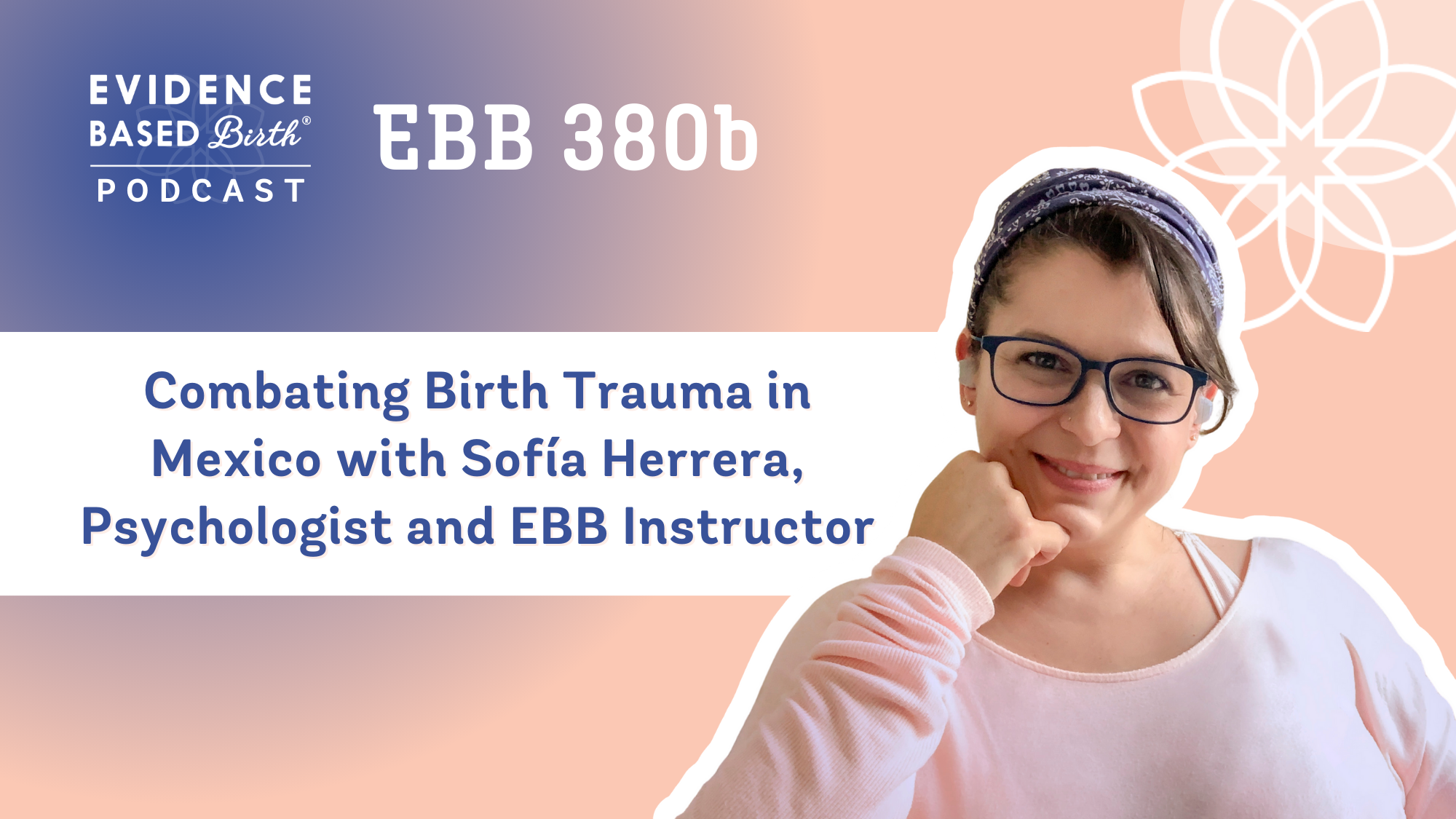
Hi, everyone. On today’s podcast, we’re going to talk with Paola Sofía Herrera-Quiroz about birth trauma and preparing families with evidence-based information in Mexico. Welcome to the Evidence Based Birth® Podcast. My name is Rebecca Dekker, and I’m a nurse with my PhD and the founder of Evidence Based Birth®. Join me each week as we work together to get evidence-based information into the hands of families and professionals around the world. As a reminder, this information is not medical advice. See ebbirth.com/disclaimer for more details. Hi, everyone, and welcome to today’s episode of the Evidence Based Birth® Podcast. Today, I am so excited to welcome Sofía to our podcast today to talk with us about birth trauma and teaching evidence-based information in Mexico. Paola Sofía Herrera-Quiroz is a childbirth educator, hypnobirthing instructor, and social and clinical psychologist. After what she describes as a beautiful vaginal birth, things took a turn for worse for Sofía. Sofía was told she had postpartum depression, and she believed it, blaming herself and her supposed inabilities to be a mother. Years later, while studying to become a childbirth educator, she began her healing process by acknowledging those struggles. When she sought help, she discovered that what she had actually experienced was birth trauma, not postpartum depression. And this realization marked the beginning of Sofía’s journey as a social psychologist, motivated to understand what was happening and to address the injustices that birthing people in her country face daily, struggles that contribute to so many cases of birth trauma. Sofía learned a whole lot about birth trauma, including how common it is, how it can be misdiagnosed as postpartum depression, and how few professionals are even aware of birth trauma. This knowledge led her to expand into the clinical side of psychology, and today she combines her expertise to support families through pregnancy and beyond, helping them prepare as fully as possible, while also reaching those who are suffering in silence. Sofía, welcome and bienvenida to the Evidence Based Birth® Podcast.
Sofía Herrera – 00:02:11:
Thank you very much. Thank you, Rebecca, for having me here today. Muchas gracias por tenerme aquí el día de hoy.
Dr. Rebecca Dekker – 00:02:17:
Sofía, can you tell us a little bit more about your birth experiences and how your experience with birth trauma shaped the way that you’re now supporting families?
Sofía Herrera – 00:02:26:
Well, first of all, I’d start by defining what trauma is. Trauma comes from the Greek. Trauma, which means wound or damage. It was first used in medicine in reference to physical wounds or damage. Later on, with the development of psychology, mainly during the past century, I mean, pretty recently, right? In reference to psychic wounds, either mental or emotional. Then, based on the meaning of trauma, my birth experience when my eldest was born caused that during many years, around 20 years. I had to live with this trauma, with this wound, both physical and mental, that I wasn’t even aware I had. So, I had to deal with this for all those years until I found out that it wasn’t postpartum depression. This caused a kind of compounded wound, you know, because something happens when you are diagnosed with postpartum depression. You already feel bad, right? You don’t feel well. And there’s this feeling of not being enough, or I’m not enough. You’re struggling day in and day out to get out of bed and take care of this whole new little person while your body is still healing. You’re feeling unwell. So you go to the doctor and then say, yeah, you have postpartum depression. You can blame your hormones. So then comes a double guilt because aside from not being enough, I’m defective, you know. You get a new wound or trauma compounded onto the other one. After studying and learning all this stuff, I realized how necessary it is to raise awareness about the different struggles the birthing- we all the birthing people have to face. So yeah, it’s complicated, but not impossible. And we can make a difference one birth at a time. To answer a question about how my experiences came into play, my two degrees, both social and clinical psychology, well, I started studying social psychology after I had my first groups as a childbirth educator with a different method. This was many years ago. I began to notice that no matter how much I taught my families the difference between a humanized birth and an uneducated one so they could have the care they deserved, you know, to look for the right professional for them, the best supporting and so on. I wasn’t really seeing any difference, really. There were no changes. My families kept on receiving the traditional medicalized model of childbirth care.
And beyond that, I was getting reports that almost half of them had been diagnosed with postpartum depression. And I was like, why? Am I doing something wrong? I’ve done literally everything by book, so this shouldn’t be happening at this rate. But it was happening. When the birthing people started to communicate with me after their babies were born, I began to notice certain patterns. I’m going to try to do this as little triggering as I can, but it might still be, so be warned. There were certain mechanical induction interventions that were most popular or common for us back then. And this is a situation among many, but this one in particular kept repeating itself over and over again. Several of the birding people in my classes ended up having these Cesarean sections weeks before their due dates. And I was like, why so many? So when they started talking about their experiences with me, even months after their births, they described how during a control check they had received vaginal exams. Which are very common, right? They were vaginal exams, and I quote, it wasn’t lubricant, but a different ointment that burned or hurt. And how the physician’s fingers didn’t look right after they took them out of their vaginas. Several mentioned bloody fingers. Turned out they were on the receiving end of not consented membrane sweeps way before the due dates. Nowadays, it’s a more common alternative intervention, but not without consent. I’m sorry. It pains me when this happens, but it was happening. People were receiving membrane sweeps without consent. I got really angry. I took that anger and put it to good use by studying social psychology to learn about what was happening and how to stop it from happening. Again, this is the case of many. Social psychology degree allowed me to understand integration basic tools so they could detect and prevent to use their voices, you know, advocate for themselves to know how to act in case of negligence or abuse. And then I actually began to see changes, but I felt so alone, you know, and- Fast forward a couple of years and I got to know Evidence Based Birth®. Then it was like, I’m not alone anymore. Alone in my head with all these facts that say that I am not crazy. This is the reality. And I felt kinship and accompanied in the search for change of justice, in a place based childbirth, care for families. Fast forward a couple of years and I kept seeing this childhood-related mental trauma that took me years of learning to identify it in myself. As we mentioned before, it’s still happening. So I searched the scientific literature, and of course the researchers talked about physical trauma during childbirth, about what it entails and some kinds of physical damages there can be during childbirth. That’s what one could find about it back then. But who really takes care of researching the mental and emotional part of it? The literature about it is minimal. It’s minimal and with some lacking in the research methods. But I found this clinical psychologist who was teaching us, I was taking a trauma competency workshop with her, and it all made sense to me. I started looking from a different angle, and I found it.
These things I felt do exist, because it’s real. We started understanding post-traumatic stress after World War II. We named the shock soldiers felt after going through their experiences in war. And, of course, it made total sense. We can experience that shock after giving birth. Is it common for everyone? No, it’s not. Not everyone reacts the same way after taking a childbirth class, right? Definitely not. We all have different beliefs, feelings, thoughts, family systems, different care systems. So that’s why not every childbirth class is one size fits all. In regard to this whole prevention mode, we try to teach, right. So it’s still pending, this part of avoiding mental trauma, as it is deeply personal. It’s not related to one unique aspect and we’re done. No. In reality, it can come from several angles and it has to do with how you feel at a time, how you perceive what is happening around you, what you’ve lived through the previous days, weeks or even years, or your own unique inner scars. So having both degrees and integrating a long childbirth education has allowed me to observe within my family’s specific needs and see how each of them could navigate all of this business of giving birth in a way that offers a bit more prevention to try and get the childbirth care they deserve. I personally hope that humanized birth term, in Spanish the term is parto, which is mainly understood as vaginal birth, so it kind of lifts out the abdominal or Cesarean births too. So therefore, adding another psychosocial weight to our pregnant brains, it’s adding more expectations that sometimes we cannot meet for several reasons. Can it only be humanized if it’s that way, and on the other hand, can it… Can it be human? I mean, what does that mean? Are we animals? What? Should not be this way, but… on the other hand, this allows me to be able to tackle as many angles as I get so the families can actually get the kind of care they deserve and that isn’t available for everyone.
Dr. Rebecca Dekker – 00:11:36:
Sofía. You clearly feel very passionate about this issue. And I like how you talked about feeling anger and how you channeled that anger into trying to create change. I think a lot of times, you know, we’re told that you shouldn’t be angry as women. And it’s refreshing to hear you talk about your anger and how you use that anger and how it’s an appropriate anger to feel as well. When you think back to your own birth experience, then what exactly was traumatic? Was it physical or was it degrading or inhumane care that you experienced?
Sofía Herrera – 00:12:18:
I think it was a bit of everything, and there were also some other stuff going on at the time. Well, my parents are physicians. They had a small hospital when I got pregnant, so my logical step was to go to their hospital and to ask for advice in regards to choosing an obstetrician. So we would, you know, quote-unquote, be safe. In my head. It was a super strong idea about needing a doctor so everything would be safe. What many of us worry about, right? Being safe. So I went to my parents. They recommended me to a certain prominent obstetrician, the director of a high-specialty hospital in my country back then. But I got myself a few unpleasant surprises. For example, the guy said that childbirth classes were for clans and hippies and that all I needed to worry about was being a good patient. That was his answer. Mine was, as a good daughter and patient, I listened to him instead of myself, sucked it up and be a good patient. I mean, now I would have blown for the hills after that introduction, but back then I didn’t. He had considerable mental weight in my mind, you know. My parents’ recommendation and the thought that he was one of the best in this field. So I truly believed that we were in the best hands. Later on, when I was in labor, everything started pretty well, pretty straightforward without complications. He told me to go to the hospital when my contractions were five minutes apart, so I did. But as soon as I checked in at the hospital, well, it was like strip where he’s sitting on the bed on my back so he could have easy access to me. And it wasn’t only one thing, there were many. At about 4 centimeters, he decided to use Pitocin, but first it was time for an epidural because I wouldn’t be able to endure the pain, he decided. At 5 centimeters, he decided to break my membranes to speed things along. All of these, he told to my parents who were in the room with me, but not once did he spoke directly to me. So I had these thoughts about me not knowing anything and the dizziness and justifying that fact by being grateful for my parents being there because I wasn’t good enough to understand any of what was going on. So back to the membranes, in comes the nurse with the amniotic hook, which is nothing right. Not threatened, really. I saw it and my mind decided to memorize it as long and as threatening as a sword. As big and long as the doctor’s arm. It all meant for a Mexican standard, so I saw it really large. Does that make sense? In a practical way, of course not. But my mom decided that it was that way and that was us. 25 years later, I still have flashbacks of that sword inside my body. And the fear that that part was the worst. I mean, he was going to hurt my baby’s head with that hellish weapon.
That’s just one example. No one asked for my consent. Not one word about risks or benefits. He just did things to my body without addressing me once. And absolute sense of lack of control about everything for me. I had asked my family to leave me alone, to stay at home and wait. Well, no, everyone and their neighbors straight into my room because… Both they had a right to, as they loved me so much. They even look through the window to the birthing room. Things that I had expressly said I didn’t want to happen happened. They took my baby away when I had asked and being told could stay with me at all times. So many things under my husband and parents’ watchful eyes and consent that I’m not going to talk about because they can be very triggering for many people. The hope of the kicker. A day later with my baby in my arms after having kept ten fingers and ten toes feeling this. Overwhelming, really overwhelming to cry and not in a good way. All the nurses and everyone kept talking about what a beautiful birth I had. And for the love of me, I couldn’t process that in a healthy way. I felt deeply betrayed. So, Now, almost 30 years later, and looking from a different perspective, I can say that it was actually pretty straightforward and healthy birth for the medicalized standards they held at the time. And what could have been beautiful for me, it was a nightmare. It hurt me physically and mentally. I felt really bad and didn’t know what was going on. I couldn’t sleep, didn’t want to sleep or eat. I felt like the worst mother ever. I told the doctor some of it because, of course, I couldn’t tell that guy everything, right? So he said that I had postpartum depression and… That it would go away to hang in there and not to worry. Two years later, I was still mad at the world, still felt like I was not enough and deeply ashamed.
Dr. Rebecca Dekker – 00:18:13:
I’m so sorry, Sofía. 30 years later, some of these or many of these problems are still happening. What is the Cesarean rate in Mexico?
Sofía Herrera – 00:18:23:
Unfortunately, we don’t have up-to-date numbers. They’ve taken up to close to two years to update them after the pandemic. I can tell you that during that time, especially during 2020, we had an incredible rate of 61% of Cesarean births. States like Nuevo León, one of the states with the higher IPC, had a 98% rate of Cesarean birds. Six months later, looking for that same information, they had erased it. They published the information in a super confusing way. We had to send an email and request the specific information. Maybe we’re lucky if we get it months later. So according to the World Health Organization, we have one of the high rates of Cesarean births in the world, not because Mexicans are incompatible with birth, as I’ve heard some people mentioning. The problem comes from many different angles, but mainly from a system that has made us believe that we don’t know how to give birth, that we have an illness, and that we need all the professional help we can get so that everything can be fine. So it’s complicated.
Dr. Rebecca Dekker – 00:19:40:
It reminds me of, like paternalism, you know, just looking down on women and saying, you don’t know what you’re talking about.
Sofía Herrera – 00:19:48:
Oh yes, it’s the mainstream. Even professionals who have adopted a more respectful evidence-based birth practice still have that paternalism ingrained in them. Even when we’re not pregnant, some of them imply it, some are more explicit. For example, I met a doctor a few weeks ago that kept calling me daughter, even though I’m like 15 years his senior. He kept doing it until I had to tell him to stop calling me that. He kept quiet after that. But yeah, we’ve learned to address them as Dr. Whatever your last name is, and use a formally respected noun for you, you know, usted, but doing that accentuates paternalism. But call them by name without titles and they’ll take it down a notch or three, you know, I mean, they’re people with different education, but they’re not superior to those people with uterus. And so, yeah, call them by name. Really? They take it down and out.
Dr. Rebecca Dekker – 00:20:50:
The Cesarean rate is very high, like you said, one of the highest in the world. For those women who are able to somehow convince their doctor to let them have a vaginal birth. Are episiotomy rates very high in vaginal births? Can you talk about that?
Sofía Herrera – 00:21:08:
Yes, unfortunately, it’s part of the protocol. And as with all protocols in some places, you just have to follow them. Even the professional midwives, while they’re training at certain facilities, they have to practice them. They can argue that it’s not an evidence-based procedure, but they have to practice them, doctor’s orders. So, yeah, it’s kind of alarming that they’re still hung up on teaching those traditional practices.
Dr. Rebecca Dekker – 00:21:36:
So even the midwives are using episiotomies?
Sofía Herrera – 00:21:39:
Unfortunately, yes. It’s an educational requirement. If they don’t practice them, they can’t graduate. Fortunately, once they’re graduated, most of them don’t do them anymore. Most of those who dare to speak up have argued against episiotomies, but anymore just stay quiet and do what they’re told.
Dr. Rebecca Dekker – 00:21:59:
You said it is very frustrating that things don’t change or they change very slowly. And you have been working on providing evidence-based education. Can you talk about how childbirth education can help some families that you work with feel more prepared, more empowered? Better able to get a healthy birth without trauma, or is it impossible?
Sofía Herrera – 00:22:24:
No, it’s not impossible. Education is everything. I mean, if you ask me from my own perspective, which are the biggest challenges to make these changes happen, I’d say the first one is the lack of education. As families, as pregnant, as birthing people, and it is a system. If you have educated pregnant families, it becomes easier to bridge that evidence-based practice gap, to get their respectful evidence-based birth deficit, to get a truly empowering birth for us as birthing people that are starting a completely new phase of life with the challenges that in itself it entails, for which most of us are not prepared. You know, these new births don’t come with an instructive manual. So we have to learn from zero. If we educate families, it’s easier they can differentiate an evidence-based model of care from a traditional one. They can choose without prejudice to have a midwife-led team or an obstetrician-led one. They can choose to get a public care or particular care. They can learn that there are public health clinics with midwife-led teams in certain rural communities, but that they’re still within their metropolitan range. And that if they stay within the cities, they’ll only have access to a more traditional doctor-led care. We educate families and they can learn they have choices. Families have choices, have voices that can be used to say, no, thank you. And that saying no is still an available choice. Families can learn that information and it’s nourishment for the brain, for their minds. A nourished mind is a mind that can face those trauma warps, postpartum depression, inducing things in a more resilient and lasting way, even way beyond birth. Can it be prevented completely? No, not completely. I don’t think nothing can completely prevent it. But it does give us much of what we need to resist it or to handle whatever situations those might be, even for… Given the case and we suffer from it to look for the right kind of help. Now, here’s a point about education that I absolutely love. We’re talking about private health care. We can get back to public health care in a bit if you want, but we’re talking about private health care right now. Childbirth is a pretty lucrative business for doctors because most of the time everything goes fine. But they’ll have to be there for many hours with long periods of doing nothing and charge the price for vaginal birth.
But here comes the tricky part. They charge way more for a Cesarean birth that will take them just a couple of hours to perform. And a vaginal birth has the potential to become a Cesarean birth at any given time. From that perspective, if we have educated families that use their voices to say no, to ask questions, to be inquisitive, they’ll most likely be educated enough to detect that money sign in that doctor’s eyes and choose to look for someone else since they’re pregnant. Those professionals will be losing clients and maybe start to wonder what they’ve done for that to happen and what they can do to get more clients out. Maybe they even decided to change tactics and adopt a more respectful evidence-based practice instead. I’ve seen it happen. It can still happen that an educated family didn’t get evidence-based care, and I’m not going to lie. I had a family that educated themselves the obstetricians they chose, told them all the right things, and they concluded that guy was the one for them. But at the time of birth, everything changed. There was hardly any infant concerns. He kept calling them. The mom thinks like, you can’t. I can’t let you. I can’t allow you. And did everything they didn’t want him to. This was a pretty interesting experience because even though the odds turned strongly against them, they were super aware that they still had choices. They talked about walking out, but the mom decided that she didn’t feel safe enough with that. I was at the phone with them at the time. The mom was like, I’m already checked in. Walking out is not an option for me right now. My labor is past the halfway point, and I just remember something you told me once of here. I’m already here, so the way forward that I can see is through. So let’s get through this. How can we really manage that? So we took a few minutes and brainstormed several choices and strategies. The dad was taking notes.
At the end of those minutes, the mom decided that if the doctor wanted to give her Pitocin, she would let him give it to her. But her baby would be there under her own terms. So after that, if the doctor said something like, I’m going to do something or other, and wouldn’t watch to the negative, she would close her ears and tell him, I’m letting you do this to me. And inside herself, she would chat to herself, I’m allowing myself to do this, so let’s get going. That sense of control made all the difference for them. So you have families educated in many more holistic ways. And you’ll have families that can advocate for themselves. They can start the parenthood from a more healthy place, so you’ll have healthier families in the long way.
Dr. Rebecca Dekker – 00:28:09:
That’s very powerful. Thank you for sharing that example. Can you briefly explain the difference between the state hospitals and the private hospitals? It was interesting. It sounds like one of the incentives for the high Cesarean rate is the financial incentives and the time. Is that the same in the private and the state hospitals? Or were there any major differences between them?
Sofía Herrera – 00:28:35:
No, there are differences. In private settings, well, time is money. You need to be aware of that especially for a typical hospital. There’s one published study, if I remember correctly, from 2021. I’m not going to name names, but it’s a famous hospital with facilities in several states that is affiliated with almost all of the insurance companies, so they have a big childbirth clientele. So a couple of residents did a study at the facility in Ciudad de Mexico, and they found that this hospital had, if I remember correctly, was at around 86% rate of Cesarean births, which is pretty high. It was exactly the same hospital where the family I was talking about earlier ended at. And when I read that study, everything that family had gone through made perfect sense to me. It was like, of course, they have one adequate birthing room. One. They see hundreds of people, probably dozens of birthing persons at any given time. Time is money. Cesareans are more money. Let’s rush them or we get them as Cesarean as soon as possible. Like, you know, that would be great. When we talk about public childbirth care, I’m not going to lie, it’s not free. Childbirth care is different in the way that medical interventions are not practiced as frequently or at the same rates because they’re usually understaffed, because they don’t have enough supplies, and supposedly because they want to teach the students the quote-unquote new humanized model of patient birth care.
They put a bunch of birthing people in the big rooms separated by curtains, if so, with only their chosen support person as company. And enough room to walk a few steps beside of it. Movement is restricted. But basically, they let everything progress as it may. Once the birthing parent is in transition, you can see the baby’s head starting to emerge. They rush the parent to the delivery room. If you want an epidemic, you need to rub up the trauma to get it and get your support person to rub them until they relent and give it to you. Maybe. That’s when things take turn for the medicalized. And they perform episiotomies. It means probably taking the baby away and keep them short of water, make formula, etc. They’ll give you your baby when it’s time to pass the babies around their parents. You can’t eat, you can’t drink. If you haven’t had dinner, but dinner time is over, it’s a lot. You won’t take dinner. It’s not free. I’ve had families that have done their homework and have managed to get childbirth care at those midwife-led facilities I was telling you earlier, and it’s worked for them. They have still had choices.
Dr. Rebecca Dekker – 00:31:30:
Yeah, it’s so interesting that to find better care, sometimes you have to go to the more rural areas instead of the cities.
Sofía Herrera – 00:31:37:
Yes, they could face the same situations. Like if they want an epidural, it’s probably they won’t get it, but they know what they’ll be facing. So they have a whole comfort measure, measure still kit to put to confused and say, I didn’t feel it that much. I could give birth seven more times and still enjoy them as much. I’ve been told that quite a few times. I’ve had families that have told me that it hurt so much. They wanted to rip their hair out just to feel something else. But I did it my own way, you know. I chose it, so it was a complete success in every way. And you’ll probably get an episiotomy, but you already know what you’ll be working with because it’s midwife-led. Of course, it’s curious that we can find those settings in the rural areas.
Dr. Rebecca Dekker – 00:32:27:
One last question with the time we have left. What are the resources from Evidence Based Birth® that you’re using? How have they been most helpful? Like, how are you using some of those resources?
Sofía Herrera – 00:32:38:
All the information, all the Evidence-Based Birth® handouts are part of the syllabus of all my families. I used to be a Pro Member, and I decided to give it a shot at childbirth class instructor. That made my life so much easier in the way that it would be meeting you, give them all the science and practical information. I love the way you do it, by the way. Very practical and visual for all the styles of learning out there. They do readings and I can do the follow-up in a much more easier way, which I find great as a professional in my field and as an instructor. My families often ask me if they can bring the EBB handouts to their professionals, and the answer is always yes, please. Please do. And invite them to become a Pro Member because we all need this. And I see myself here from the other side, too. You know as professionals trying to roll against the curve is sometimes pretty hard. If the traditional model of childbirth care tells you that you have to do certain procedures as a part of a protocol and you know it’s not based in scientific evidence and you want to go in a different direction, it can be overwhelming too. Like, I don’t follow protocol and this person eats and drink and something goes wrong and I get sued for malpractice. You know, sometimes those thoughts are irrational, right? Like, why would it happen if it’s evidence-based? Well, it’s many years of conditioning and beliefs that require different kinds of care. No matter how prepared you are, if you can find like-minded professionals, change is going to be way harder. So the fact that you can become a Pro Member means you’ll be able to meet like-minded professionals. Thank you.
Dr. Rebecca Dekker – 00:34:32:
That’s wonderful. Thank you for sharing that. And I want to encourage our listeners to look for the handouts in Spanish. So if you go to evidencebasedbirth.com/translations, you can see all of the Spanish handouts. And also, you know, Google Translate is great for the website and on YouTube. You can choose Spanish closed captions for all of our videos. Sofía, do you have any… Maybe if you have one piece of advice. For someone listening who’s giving birth in a setting, like either in Mexico or in a setting like that, where they’re worried about obstetric violence or, you know, not being listened to or heard. What’s, you know, your top piece of advice for families?
Sofía Herrera – 00:35:19:
Educate yourself. Search for it. Look for alternatives for you. There are many out there, but please educate yourself. Most of us can help you find something right for you. Even if money is an impediment for that, most of us can offer you a scholarship so you can be accessible to everyone. I myself have several spots for scholarships in my classes. You are able to educate yourself and not let it for the last minute. It’s important to do it as soon as possible. And another tip is if after you’re giving birth, something doesn’t feel right or as you think you should feel or should be, look for help. Speak up. I know it’s not easy, particularly when there’s trauma because one doesn’t even know where to start. But speak up. Even though it might be something like, I’m ashamed because I have nightmares. That’s a big step. Yeah, so look for a person that’s training the subject so that you can burden yourself from those things without fear of being judged or that they’ll make you believe that you’re a bad mother. If something doesn’t feel good, something most likely isn’t. But it’s not your fault. Let me tell you right now, it’s not your fault and it has a solution.
Dr. Rebecca Dekker – 00:36:49:
Well, muchas gracias for your help, Sofía, and all the work you’re doing in your part of the world to help women and families and birthing people get evidence-based care. We really appreciate the work you’re doing, and we’re so glad you’re part of the Evidence-Based Birth® community.
Sofía Herrera – 00:37:04:
Thank you for having me here. It’s a pleasure to share with you all.
Dr. Rebecca Dekker – 00:37:07:
And how can people connect with you?
Sofía Herrera – 00:37:12:
Right now, through my social media, I’m not going to lie, they’re a bit abandoned right now. I have a bit of a love-hate relationship with social media, and I’m very particular in the way I like to manage, but I do answer messages all the time. If you have any questions, just send me a direct message at sukhamoms, S-U-K-H-A-M-O-M-S, @instagram or Facebook. Any question, either English or Spanish, I’ll try to answer you shortly. If you want to know where to get that education, just DM me, and we’ll look for a way to make it work. You’re welcome, it’s my pleasure.
Dr. Rebecca Dekker – 00:37:55:
This podcast episode was brought to you by the book, Babies are Not Pizzas: They’re Born, Not Delivered. Babies Are Not Pizzas is a memoir that tells the story of how I navigated a broken healthcare system and uncovered how I could still receive evidence-based care. In this book, you’ll learn about the history of childbirth and midwifery, the evidence on a variety of birth topics, and how we can prevent preventable trauma in childbirth. Babies Are Not Pizzas is available on Amazon as a Kindle, paperback, hardcover, and Audible book. Your copy today and make sure to email me after you read it to let me know your thoughts.
Disclaimer: This content was automatically imported from a third-party source via RSS feed. The original source is: https://evidencebasedbirth.com/ebb-380b-combating-birth-trauma-in-mexico-with-sofia-herrera-psychologist-and-ebb-instructor/. xn--babytilbehr-pgb.com does not claim ownership of this content. All rights remain with the original publisher.