Dr. Rebecca Dekker – 00:00:00:
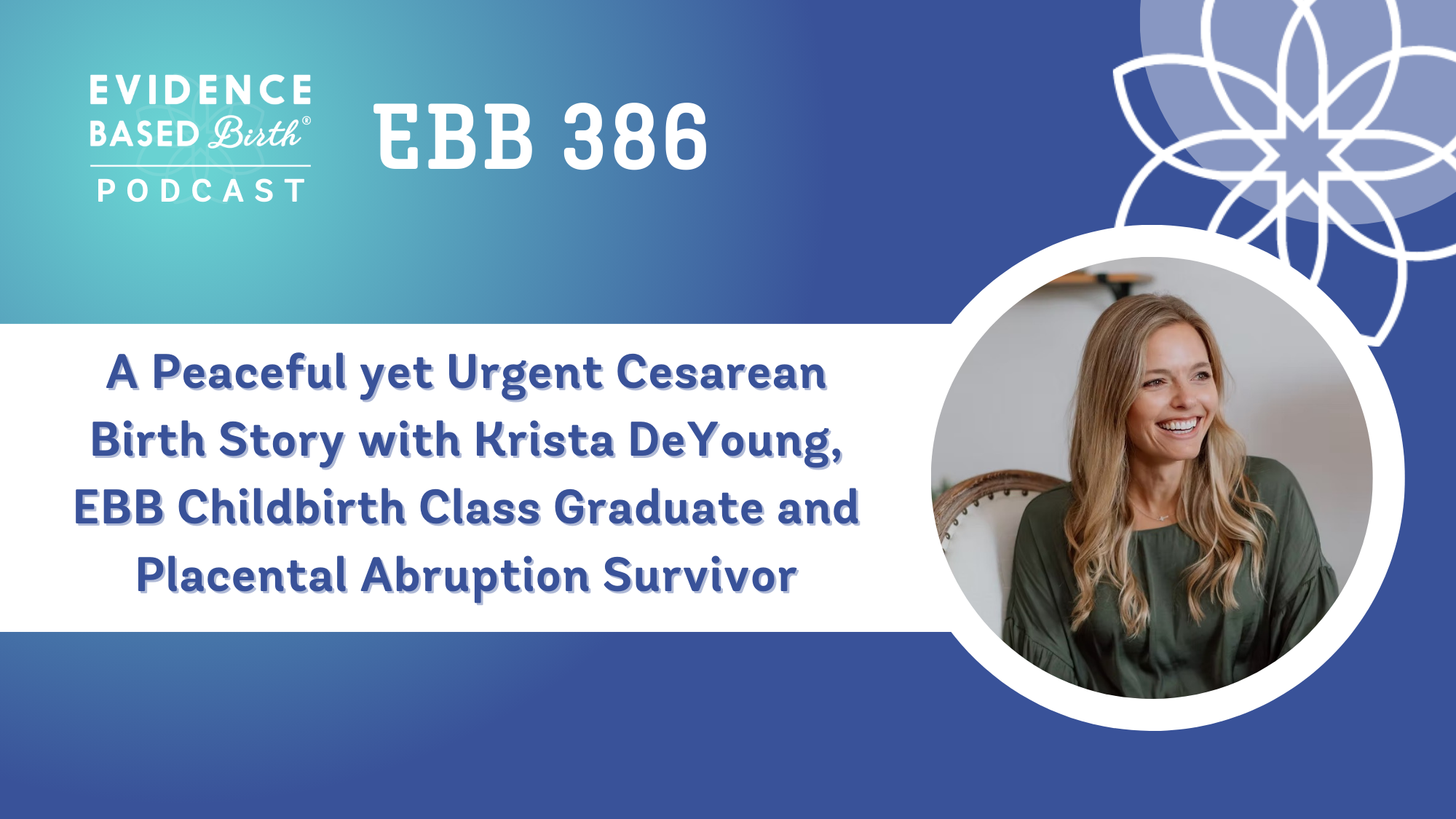
Hi everyone, on today’s podcast we’re going to get an update from Krista DeYoung about her planned but urgent Cesarean that happened during an extended hospital stay for partial placental abruption. Welcome to the Evidence Based Birth® Podcast. My name is Rebecca Dekker, and I’m a nurse with my PhD and the founder of Evidence Based Birth®. Join me each week as we work together to get evidence-based information into the hands of families and professionals around the world. As a reminder, this information is not medical advice. See ebbirth.com/disclaimer for more details. Hi everyone and welcome to today’s episode of the Evidence Based Birth® Podcast. Today I’m so excited to have Krista DeYoung back on the podcast to share her Cesarean birth story. Krista was born and raised in Colorado and has a passion for global travel and humanitarian work. She’s a therapist, a parenting coach, and speaker. For more than a decade, Krista has been working with teenagers and parents to help bridge relationship gaps and address self-worth issues among teenagers. Krista has her master’s in counseling and she owns her own private practice, Set Your Mind Counseling, focused on serving teen girls, mothers, and women. Krista is also a graduate of the Evidence Based Birth® class with instructor Chanté Perryman and her first birth story after taking that class was featured in episode 305 when she talked about her high-risk pregnancy and labor induction. Later she came back in episode 350 when she joined us live from her hospital room while she was hospitalized for partial placental abruption. And during that episode we did a crash course in prepping for a Cesarean. Krista is also my sister-in-law and married to my brother John so the babies that we’re talking about in these episodes are two of my adorable nephews. Krista, welcome to the Evidence Based Birth® podcast.
Krista DeYoung – 00:02:04:
Thanks Rebecca. This is so fun. I love talking to you.
Dr. Rebecca Dekker – 00:02:07:
Yeah. I’m so glad you could come back and give us an update because you kind of left everybody hanging in episode 350. At that time, you were in the hospital. You’d been there for a really long time. You were pregnant and you were preparing for what was going to be a scheduled Cesarean at 37 weeks, but something happened right after our interview. So, can you remind us a little bit about like where you were at that point in your hospitalization? How long you had been there? And then tell us what happened like right after we got off the call.
Krista DeYoung – 00:02:42:
Right. So I believe when we talked last time, I had been in the hospital 39 or 40 days. I had it written up on my wall. So one of those. And it was, it was really amazing that we chatted that morning because everything we talked about in that episode ended up being very helpful to me that afternoon. You and I chatted, wrapped up the podcast, and then I think it was about 20 or 30 minutes later, I started having another bleed. And I knew that the next time I started bleeding, that it was going to be a conversation about, do we deliver the baby? Do we not? You know, what are we doing here? So that started, once I started bleeding again, it kind of cascaded into what ended up being the birth of my little baby, Jace. So started bleeding after I chatted with you. And then they pretty much took me right over to labor and delivery right after that. Some of these details were kind of foggy for me. And I had to talk to my mom and John about it last night because I was like, what happened? It was such a whirlwind. And it was about nine months ago. So, we went over to labor and delivery. From what I remember, so this is like my best recollection of the day. If you were one of the doctors or nurses that was there and I get this wrong, then I’m sorry, but this is how I remember it. So we went over to labor and delivery and they did the continuous monitoring. And it was kind of this conversation about… Do we want to make sure that this happens today? Or if there’s not, you know, if the bleeding stops, do we want to hold off for six more days to see if we can make it to that 37-week scheduled mark? So it didn’t start off emergent right when I started bleeding.
Dr. Rebecca Dekker – 00:04:50:
And just to remind and just to remind our listeners who maybe weren’t around. For episode 350, but you should go back and listen to it because it’s fascinating. Like, you know, you were in the hospital because you were bleeding, because your placenta kept kind of peeling away from the wall of the uterus, correct?
Krista DeYoung – 00:05:09:
Yeah, I kept having these kind of bleeding episodes. And the goal from the beginning was to try to keep baby in as long as possible, obviously. And then we had scheduled the Cesarean procedure at right at 37 weeks. And so this was just six days shy of that. And this was another bleeding episode. And, you know, it was right on that mark where kind of everybody was like, we could we could have this baby now and it would be OK. Or we could wait. And they talked to John and I about that and kind of let… I felt like they were giving us a choice. If I was like, let’s do this right now, then they were, they felt comfortable with that or we could wait. And so kind of where my mind had landed on it, because it was fairly early in the day, you know, it might’ve been around like 11 or 12 o’clock Colorado time that I started bleeding again. My perspective was let’s ride out this day and see what happens. Also, though, I was on blood thinner medication, so I know that they wanted to if we could give it at least six to eight hours from when I got that injection in the morning to do the procedure.
Dr. Rebecca Dekker – 00:06:32:
Okay, and can you remind everyone why you were on blood thinners?
Krista DeYoung – 00:06:35:
I was on blood thinners because I have a condition APA, antiphospholipid…APS. Antiphospholipid lipid syndrome.
Dr. Rebecca Dekker – 00:06:46:
Antiphospholipid syndrome.
Krista DeYoung – 00:06:48:
Yeah. That’s like so many words. Yes, so I was getting blood thinners daily for that. And so that was part of what made this tricky too is… Is kind of doing the calculation of… Blood thinners versus when we do the procedure. I know that every time I had a bleed in the past, they had stopped those blood thinner medications and then kind of waited until it was 24 to 48 hours after to make sure I was done bleeding before they started it again in case we went into this emergency C-section procedure. So that was one of the complicating factors as well. But right when I started bleeding, everybody was like, okay, no more food, no more drinking. We’re going to prepare as if this might happen today.
Dr. Rebecca Dekker – 00:07:39:
You and I had talked that morning. We did a crash course in preparing for a Cesarean, which is the second half of that podcast episode. We talked through Cesarean birth options in detail because you’d never had a Cesarean before you had a vaginal birth the last time. And then after we got off the recording, you asked me to talk with John. So John called me and I gave him the same crash course over the phone. This is my brother, your husband. He was like, yep, yep, got it, got it, got it. And I was a little worried, like neither of you would retain like what I was telling you. But were there any things that stuck with you that you were like, oh, I would like this or this. It made you think about different things or I know what to expect now.
Krista DeYoung – 00:08:28:
Right. And I. Yes. So you did that. And then you sent over a document that I think was something along the lines of like planning kind of like birth plan.
Dr. Rebecca Dekker – 00:08:38:
Yeah, yeah.
Krista DeYoung – 00:08:39:
Truly, thank God we had that conversation because even as I was re-listening to our podcast, you were asking me questions. And I’m like, I have no idea. I had never thought about that. I didn’t know this. Like I had not even considered birth plan options. And that conversation that we had was the only time my brain even thought about it. So I had a couple of hours, you know, to ponder.
Dr. Rebecca Dekker – 00:09:02:
It’s like you just kind of assume I’m having this surgery and you don’t realize that there’s options?
Krista DeYoung – 00:09:07:
Yeah. And it was kind of one of those things where it was like, oh, it might happen now. It might happen in a few weeks. And then as it crept up and when we chatted, I was like, oh, this is happening sometime within the next six days. I need to think about some of this so we did get to chat a little bit about it but I don’t think on that day given everything that had happened I didn’t have these really strong preferences that my biggest thing was let’s get this baby out of safe and I was really concerned about talking to an anesthesiologist because I do not do well at all with fentanyl and like I get so sick and nauseous so I just wanted to talk to him about that. And then I wanted to meet the doctors who were going to be there. Those were kind of my main preferences. And outside of that.
Dr. Rebecca Dekker – 00:10:04:
Those were your priorities.
Krista DeYoung – 00:10:05:
Yeah. And the delayed cord clamping was kind of.
Dr. Rebecca Dekker – 00:10:09:
Uh-huh.
Krista DeYoung – 00:10:09:
A bigger one. So I do think that the things that were kind of utmost, if I would have had more time, I would have, you know, maybe wanted to curate a different environment or whatnot. But honestly, after being in the hospital that long. John and I both were like, come what may, let’s just have a safe situation. But the fact that we got to talk about it was really helpful. And the part that was the most helpful was you kind of walking me through, you know, there will be tugging and pulling. There will be like use your grounding statements or have John give you encouraging words and comments, like all of that stuff. Ended up being the most helpful.
Dr. Rebecca Dekker – 00:10:59:
Okay. Yeah. So just remembering how to stay calm and centered during the surgery and during the birth. And then also, I think… You feeling more empowered to talk with the anesthesiologist about the medications they would be using? Because I think we talked about that. Like there’s medications that make you feel sick or sleepy. And you can have a conversation with them about what medications you prefer, what the side effects might be.
Krista DeYoung – 00:11:27:
Absolutely. And we came up with a plan together because he felt like using some form of fentanyl would be helpful. And so we’re like, okay, we’ll give, you know, some nausea medication with it. And it ended up being fine. But yes, I think it allowed me to just think through what the experience might be. And I wasn’t quite as shocked as it was.
Dr. Rebecca Dekker – 00:11:50:
So you were on labor and delivery being monitored to see if this surgery needed to happen today or not. What happened next?
Krista DeYoung – 00:11:59:
So we kind of rode out the day and it was towards the evening time that they cleared me to eat. I want to say it was around, you know, six or seven, sometime around dinnertime. They cleared me to eat because we were like, if we’re going to do this, it won’t be till tomorrow. Looks like the bleeding has stopped. And I just knew. I knew in my gut that I should not eat. Like the minute she said it, I was like, no, this is happening. Maybe within the next 30 minutes. I started actually having contractions and having more bleeding. And that was really interesting because once I started having contractions and they were able to monitor it, then that’s when it became more of like a…like a rushed emergency situation what it didn’t ever feel everybody did such a great job remaining calm even if they weren’t if it was this big high level emergency situation I was not aware of it although I could tell that they were like all right let’s go. So they wanted me to get my mom there. And thank you for telling me that I needed another person there. That’s not something I would have thought about either.
Dr. Rebecca Dekker – 00:13:19:
Oh, yeah. Tell everybody why I suggested having a second support person.
Krista DeYoung – 00:13:23:
So you mentioned having a second support person because technically there’s two people who need support after the birth. So baby Jace needed support and so did I. And you’re like, if he has to go to NICU, someone’s going to need to go with him and you’re probably not going to want to be alone. So I did have my mom there. But she lives 30 minutes away she and she wasn’t expecting it so she had to get ready we probably waited for her I don’t know, 35 or 40 minutes. But in that 35 or 40 minutes, you know, I’m talking with the anesthesiologist, nurses are in and out, doctors are in and out, and they started to get pretty antsy, being like, where’s your mom? How far away is your mom? Can you call your mom? Let’s get your mom in here. And it was… I get it now, but in the moment, I’m like, we just waited 40 days or 39 days. And now we’re like, let’s go.
Dr. Rebecca Dekker – 00:14:23:
And you’re like, it’s Denver. Everything’s like an hour.
Krista DeYoung – 00:14:26:
So that was kind of funny because we had, I don’t know, I just sat around for a month. And all of a sudden, it’s like, where is she? Let’s do this. Let’s go.
Dr. Rebecca Dekker – 00:14:36:
Like, go time. Go, go, go.
Krista DeYoung – 00:14:38:
But they got me all ready. They gave John the little bunny suit, is that what they call it. Little outfit for the OR. And what was really, really great, and I love that this happened, is one of the doctors that was in the room doing the procedure was a resident that I had seen, you know, many times over my stay, Dr. Kahn. And I felt very comfortable with her. And it felt like I had kind of like a friend in the room. So thank goodness that that happened. That was just a blessing to me. Because I didn’t know the other doctor, but I knew Dr. Kahn. My mom gets there and it was not even five minutes before they’re like, okay, welcome. Thank you. Go wait in the waiting room. We’re going. So we went back to the OR. And they did, like, we were able to talk through some birth plan stuff. You know, do you want music playing? Do you? And I just, Rebecca, I did not care about anything. I felt so neutral to the whole thing. My focus was just keeping my mind calm and keeping my body calm. Because it was freezing in that room. I could feel myself starting to get shaky. I just didn’t want to like emotionally escalate. I wanted to stay, relaxed to the degree as possible.
Dr. Rebecca Dekker – 00:16:10:
Just quiet kind of as possible.
Krista DeYoung – 00:16:12:
Yeah. And, I, the way that I did that, wasn’t through music, and it wasn’t through the setting. It was just me in my mind, just kind of honing in, and trying to be serene in myself, if that makes sense.
Dr. Rebecca Dekker – 00:16:28:
Yeah, you went inward, just like someone would in labor.
Krista DeYoung – 00:16:31:
Right.
Dr. Rebecca Dekker – 00:16:32:
Which you were in labor as well.
Krista DeYoung – 00:16:34:
Yeah.
Dr. Rebecca Dekker – 00:16:35:
And you’d been bleeding and having contractions. So it was a lot of stimuli.
Krista DeYoung – 00:16:40:
Yeah. There was quite a bit happening. That’s what I did was like, just remain calm. So do you want me to walk through kind of all of what happened?
Dr. Rebecca Dekker – 00:16:50:
Yeah, walk us through this step. So did you get an epidural or a spinal? And like, was John allowed to stay with you during that part?
Krista DeYoung – 00:16:58:
I do not remember if he was allowed to stay with me during that part. I think so. I think so. And I got what I believe is an epidural. It goes to the spine, though, right?
Dr. Rebecca Dekker – 00:17:13:
It was probably an epidural because it lasted for a while after the surgery. Right. Okay.
Krista DeYoung – 00:17:18:
Yes. So they did that. I met everybody in the room. They did all introduce themselves, which was great. And.
Dr. Rebecca Dekker – 00:17:25:
Mm-hmm.
Krista DeYoung – 00:17:26:
It went, I mean, it went really smooth and really fast. And I appreciated they did kind of walk me through what was going on. But I felt that they shared relevant information, not like every little detail. I didn’t realize how much like tugging and pulling that there would be. I know you mentioned it, which was good. So I just kept holding on to like, Rebecca said I would feel tugging and pulling.
Dr. Rebecca Dekker – 00:17:54:
But not pain.
Krista DeYoung – 00:17:55:
But not pain. So that was something that I was thinking of. Like, does this hurt? And it feels, it’s like you could define it as pain potentially, but mostly it’s just weird. Like it’s an odd sensation. And I felt like it was way higher up than I expected. Like I felt it all the way up kind of at the top of my ribs. I don’t know if that’s normal, but I’m like, wow, they are in there. They’re in there. So that was unexpected. When they got Jace out, they’re like, wow, he has a lot of hair. Did the other one have a lot of hair? You know, did Eli have a lot of hair? And I don’t know. I don’t remember. But Jace did come out with a full head of hair, which is great. And so what John was retelling me last night is, you know, the anesthesiologist was there. John was up kind of by my head. He stayed pretty quiet, which was great because I just needed to stay focused.
Dr. Rebecca Dekker – 00:19:01:
And John could be chatty sometimes.
Krista DeYoung – 00:19:03:
Totally. And he just did such a great job being, I don’t know, attuned to the moment. And he was there. The anesthesiologist was there. I think… The anesthesiologist had maybe an assistant or a nurse with him, and they both were great. I was uncomfortable with my arm placement. Like, they have your arms kind of out. And I didn’t love that. So that was one of the things that I was just kind of walking myself through is. This is temporary. It’s going to be okay. This discomfort, you know, it’s not going to last forever. I did ask the nurse to kind of move my arm, like to rotate it. It was just in a goofy position. At one point, I have a lot of neck issues. Like I just hold stress in my neck. And so I could feel my neck like just tensing. I could feel the knot coming in. And I just started focusing on my neck. And I was like, it’s okay. You don’t have to do this right now. You know, like we are safe. We don’t need to do this. And I just was visualizing, because you had mentioned like visualize a safe place or all that. I was just visualizing God in the room with me and calming light and all of the things. And I genuinely, this has never happened before, but I felt that knot kind of release and relax. I was like, praise the Lord. Okay. Um. So that was really lovely. And from what I remember John telling me and what he kind of retold last night, they were, he said that the nurse did some sort of stimulation on Jace for a little while, like was rubbing his chest. I don’t know what that would have been focusing on. I think they were making sure his oxygen levels were good. His temperature was good. They did bring him to my face for a second. I think. I don’t totally remember. I was really inside myself. Trying to stay calm. And once I knew he was safe, I really was just focusing on myself, my body, as they were, you know, putting all the pieces back together, sewing everything up. I was like, he’s baby’s good. John’s got baby. He’s good. I’m going to sit here. And just remain calm. That’s what I remember of the procedure is walking through my-
Dr. Rebecca Dekker – 00:21:40:
It reminds me of like… Putting your oxygen mask on first in a way.
Krista DeYoung – 00:21:46:
Totally. Yes. I wanted to. Just, I don’t know get through the procedure and I don’t remember maybe because I was remaining calm and focusing on my emotions focusing on those grounding statements I really don’t remember it being a bad experience I remember the tugging and pulling being uncomfortable And I remember… Being like, this is a lot really fast. Like, this is an intense moment. But it’s okay. And then they… When they like roll you on off of the little operating table onto the bed. That they take you away in? That was a really odd sensation. They’re like, okay, we’re going to roll you now. I remember… That just was weird, but funny. I feel like I kept my spirits up during that procedure. And the doctors and everybody were great. So it ended up being, even though it was quick. It ended up being, I think, pretty smooth. Does that sound like it was pretty smooth? It felt like it was pretty smooth.
Dr. Rebecca Dekker – 00:22:56:
Yeah.
Krista DeYoung – 00:22:57:
Yeah.
Dr. Rebecca Dekker – 00:22:58:
Yeah, and I think I mentioned earlier you had an epidural if it lasted, but it was probably what we call a combined spinal epidural where they give you the spinal injection first and then spread the epidural so that it can stay and give you more lasting pain relief. Because the spinal works within a few minutes, whereas with an epidural, you’d have to wait like 15 or 20 minutes for it to kick in and they were probably in a hurry. So probably didn’t, they were in a hurry.
Krista DeYoung – 00:23:24:
Yeah. Yeah.
Dr. Rebecca Dekker – 00:23:26:
And I have a couple of questions. One is, what were some of the grounding statements you were saying to yourself?
Krista DeYoung – 00:23:33:
I don’t remember specifically the grounding statements, but just knowing myself, I imagine I was saying things like. You are safe. You’re baby’s safe. You’re with an excellent qualified team. This is not going to last forever. This discomfort is temporary. I think I did a lot of, a lot of, I do remember this, like very intentional breathing. Deep, deep breaths because your body responds to your breath. If you’re kind of breathing really, really short, fast breaths, that sends the message to your brain sometimes that we’re in fight or flight. And this is a dangerous situation and your brain is not getting enough oxygen. So slowing it down. Giving your brain oxygen and breathing in a way that would send signals to your brain that like, this is, this is okay. We are safe even though your body is going through it right now.
Dr. Rebecca Dekker – 00:24:32:
Even though you really have been going through.
Krista DeYoung – 00:24:34:
Yes. So just trying to remind my brain that this is okay. So that’s the kind of step I was really, really focused on and trying to keep my muscles loose and not letting myself totally tense up because that’s what I wanted to do. I wanted to be like, whoa, what is happening? So I feel like… I really focused on letting my mind, like this strong, calm leader part of my brain, take over in that moment. And just calmly guide other parts of me that were nervous or dysregulated.
Dr. Rebecca Dekker – 00:25:15:
That’s really helpful. What happened next? Did you have to recover separately than Jace? Did he go to the NICU and you two get split up temporarily?
Krista DeYoung – 00:25:25:
Yes, so they brought me to kind of a temporary recovery room. They did bring Jace in there for a second, like a very, very short moment. They brought him in, I think, to do some skin to skin to see if it would regulate maybe his oxygen level or his temperature. I don’t remember exactly what it was. They brought him in and I did get to do just a hot second of skin to skin and see him, which is great. And then they’re like-
Dr. Rebecca Dekker – 00:26:01:
How did and how did that feel when you were holding him?
Krista DeYoung – 00:26:03:
Oh, it was great. It was so great. And he was just itty bitty. So I’m I’m glad we got that moment, even though it was short, because then they the nurses are like, this is not this is not working. We have to get him to the NICU. So he did end up getting taken to the NICU. But I got a moment to see him and be with him before they took him, which is wonderful. And then a little bit later… They rolled my bed over into the NICU and we did this like little pit stop at the NICU to see his room, see him. And then they rolled me.
Dr. Rebecca Dekker – 00:26:45:
Like you were in a stretcher and they rolled you into where he was.
Krista DeYoung – 00:26:49:
Yeah. Like in the hospital bed. Yep. And they rolled me down the hall into the NICU. Said, hi, this is where he is. And I met the NICU nurse. And then we rolled away into my room.
Dr. Rebecca Dekker – 00:27:03:
That’s incredible.
Krista DeYoung – 00:27:04:
Isn’t that great? I know.
Dr. Rebecca Dekker – 00:27:06:
So how was your postpartum recovery then, both immediately and then after you went home.
Krista DeYoung – 00:27:13:
My postpartum recovery, I think, definitely has ups and downs. Probably as, you know, every postpartum does. I really don’t love taking medication. I was kind of stubborn about this in the hospital. So that initial time you have the epidural still or you’re like numb.
Dr. Rebecca Dekker – 00:27:31:
For a few hours.
Krista DeYoung – 00:27:33:
For a few hours.
Dr. Rebecca Dekker – 00:27:33:
Yeah.
Krista DeYoung – 00:27:33:
So it was great. And then I did not want to really take the oxycodone that they gave me. It was like rotating between oxycodone and Tylenol, I think. And I don’t take Advil because I have Crohn’s disease. So it really, it can trigger flares and just aggravate my gut. So I remained fairly unmedicated for the whole time. I’m sure I took a few of the oxycodone throughout my time, but I really remember not doing that. And then even when I got home, I’d take like half of the Tylenol. So part of what made it hard for me is that I was experiencing like the full force of the pain that came with it. And I remember John and I were in the hospital room and we’re like, we want to do something lighthearted. Let’s watch, you know, this comedian, this comedian’s Netflix special. And we had to turn it off because it hurt so bad to laugh. I’m like, this is so what I want to be doing right now, but I can’t because laughing is…painful. I did not want to leave the hospital. I don’t know what the average discharge time is. Maybe two days or something. Insurance covers up to four days before they kick you out. But I, when given the choice, like I just was not ready to leave. I wanted to be there with Jace, but also I was like, I’ve been here. Like this feels comfortable to me now. Like it just felt very overwhelming to go home. Even though part of me obviously wanted to go home, it just felt like everything was different. And at that point, like I knew people at the hospital and I was settled in and I’m like, I live here now. I live here now and I’m not leaving. So that was something that I actually did not expect. The fact that I was really hesitant to leave the hospital.
Dr. Rebecca Dekker – 00:29:42:
Yeah, that seems that’s an interesting observation because I could imagine it could go either way. Like some people who’ve been stuck in the hospital for a month would be like, you know, I’m leaving whether or not you agree with me, I’m out of here. But you were like, I live here now.
Krista DeYoung – 00:29:57:
I was like, I live here now. And then on the fourth day when they’re like, okay, you have to leave. I felt, really intimidated to go home and sad like part-
Dr. Rebecca Dekker – 00:30:09:
Because you have a small child at home to take care of as well.
Krista DeYoung – 00:30:13:
Exactly. Yeah, it just it felt like a lot to leave, um now I have to do this on my own without my care team. And I know that that’s a common feeling anyway, when you’re like, oh, I can’t take my nurses with me. What? So part of me knew like it was just the closing of a chapter, even though it was a hard experience being in antipartum. I think part of me really is grateful that I got that opportunity, as odd as it sounds like. I got the opportunity to meet wonderful people, to take some time to just relax, breathe, rest. Yeah, I don’t know. That was interesting. The great part about it, so Jace ended up being in NICU for seven days. He was on oxygen, and it was varying levels of oxygen, and I can walk you through his NICU experience. But what ended up being kind of wonderful is I got to go home a few days before bringing him home. So I got to go home, spend some time with Eli. I got home the day before Eli’s birthday. Eli is my four-year-old, so I got to actually celebrate his birthday and focus on him. I got to adjust back to being at home. Before bringing a baby into the mix. So that was a blessing, for sure.
Dr. Rebecca Dekker – 00:31:38:
Mm-hmm.
Krista DeYoung – 00:31:39:
And you had warned me in the last episode, like, don’t be alarmed if you have kind of these unexpected emotional moments. And I was like, yeah, that’s probably true. But when I got home, like when I walked into and we were living with my parents at the time, which was also amazing. But when I got home and walked in the door, I just started bawling like, mini meltdown bawling. And I think it wasn’t even like I was sad or I was so happy to be home. I think what it was was I was like, what just happened? And, like, that’s the feeling that I felt was I’m back home. What in the world have I just experienced? And I think, that, it was really good to experience that and thank you for, like, giving me permission, so to speak because, I was like, Rebecca so this would happen, and your brother, John, was so great. He was such a rock star. 10 out of 10. He handled everything. Just phenomenally and having five sisters I think equipped him for like handling this situation. So he was, he was wonderful.
Dr. Rebecca Dekker – 00:33:01:
I mean, it sounds like you needed to have like a release of a, you probably, you’d been staying calm, but you probably also been holding some things in.
Krista DeYoung – 00:33:10:
Totally. A hundred percent. I think my body needed to acknowledge what had just happened. It needed to acknowledge like you just pushed through kind of survival mode for a month. That was wild. And okay, you’re home now and you can… Like you can just kind of let your guard down. Yeah, it was really important to have that.
Dr. Rebecca Dekker – 00:33:35:
was it trying to, you know, get Jace off of oxygen so he could come home? Or did he have to come home on oxygen? What happened with that?
Krista DeYoung – 00:33:43:
They thought that he would be off of oxygen, you know, a handful of times while he was in the NICU. But he never, during his oxygen tests that they were doing, he really just never stabilized. So they did end up sending him home on oxygen, which was very intimidating for me. Like, I didn’t want to leave the hospital, but then I really didn’t want him to leave the hospital. Like when they were talking about discharging him and all of this, I, like I had like an ugly cry, very uncharacteristic meltdown in the NICU when I was talking to the doctors, like, I think it was similar, to the emotional release that I had when I went home, is in the NICU I was like, I am so scared to bring this baby home. I’m so nervous like, I feel like I’m a wreck, and now I have to bring him home and I have to bring him home on oxygen and what do I do, and like can I remember asking them like can you just keep up? Can he stay, and then I’ll like come back later? That’s how I felt. I was like, y’all keep the baby. I’ll pick him up when he’s one. Like I was just not ready to bring him home. But we did, we brought him home. And my mom is a, spent her whole career as a pediatric nurse. She’s a pediatric RN. So that really helped. She was able to help me remain calm about oxygen. And once we got the hang of it, it was okay. It was okay.
Dr. Rebecca Dekker – 00:35:24:
Yeah. Yeah.
Krista DeYoung – 00:35:25:
He ended up being on oxygen, a few months. We didn’t get to get him off as soon as we wanted. There was something with maybe like scheduling or equipment. Delivery or something. He ended up being on oxygen a handful of weeks longer than he might have needed to be. But when he was-
Dr. Rebecca Dekker – 00:35:47:
Right, they couldn’t get the testing done.
Krista DeYoung – 00:35:50:
Yes, they couldn’t get the testing done. They didn’t have the equipment. And then we had to wait, you know, a week for the equipment and then they rented it out to someone else. So, yes, that’s what it was. We just couldn’t do that final test that they needed to do. And then when he was off of oxygen, he did great.
Dr. Rebecca Dekker – 00:36:07:
How did feeding go with him?
Krista DeYoung – 00:36:10:
Feeding was fabulous in the beginning. Like I would say the first three months he nursed really well. And we did bottles here and there for John to be able to feed him. And then we moved and I don’t know if I, just in the mix of moving and having my schedule mess up, if I was, you know, giving him bottles more than I had been in the past. But at this point, like from then on, so probably three or four months on, he will only take a bottle now. So I have been pumping my life away for months. And there’s been times in there that I’ve tried to… like retrain him to nurse and it’s just not happening. And actually, so he’ll be 10 months old in maybe a week or two. And he… and at this point is not wanting to take solids like he likes the flavor of things like sauces and put it on his pinky or something but he’s gagging if i give him anything even if it’s soft grow up so I emailed his pediatrician I have a a speech therapist person coming over to do an eval so that’s where we’re at with feeding, but he started off great. I don’t know what happened.
Dr. Rebecca Dekker – 00:37:37:
Yeah. I wanted something to remember, and we’ll put the links in the show notes to some of our episodes about having a baby in the NICU, is, you know, feeding, oxygenation, those things are common issues. And then it’s really interesting. I’m sure parents have a wide range of emotional experiences with like really wanting to take their baby home and then being afraid to take their baby home. Because, you know, then you’re the sole ones responsible for their care. But then also that their care doesn’t end after they’re discharged. Like a NICU baby needs follow-up and they need evaluations and they might need extra support. Because of the timing of their birth.
Krista DeYoung – 00:38:17:
Yeah. And I think like as I reflect on this, we’ve all done this where you like say something or have a moment where you’re like very passionate about something. And then once you get it out and you verbalize it, then that emotion kind of tamps down and you’re able to revisit it a little bit later and be like, actually. Actually, I do feel okay. Or actually, there’s this. So once I just cried and cried and told the doctors like, I’m scared. Then after that, You know, maybe a few days later, I’m like, okay, we can do this. We’ve got this. I just needed to cry about it. And I do have a strong support system. I’ve done this before in the same way. But, I mean, Eli was in the NICU too for seven days. So, like, he wasn’t on oxygen. There was just… I think the oxygen thing was very intimidating. To me.
Dr. Rebecca Dekker – 00:39:11:
Yeah, I could totally get that. And then we talked briefly about your immediate physical recovery. But as the days went on, once you brought Jace home, how was your emotional and physical recovery going for your own postpartum experience?
Krista DeYoung – 00:39:26:
It was really, I think it was tough physically. It was physically hard for me. I think emotionally, I stabilized and felt very supported by John, supported by my family. I would have like kind of crying spells here and there, but I just was overcome with gratitude that this baby’s alive. I’m alive. We did it. My attitude was like, I did it. We made it. Physically, though, I don’t think I realized how tough a Cesarean recovery is, especially people talk about Cesarean like it’s the easy route or like this quick option. And that recovery, was intense and John, had to multiple times remind me, throughout that initial six-week period and beyond. Like, you just got major surgery, like major abdominal surgery. And I think we forget that it is a major surgery, you know? And so it was hard. I was having kind of up by my rib cage. I was having like these shooting nerve pains. I don’t know if that’s normal or not, but they were debilitating. So I was experiencing that. The initial gas pain. It’s horrendous, but that gets better in time. But it was really just that nerve pain that was kind of off and on. That was the worst. But I would say that’s six weeks. Is that when they do the follow-up appointment in six weeks?
Dr. Rebecca Dekker – 00:41:00:
Yeah, sometimes, you know, they’re supposed to do them earlier now, but some people that’s still when they’re having their follow up appointments.
Krista DeYoung – 00:41:06:
Yes, I believe it was six weeks that I mean, it took all of six weeks to even feel kind of like a normal person. And then the nurse at my follow-up appointment was saying like, with these C-sections, it can take six months to a year to feel kind of more normalized. So I’m glad she said that. It gave me kind of… I don’t know, some context for what to expect. And I think I started feeling more normal. Around six to eight weeks but even now my incision like still feels a little bit sore sometimes.
Dr. Rebecca Dekker – 00:41:46:
Yeah. And sometimes people can have adhesions or different, you know, the tissues kind of sticking together. Or if the nerve pain continues past, you know, those first couple of weeks, those are all reasons to see a health care provider. Also, we’ve had several pelvic floor therapists on the podcast before and one in particular talked about recovery after Cesarean. And I’ll link to that in the show notes. But there are different like, self-massage techniques and exercises that can be helpful after a Cesarean. So I just want to make sure people know like, you can and should get help if you’re continuing to have symptoms.
Krista DeYoung – 00:42:25:
That’s good to know.
Dr. Rebecca Dekker – 00:42:26:
And so you had lifting restrictions and all of that.
Krista DeYoung – 00:42:29:
Yeah.
Dr. Rebecca Dekker – 00:42:30:
During those recovery weeks as well.
Krista DeYoung – 00:42:32:
Yeah, I did.
Dr. Rebecca Dekker – 00:42:33:
What was that like?
Krista DeYoung – 00:42:34:
It was okay. Thankfully, like I said, we lived with my parents. So there were so many people there to take care of Eli, to help me with this, that and the other. John. Was gonna take a few weeks off of work and he did his best. But he like would work in between there. But anytime I really needed anything, he was just there, which was great. So he would lift stuff. He wouldn’t let me drive. He was like my chauffeur. I felt very supported. It was hard, though, not being able to pick up Eli or hold Eli in the way that I normally would. Even though I wasn’t pregnant anymore, I still couldn’t really engage with my toddler how I wanted him to. So I do remember when I was able to kind of lift again, I picked him up and relished that moment of being able to actually hold him for the first time in months and months. That’s special.
Dr. Rebecca Dekker – 00:43:32:
I’m sure he loved that too. So looking back now on your whole experience, is there any wisdom or advice you’d like to share with other families who are having a Cesarean to know about preparation or advocating for yourself or recovery, anything you want to talk about.
Krista DeYoung – 00:43:52:
It would be good to… Kind of how we talked about last episode, like know that you have options and to make that birth plan, but also to hold it loosely, regardless of how the moment goes. I mean… Hopefully it’s not like a really emergent situation. But you, you in your mind have the ability to decide how you’re going to experience that moment. You know, like that’s what I felt. I felt like, okay, this is not what I planned. This is not something that I got to foresee and like really curate. But I have. Within my mind, power to make this situation. Calmer, or more regulated. Like you are a tool, if that makes sense in your own experience. So I think that’s really good to know. Now that I look back, I think I would have asked more questions about that nerve pain than I was experiencing because I kind of just ridded through it. But it was really intense, like debilitating. So ask questions and advocate for yourself. Have a lot of grace for the healing process because it’s definitely not easy. Yeah, just engage your support system. If you need something, it’s okay to ask for help. I think people want to be helpful and they don’t always know what to do. And it’s okay to kind of guide people on how they can step in and support you.
Dr. Rebecca Dekker – 00:45:21:
Those are all good tips. Well, Krista, I know you ran into and got to know a lot of people. And I didn’t know if you want, are there any shout outs you want to give to any organizations, groups, or people you’re welcome to say, whatever you want?
Krista DeYoung – 00:45:38:
Yes, I have my list. Yeah. So I wanted… I like feel emotional, doing this. Okay, hold on. Okay, I want to shout out to St. Joe’s Denver because you guys are champions. And… that experience was crazy. Like being in the hospital for months on end is wild. And also being a nurse is not easy. Like I watched you guys, do your holidays at the hospital. And I watched you guys have to be away from your families in the same way that I was. And all of you stayed very positive. And if you were ever like… panicked or sad. Or upset. Like you didn’t let it show. And you were just very very loving. So shout out to the whole MFM team. Dr. Swank. And friends at St. Joe’s. And obviously Dr. Sophia Khan. Who did my delivery. Thank you for waking me up at 5am so many times. But then also taking good care of me. And then… I wrote down all of my like antepartum nurses and they’re like, the reason I did that… was because like, I had a lot of time on my hands. I wanted to get to know you guys, but also I wanted to make sure that I was intentionally… like praying for you. And… trying to be like a good support for you. And so this is not an extensive list. It’s mostly, but if I forget anyone, I’m so sorry. I love you too. But shout out to Carrie, Heather and Heather, Michelle, Kathy, Melissa, Serene, Chandray, Katya, who I did not get to say goodbye to, but goodbye and thank you for everything. Alma, Wendy, Barb, Emily, Megan, Eva, Ashley, Meredith, Alicia, and anybody else who helped me along the way. But super duper high fives and shout out to Kendra, who was with me when all of this went down. And who kind of strolled me over to labor and delivery and got me prepared and then came and visited Jace in the NICU. So like. Kendra ended up being my rock and my support it was almost like having like a friend or my mom there and literally, good nurse. That’s all.
Dr. Rebecca Dekker – 00:48:41:
Thank you to all the nurses out there for everything you do.
Krista DeYoung – 00:48:44:
Well, it matters.
Dr. Rebecca Dekker – 00:48:45:
Yeah.
Krista DeYoung – 00:48:45:
It’s like, I didn’t even expect to get emotional. And I’m nine months out of this. And, when I think about this experience, I think about those nurses. Even when they come and they’re like, okay, time for medication or all right, you know, what do you need? Like it’s a big deal and you guys work really, really hard and you did an amazing job. So thank you for that.
Dr. Rebecca Dekker – 00:49:15:
And on behalf of our entire family, thank you for helping. Ensure the safety in the lives of our beloved Krista.
Krista DeYoung – 00:49:25:
Thank you.
Dr. Rebecca Dekker – 00:49:27:
We appreciate all the nurses at St. Joe’s in Denver.
Krista DeYoung – 00:49:30:
Thank you. Thank you, yeah.
Dr. Rebecca Dekker – 00:49:32:
Today’s podcast was brought to you by the Evidence Based Birth® Professional Membership. The free articles and podcasts we provide to the public are supported by our professional membership program at Evidence Based Birth®. Our members are professionals in the childbirth field who are committed to being change agents in their community. Professional members at EBB get access to continuing education courses with up to 23 contact hours, live monthly training sessions, an exclusive library of printer-friendly PDFs to share with your clients, and a supportive community for asking questions and sharing challenges, struggles, and success stories. We offer monthly and annual plans, as well as scholarships for students and for people of color. To learn more, visit ebbirth.com/membership.
Disclaimer: This content was automatically imported from a third-party source via RSS feed. The original source is: https://evidencebasedbirth.com/ebb-386-a-peaceful-yet-urgent-cesarean-birth-story-with-krista-deyoung-ebb-childbirth-class-graduate-and-placental-abruption-survivor/. xn--babytilbehr-pgb.com does not claim ownership of this content. All rights remain with the original publisher.