Dr. Rebecca Dekker – 00:00:00:
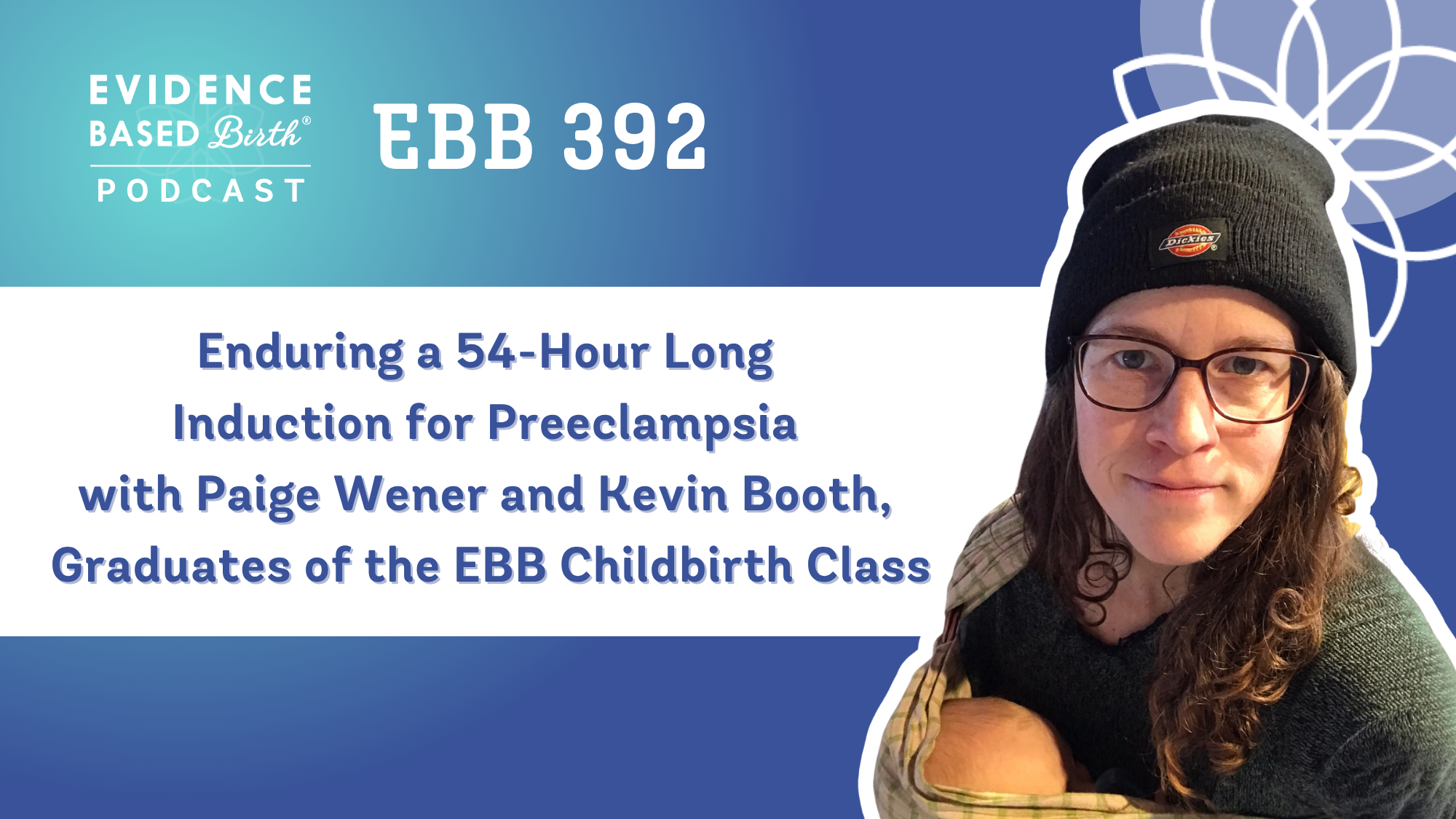
Hi everyone. On today’s podcast, we’re going to talk with EBB Childbirth Class graduates, Paige Wener and Kevin Booth about navigating a surprise preeclampsia diagnosis, a 54-hour long induction, and finding peace with a birth that looked very different than originally planned. Welcome to the Evidence Based Birth® Podcast. My name is Rebecca Dekker, and I’m a nurse with my PhD and the founder of Evidence Based Birth®. Join me each week as we work together to get evidence-based information into the hands of families and professionals around the world. As a reminder, this information is not medical advice. See ebbirth.com slash disclaimer for more details. Hi, everyone, and welcome to today’s episode of the Evidence Based Birth® Podcast. Today, I’m so excited to welcome our guests to the podcast who are here to share their birth story, Paige Wener and Kevin Booth. Paige and Kevin live in rural Vermont with their son Ira and their dog Athena. Kevin is a scientific instrument technician at their local college, and Paige runs a small-scale organic vegetable farm. They enjoy reading, listening to podcasts, cooking, and working outside. They are both graduates of the EBB Childbirth Class with Lucy Paradiso, and today they are here to share their birth story. Paige and Kevin, welcome to the Evidence Based Birth® Podcast.
Paige Wener – 00:01:26:
Thank you for having us.
Kevin Booth – 00:01:27:
Thank you.
Paige Wener – 00:01:29:
Exciting.
Dr. Rebecca Dekker – 00:01:29:
So could you tell me a little bit about how like you got connected with EBV and eventually with the Childbirth Class?
Paige Wener – 00:01:37:
Yeah, I was an avid listener of the podcast for like two years before we got pregnant. I like to really prepare for things. So I found your podcast through Lily Nichols work, actually, because I had read her book, A Real Food For Pregnancy and listened to a lot of podcasts that she was on. So I got clued into your podcast and started listening. And then from there, I think we knew, I knew that I If I was going to take a Childbirth Class, which is always a good idea, I would do it through EBB and you overheard a lot of the podcast.
Kevin Booth – 00:02:12:
Yeah. I’m not somebody who presses play, but I hear a lot.
Paige Wener – 00:02:16:
Yeah. So that’s how we kind of found it. And then. Lucy did an online only. Class in the Northeast. So we were on there with a lot of other people in the Northeast, but Vermont is very rural, so it’s hard to find. Like any in-person things really.
Dr. Rebecca Dekker – 00:02:32:
Right, right. And when you were listening to the podcast for those like two years before you had a baby, what were some of the topics you were most interested in learning about? Since it sounds like you really like like educating yourself.
Paige Wener – 00:02:46:
Yeah, I like to kind of become a sponge and absorb things. So it was a lot of that, a lot of osmosis. I love the birth stories and hearing everybody’s. I think it’s really helpful. I think the birth stories are helpful because things happen and you get to hear how people respond to them and how they’ve been prepared for them or not. And just lots of different experiences too. And then we’re really into evidence, too. So all of your features on very specific. You know, we listened to a lot of the really research-backed stuff, which was extremely helpful because it’s good to be prepared. So we wanted to be really prepared. So a lot of all the nicks of things just in preparation.
Dr. Rebecca Dekker – 00:03:25:
And could you both kind of tell me a little bit from each of your perspectives what it was like taking the class with Lucy?
Paige Wener – 00:03:32:
I knew a lot of the things going in because of listening to the podcast. And for me, it was really nice to have like it was a practice for both of us to be together and prepare. So that was really good experience of being together and learning things was really great. The class was extremely thorough, Lucy was really nice and it was nice to connect with other couples, who were expecting kind of in the same time as us and hear about their worries and their concerns and everything. So, yeah.
Kevin Booth – 00:04:06:
Yeah, I’d say that doing that as a couple was really important. Like, it’s the, and doing something as a unit and like being on a call like this kind of, but with a class acting as a unit, really important to get ready for that. Cause again, we had been doing a lot of reading, but it really sparked a lot of conversations about specific. If this, then what kind of, because that’s, I think that’s the way I think. So the class really, the class really worked for me in terms of thinking through things that kind of flowchart sort of style of thinking. That’s the part that I really like absorbed from.
Dr. Rebecca Dekker – 00:04:44:
Like not having a rigid plan, but more. Like you said, if this, then that, here’s the options we would have.
Kevin Booth – 00:04:51:
Yeah. And I think like, know your, know what you’re gonna do given certain information ahead of time. You know, don’t, you know, if, if I ask this question and I get this information back, this is the way we want this with, the way we would prefer to go, but we also know. If we get different information back, we can go this way. So you can’t plan for everything, but you can do it. You can do a lot of planning.
Dr. Rebecca Dekker – 00:05:17:
You can learn as much as you can. And was there anything in particular for either of you that you like didn’t know about birth going in that you learned in the class or through the course of educating yourself about pregnancy and birth that kind of wowed you or was like, wow, I’m I’m learning something really important right now.
Paige Wener – 00:05:36:
Oh, yes. One thing because Lucy is a doula. So she also has her own personal experience that she brings to the table from helping clients. And something that actually ended up helping us and that I like was a little bit like, oh, that’s really interesting. Was she recounted. Having a client who needed an induction because of high blood pressure. And she was able to ask to get a sleeping medication and like spend the night in the hospital before getting her. Before starting her induction and she was just able to relax a lot more and get a good night’s sleep and then go forward through the induction so like asking for kind of what you like that level of asking for what you really needed at the moment in the face of something really surprising where you weren’t prepared for it was really important. So that was a really nice example of advocating like a specific one that I really. I took to heart.
Kevin Booth – 00:06:37:
For me, one of the most surprising ones is the way that medical professionals kind of frame decisions, whether they are. And you colloquially hear people come out in situations like a birth where they say things like the doctors made us X, Y, or Z.
Paige Wener – 00:06:52:
Or they let us.
Kevin Booth – 00:06:52:
Or they let us or those kind of things. Just the class really kind of illuminated how. That kind of framing doesn’t really, it’s not really right. Like you, you are the. Decision maker in that situation, when you’re the one who’s like the patient is the decision maker and you have to make those decisions. Junction with your doctors and nurses, but. I think that was something that class really exciting. Because I guess I would have kind of believed more like, oh, well, the hospital forces you to do that. X, Y, or Z.
Dr. Rebecca Dekker – 00:07:20:
You have to do things.
Kevin Booth – 00:07:22:
Yeah, but they don’t strap me down. I mean, normally, that would be a problem. Yeah, that was really informative to me.
Paige Wener – 00:07:29:
Yeah, they’re not the legal authority in the room. Yeah, which is helpful.
Dr. Rebecca Dekker – 00:07:32:
So it sounds like self-advocacy and some communication. Techniques were helpful for you. And that can translate to much, you know, far beyond birth. That’s great that you had that experience together. So what kind of birth then were you planning like as you were taking the Childbirth Class?
Paige Wener – 00:07:52:
I really wanted a water birth. Our birth center was amazing. So we have a small rural hospital. Which has a hospital-attached birth center, but it’s separate. You don’t go to triage when you get there. You just go right to the birth center. So all my prenatals were in this one office building and the birth center is like right, just a little sidewalk walk away. So they and they are amazing. We’ll probably get into all the things they offer. But they did have an AquaDoula tub, like the big tub. So I really wanted to do a water birth. Like that’s kind of what I was planning. And I had pregnancy was really easy for me. We didn’t have complications until the end. So it seemed like that was going to be very possible. I stayed really active. I was farming all the way through. And I had some like dizziness spells. And I- Yeah, morning sickness was rough and I vomited through the second trimester and it finally ended. But going forward, we seemed, it seemed as though we would be able to have like a very low intervention. We wanted a low intervention birth. And we wrote a birth plan, but a lot of things were covered by our birth center. So they have many fridges in the room. So we knew we were going to be able to eat and drink or I was going to be able to be able to able to eat and drink and everything. They have tubs and showers in every room you labor and birth in the same room and then stay postpartum in the same room. And you can get in the shower and tub whenever you want. If you give birth in the child there, it’s whatever. They only have wireless monitors. So like a lot of like very amazing amenities, I guess I would say, like really evidence-based. So stuff that makes breathing people really comfortable. They all had that. So we were pretty, pretty, yeah, secure going in.
Kevin Booth – 00:09:49:
Yeah, our checklist was kind of redundant with their policies in a lot of ways.
Dr. Rebecca Dekker – 00:09:53:
Right. It’s like they were already providing the care that you were interested in having. So it was a good match.
Paige Wener – 00:10:00:
And I saw all midwives for my prenatals. I didn’t see an OB except for like the original, the first ultrasound. And then… Anatomy scan, um, so it was it’s very midwife led and the midwives do all the work during, um, birth mostly unless there’s a, there’s always a doctor an OB on call but it’s all midwives, otherwise, so.
Kevin Booth – 00:10:21:
And all, all women. Exactly, we ended up, we ended up having a male OB, visit us once you’re when he was on.
Paige Wener – 00:10:29:
Yeah.
Kevin Booth – 00:10:30:
But that was, he was visiting, taking coverage.
Paige Wener – 00:10:31:
He’s a traveler.
Kevin Booth – 00:10:32:
He was a traveler. So. We had not met him before, but he was not, you didn’t have any real interventions with us.
Dr. Rebecca Dekker – 00:10:42:
Yeah. So then at some point things change. So can you walk us through how all of that unfolded?
Paige Wener – 00:10:50:
We, I went in for, well, we, we were going to a lot of the. The prenatal appointments together, not all of them. But we both went in on, it was a Friday for a routine prenatal, and I was towards the end of my pregnancy, and I got a high blood pressure reading. And I had actually been kind of worried about preeclampsia or high blood pressure my entire pregnancy. I was monitoring at home because I had had some borderline high readings, just like at doctor’s appointments before. So it was something I was following a lot of Lily Nichols advice for diet. Based on that, trying to avoid as many complications as I could. Which was going well. I had like no swelling or anything. But I had a high blood pressure. It was pretty high. It was like 140 over 90 or something at that first appointment. So they did some monitoring. Everything looked fine, with a baby of nine.
Kevin Booth – 00:11:47:
That wasn’t the- You’d had a couple of appointments where they were marginally high, right? Prior to that.
Paige Wener – 00:11:54:
Like, 120 over like maybe 80 or something. So like borderline high.
Kevin Booth – 00:11:59:
Okay.
Paige Wener – 00:12:01:
But yeah, this was the first that was like, it was like, whoa.
Dr. Rebecca Dekker – 00:12:04:
You’re clearly abnormal. Yeah.
Paige Wener – 00:12:07:
Very much so. Like my, I had a great nurse. Her name is Lily. She was awesome. And she was like, she didn’t even take it with the, she brought the big machine in. She was like, I could already hear that it was like, really something was going on in her though. The special, the handheld one that they use. They monitored, everything was fine. I was meeting a new midwife that day that I actually hadn’t seen yet, so that was good. And she was like, we’ll send you home with a 24-hour urine collection. Because it was the weekend, they were like, you don’t need to come back in. We’ll see you. Drop it off on Monday. We’ll see how it was going to be, you come back in on Monday and we’re going to see, you know, all the, see what we can see and everything. So that was, that was fine. We went home for the weekend. You know, one high reading wasn’t like anything super unnerving for anybody. And then I dropped off. The urine sample on Monday morning. And then we had another prenatal that afternoon. So I was just in town doing things. And then we went to that. Appointment together. It was like Monday afternoon. Yeah. And I hadn’t checked my chart, like my online thing or anything for any like test updates or anything. So we were kind of going in like, okay, we’ll see what my blood pressure is. Like, you know, I was not expecting a diagnosis at the time. And the midwife who came in was immediately like, well, I think it’s time, which was like very jarring to hear. And a little bit really kind of set me off a little bit. We were doing a lot of before she came in we were doing a lot of like breathing exercises and just trying to keep me like calm before blood pressure reading and everything.
Kevin Booth – 00:13:54:
Which was a lot. Yeah. And like you said, you were doing at home monitoring.
Paige Wener – 00:13:57:
Yeah.
Kevin Booth – 00:13:57:
And I think a lot of that.
Paige Wener – 00:13:58:
And nothing was high.
Kevin Booth – 00:13:59:
And nothing was high through the weekend.
Paige Wener – 00:14:00:
Yeah.
Kevin Booth – 00:14:01:
I mean, for me, I was talking a lot of it, especially on Friday up to white coat syndrome, the blood pressure readings. But those Paige definitely does get like this. You see, well, yeah, she gets flushed. She gets anxious when doctor comes into the room and to do blood, especially because you were so. Read it now. Like, I, you can tell you were getting, you know, your blood pressure rose when it was time to measure your blood pressure. But I think that was part of why you were doing the at-home stuff was so that you could kind of know in your mind, like, this, I don’t have high blood pressure right now. Maybe help, but yeah, by, by Monday it was pretty obvious. It was not just blood pressure, anymore now it was the urine sample, just-
Paige Wener – 00:14:44:
Yes. Yeah. So I had protein in my urine. So classic preeclampsia, I didn’t have any symptoms at all, and like I said, I had no swelling. So it was a little, it was surprising for sure.
Dr. Rebecca Dekker – 00:14:54:
I mean, it sounds like they caught it, like, um, you know, most soon as, they could have. Right?
Paige Wener – 00:14:59:
Absolutely.
Dr. Rebecca Dekker – 00:14:59:
The first high blood pressure reading, and-
Paige Wener – 00:15:01:
Yeah. So they caught it really early, and I was at 38 plus six on that Monday. So, I was like, we’ve made it pretty much, so. The midwife who I was seeing was like, they sent me over to the birth center to have more monitoring and to talk to the midwife who was on call in the birth center at that time. Because she was like, it’s the on-call person’s decision of like where to go from here. So we went over and I actually felt a lot calmer in the birth center. So. We got hooked up on the wireless monitors, they’ve got the band and just like the little discs that they put on and everything met a couple of nurses, one who we hadn’t met before because she had given us a tour of the birth center. And my blood pressure was normal as I like sat there and everything. So they were like, you have preeclampsia. There doesn’t seem to be any like immediate danger. And we kind of talked to them. It was like, we were like, we would really like to go home tonight and come back because I had to run payroll for my farm like that day. And like Kevin had just come from work and-
Kevin Booth – 00:16:12:
We hadn’t worked out what to do with it.
Paige Wener – 00:16:14:
Yeah. I mean, we were like ready for, you know, labor to start at any time, but like also not quite ready.
Dr. Rebecca Dekker – 00:16:19:
Right. If you’re like, if you can give me 12 hours.
Paige Wener – 00:16:23:
Exactly.
Kevin Booth – 00:16:24:
Exactly. 12 hours. Yeah.
Paige Wener – 00:16:26:
Yeah. So that was great. So the midwife just checked with the OB on call. And- She was like, yeah. And then they were saying, oh, you could come back in on Wednesday, like two days and everything. But then so we settled on I was going to come. They start all inductions at 7 a.m. in the morning, which is nice. That’s like that’s. Just a nice thing. We were-
Kevin Booth – 00:16:48:
All the night.
Paige Wener – 00:16:49:
We left. Yeah, it’s not midnight or anything like that. It was, I was, I was very disappointed and a little bit angry at first about the diagnosis. It was just like, nobody’s happy when something like that happens. And with an induction, I couldn’t get intermittent monitoring. And I also couldn’t get in the big birth tub as well. So there were some parts of my plan or my preferences that were then off the table, which happens and is disappointing and everything. The nurses were super great. Because they were like, you know, you’re a healthy person. You’re just, your placenta got a little wacky and everything. And they were really reassuring. So it was like hard to have, you know, the diagnosis. Um- That’s kind of how preeclampsia, you entered our world.
Dr. Rebecca Dekker – 00:17:43:
So you went home and you had, that kind of evening and night to wrap your mind around what was happening and get everything ready for the next day.
Kevin Booth – 00:17:52:
Exactly.
Paige Wener – 00:17:53:
Yeah.
Kevin Booth – 00:17:53:
We packed up some food. We got Athena to- I forget exactly how we got Athena. We dropped her off on the way-
Paige Wener – 00:18:01:
That morning. She goes to a doggy daycare and they do boarding as well. So we were able to drop her off. My mom was going to come get her if we had to. I had gone into labor spontaneously. But yeah, we dropped her off that morning. Then we packed up. We were like, we’re moving into this room. So I brought, they have peanut balls and birth balls and lots of other stuff and like diffusers.
Kevin Booth – 00:18:23:
Yeah.
Paige Wener – 00:18:24:
The birth center. But we like we brought our birth ball. We brought yoga mat. We brought, you know, tons of clothes. We brought our own food.
Kevin Booth – 00:18:32:
We brought candles.
Paige Wener – 00:18:33:
We brought our flameless candles. We brought a ton of, I had a ton of electrolytes and everything. So yeah, we, at 7 a.m., we had like gotten a good night’s sleep. And then we moved into the room for our induction. Yeah. And ship changes happen at 7 a.m.. So I guess we’ll get into the birth story. Right.
Dr. Rebecca Dekker – 00:18:57:
Yeah. So what were the decisions you made? Like, what were the conversations like about? Which medications or devices or methods you would use to do the induction.
Paige Wener – 00:19:07:
Yeah, everything was, we got two, all the midwives are awesome, but we got two really good ones the first two days who are very like, It’s your decision. They’re like very like willing to go with what we really wanted. So the first morning, I was not. So they had done a cervical check and I was like maybe starting to open, but like not nowhere really there. So the main option was. Misoprostol. So, and also, I use a Coudé catheter. I’m just checking my notes. I needed to get, you know, dilate a little bit more for the catheter to go in. So we started with. You know, I took one-half of hard pill and then another one four hours later or whatever so I was having some We really wanted to go low intervention to start.
Kevin Booth – 00:20:04:
Which they also, they tend to as well.
Paige Wener – 00:20:06:
Yes.
Kevin Booth – 00:20:06:
That’s what I see as well.
Dr. Rebecca Dekker – 00:20:08:
Kind of like start slow and just get your cervix ready first. Okay.
Paige Wener – 00:20:13:
They kind of wanted me to have a, they do ports. Like, say, lane ports, you don’t have to get hooked up to anything. But they wanted me to have a port ready. I did not want, just in case something happens with the pill or something. I declined that. For the first day, because I was like, I really don’t want something that’s practically.
Dr. Rebecca Dekker – 00:20:32:
You didn’t have to have a saline lock or an IV in your arm for the first day.
Paige Wener – 00:20:34:
Yeah, to start things. I was having some cramping and stuff and it was like, we had taken a Spinning Babies® class towards the end of my pregnancy, which I love and is really helpful. And. I totally recommend it to people. So we were doing a lot of the moves from there and all the nurses there were like very much like, yeah, everybody was like, keep moving and stuff throughout our whole labor and everything. So that was great. And then towards the end of the night, which is when the nursing shift changed. We did the Coudé catheter because it was like labor could start with Misoprostol, but, it didn’t for me. No, it was clear it wasn’t like getting like the whole shebang started. So we chose to get a part put in and the Coudé catheter inserted. So this was Tuesday was the first day in the evening before the nursing shift changed. And the Coudé catheter has the two bubbles that they inject with water on either side of your cervix. So that was uncomfortable. And. Stuff-
Kevin Booth – 00:21:46:
And you were able to keep moving.
Paige Wener – 00:21:48:
Yeah, you can walk-
Kevin Booth – 00:21:49:
Through in like our circuits of Spinning Babies® moves and things like that pretty regularly.
Paige Wener – 00:21:55:
Yeah, they just take it to your leg, the outside of it. So that was the end of the first day. And things started like getting kind of intense with the catheter, I had to, I shockingly, but not shockingly to anybody. I was a puker during labor, like throughout the whole time. So, yeah, I wasn’t really surprised because of my experience during pregnancy. But the catheter definitely got things going and I had to poop and I had to puke. And it was like, all right, things are kind of moving along. So we just kind of kept going through the night. And I think, we maybe got a little bit of, I mean, I maybe slept through some of it and everything, but I was kind of sick feeling.
Kevin Booth – 00:22:39:
Everything’s tough. That’s probably our biggest, my biggest complaint about the hospital setting was just how difficult sleeping is. It’s not like the dark, quiet room we sleep in typically. Lights, there’s just so many LEDs in a hospital room, even like a nice calm one. They’re just everything’s got to. Blinking light or a green indicator or red indicator, something. And the, you know, where it is, the parking lot wasn’t that far away. So there’s pretty nice curtains, but still pretty bright coming in. So sleeping, even. If you weren’t in labor, I think sleeping would have been kind of tricky in that room.
Dr. Rebecca Dekker – 00:23:20:
I don’t think anybody wants to go sleep a night in a hospital unless they have to be there for some reason. Do you think having like an, I’m just thinking of people listening, would having an eye mask or earplugs or something like that have been helpful? Maybe if you had to do that again.
Paige Wener – 00:23:36:
Yeah, definitely. And my second midwife was like, oh, we can put like, we can bring blankets in and you can cover the big monitor station and you can put blankets against the door so the light doesn’t come in from outside and stuff. So they were like really willing to like, okay, what do you need to make this happen? But like an eye mask or something would have definitely, definitely helped, I think. Yeah.
Dr. Rebecca Dekker – 00:23:58:
So Wednesday morning, what was the update then?
Paige Wener – 00:24:00:
The catheter is supposed to just fall out, supposed to just fall out when you reach four centimeters. So it hadn’t fallen out, Wednesday morning, which had concerned me a little bit. So, but they were like, we take it out after 12 hours, no matter what. Really I had gone from like seven to seven. I was glad I had the port because I got a lot of Zofran like intermittently and everything, which is an anti-nausea medication for those people listening. And they just inject it right in. And it was great. But they took out the catheter and, they measured me and I was at four centimeters but it just hadn’t fallen out so that was like pretty reassuring because I had been worried and then I was reassured that I had actually, um, yeah. Was progressing. Pitocin is usually the next thing but if you guys want to take some time go ahead so we did I they um they led I’m gonna say it again but we, took off all the monitors and everything. I took a shower. I got like kind of a break that next morning. And we just like walked around. We got to walk outside. We got to go outside.
Kevin Booth – 00:25:07:
So we ran into a friend.
Paige Wener – 00:25:09:
Yeah, we ran into a friend who works there at Porter. And I had brought my like Medilla little hand breast pump and I was pumping to try. I was like, just try it. We were trying to, we were doing like spinning baby circuits. We were trying to do everything.
Dr. Rebecca Dekker – 00:25:23:
The natural induction techniques that could maybe help? Possibly move things along.
Kevin Booth – 00:25:28:
I remember, was it like every 20 minutes we were doing?
Paige Wener – 00:25:30:
Or half an hour.
Kevin Booth – 00:25:31:
It was kind of just something to pass the time.
Paige Wener – 00:25:34:
Yeah.
Kevin Booth – 00:25:34:
Something I’m remembering right now is the, just the. About the EBB class and with our group that we talk. I remember cervical exams was like a big topic of discussion in our class. And people being like, we’re not doing cervical exams. And I would say for me, especially for as long as you were there in labor, they were so important for like signposting and just like, okay, we are, progress is being made. Like I, if we weren’t doing that, if I wasn’t getting at least like a, every 12 hour, like you are still progressing after. 30 some hours, I would. My mind I think? So that was like, yeah. Knowing that like, by Wednesday morning we were at four centimeters, that was that was important.
Dr. Rebecca Dekker – 00:26:21:
Yeah, you have to fight really hard for those first, you know, four centimeters when you’re being used and you were not. You know. Dilated it all at the start. It’s hard work for sure. So it sounds like you got to reward yourselves a little bit. Go on a walk, take a break, take the monitors off before you kind of started the next phase.
Paige Wener – 00:26:41:
Yeah, that was really nice. But just a little refreshing. Stay hydrated and yeah, probably have some breakfast, at that point, I was probably feeling up to eating at that point in time. And then around probably 1038, we had a midwife change. Because they do 24 hour shifts and then the nurses do 12 hour shifts. So we got a new midwife who I hadn’t seen quite a few times during prenatals and she’s really sweet. So at like 10.30, we were like, well. We’ll just, we’ll start the dose. It’s fine. So we have, like, it seems necessary. So they start super low and slow. They start at like they start at one micro unit or whatever it’s called. And then they increase by one or two, depending on how we feel every 20 to 30 minutes. I think the most I was at any time was 14, or like my whole. My whole labor.
Kevin Booth – 00:27:35:
It took hours to get up to that.
Paige Wener – 00:27:37:
Super low and slow. So we knew we were in good hands starting Pitocin. The really annoying thing was that I have now an IV tree that follows me around. So that was the big downside of that. So, but again, I have like this rolling thing that I can walk around. I’m not in a bed or anything.
Dr. Rebecca Dekker – 00:27:52:
You’re still mobile.
Paige Wener – 00:27:54:
So we were still doing, I was bouncing on the ball. At one point, this was later in the night, but they let me get in the tub with it and everything. So, I mean, they were amazing. But yeah, we just went through the day. Contractions started and we’re picking up and everything. So that was Wednesday, the second day. And at 5 p.m. on Wednesday, my water broke by itself. In a very spectacular fashion. I mean, we were lying in bed, like watching TV or something. And I felt it burst, and I was like, oh my God, my water just broke and it was like everywhere. And it was like very like TV movie kind of like.
Dr. Rebecca Dekker – 00:28:35:
Like that amount of fluid, yeah.
Paige Wener – 00:28:37:
That was great. I remember my nurse saying, oh, that’s great. Cause then they don’t have to do it. Like, it’s great that your water did it on itself. And I was like, okay. Because things are really started to get intense after that cause there’s less cushion. So. I was at like five or six centimeters at that point in time. Wednesday night. And my water had broken. So, yeah, that we were entering the second night. Again, lots of Zofran. And at a certain point in time, like the next day, they started giving me Reglan, which is a stronger anti-nausea medication. And at that point, I pretty much couldn’t eat much, but they were still offering popsicles and saltines and like lots of water and everything like that. So that night was really intense.
Kevin Booth – 00:29:24:
Yeah. Sorry to get really intense.
Paige Wener – 00:29:26:
Yeah.
Dr. Rebecca Dekker – 00:29:27:
I want to ask Kevin, this might be a good point to ask you. So like what comfort measures were you helping Paige with? Kind of during the Pitocin phase as opposed to like then after her water broke. Can you walk us through like what seemed to help the most before and after her membranes ruptured?
Kevin Booth – 00:29:45:
Okay, yeah, can I? A while ago. Yeah. So there’s a lot of counter pressure. So do you remember what the cycle of the Spinning Babies®? I don’t remember the exact size.
Paige Wener – 00:29:57:
There’s this side lying release is the one where you’re kind of hanging off the bed. And then stuff on the floor.
Kevin Booth – 00:30:06:
Jiggling.
Paige Wener – 00:30:07:
The jiggling.
Kevin Booth – 00:30:08:
Yeah, that one, just like doing it, but then also kind of, yeah. Jiggling that goes along with that. You on the floor. Yeah. The Donna’s one. Just getting you to go through those, I think, was also just kind of being like the, let’s do that. Let’s get up and go through those.
Dr. Rebecca Dekker – 00:30:26:
Movement in different positions.
Kevin Booth – 00:30:28:
Exactly. I think, yeah, through those. It all, you always seemed to be in better shape after going through one of those cycles. So yeah, those Spinning Babies® things were huge from like a water popsicles, you know, they have a little cantina outside. So popping in and out for those kinds of treats was important. And also you drank, insane amounts of water, I think. Yeah. Like the amount of water we have that, like they give you a cup, the like one meter.
Dr. Rebecca Dekker – 00:31:01:
Cup?
Kevin Booth – 00:31:02:
Yeah. Yeah.
Paige Wener – 00:31:03:
Classic.
Kevin Booth – 00:31:04:
I, I, I don’t know how many gallons of water you drank each day, but it was a lot. So keeping that filled, making sure you weren’t worried about that. And yeah, I think those were my main, like kind of my main bag of tricks.
Paige Wener – 00:31:19:
I like the counter pressure a lot. And that became more important as I started. Yeah, having more intense. Pain.
Kevin Booth – 00:31:25:
Yeah. And a lot of that is just like, it doesn’t feel like you’re doing much as the person doing that, the counter pressure, especially it’s like, does not- Yeah, you’re not putting a lot of pressure down, but you just kind of tell your partner actually is responding to it. So you just have to trust that.
Dr. Rebecca Dekker – 00:31:42:
You’re talking about counterpressure on the sacrum.
Kevin Booth – 00:31:44:
Yeah.
Paige Wener – 00:31:44:
Yeah. Exactly. Yeah. And you put some hip squeezers too. The hip squeezers were less. The counter pressure on the bottom of it back. Yeah, really.
Dr. Rebecca Dekker – 00:31:51:
That was really effective.
Paige Wener – 00:31:52:
Towards midnight that night after, yeah, just keeping doing a lot of this stuff, I really needed, I was felt like I needed something a little extra. So that’s when I got in the tub. They just kind of like saran wrap your IV in your arm and then you just have to kind of keep it out of the tub.
Dr. Rebecca Dekker – 00:32:08:
That was something you thought you might not be able to do, but you were able to get in the tub.
Paige Wener – 00:32:12:
Yeah.
Dr. Rebecca Dekker – 00:32:14:
Okay.
Paige Wener – 00:32:14:
That was, yeah, that was really great. Oh, yeah. Birth tub, no, but the, like, shower tub that they have in every room in the bathroom I could get into. So not the big birth tub.
Kevin Booth – 00:32:26:
I don’t know what the difference is, but.
Paige Wener – 00:32:30:
I love water and I love swimming and just like water. I take baths all the time. So I thought that would help a lot. But at one point I was just like. In the tab. I was at like seven centimeters at the point in time. And I was, it was after midnight and I was really tired and I was like in some pain. And so at that point, and yes, nauseous. At that point, I had our nurse call and wake up the midwife. Because I was like, I need something a little bit. I wanted pain medication at that point in time.
Kevin Booth – 00:33:01:
Yeah, you were there was probably an hour and a half of you being, I would say, like, exceptionally uncomfortable and in pain, like legit pain, uncomfortable in the job. Exhausted, like getting progressively more exhausted over that period too.
Paige Wener – 00:33:18:
Yeah. The pain wasn’t so much my issue. It was that I was I became afraid that I would be too tired to push when the time came. That was actually my main concern was how tired I was because we’re at like hour 36 or something at this point in time. So I just, I asked her. Well, I was like, can I get an epidural now? And she was like, well, there’s some things that we could do before an epidural that might help some pain options. So I was like, okay, sure. I’m like least invasive thing first. We tried new Bane. Which was, I basically, Kevin can describe the experience more because.
Kevin Booth – 00:34:00:
It didn’t work for him. I would say it did not work.
Paige Wener – 00:34:02:
I would describe the experience as I passed out for an hour, but woke up every time a contraction happened, basically, in lots of pain.
Kevin Booth – 00:34:13:
Which was every, like, fortified at this point.
Paige Wener – 00:34:16:
I think it was like two or three times.
Kevin Booth – 00:34:17:
Yeah, it was, it was bad. And it was, I mean, at that point, you’re on. It’s like dealing with someone on narcotics. Like, I can’t. Ability to kind of reason, like it was, you were already kind of loopy. To that because of just exhaustion and then it’s just like I can’t talk to you anymore. Like there’s no, there’s really no communication. Like you’re supposed to be sleeping at that point, but you’re waking up every. Let’s say two to three minutes in pain and you just, as a partner, you don’t feel like there’s any comfort to provide because there’s no. There’s no reciprocity with like, you know, giving affirmations or anything like that. It’s just. It’s just scary kind of.
Paige Wener – 00:34:57:
Yeah. You kept on the counter pressure, which is the most important.
Kevin Booth – 00:35:00:
Yeah. No, you can’t do it, you keep doing it. But it’s just like there’s no, you know, the thing like I said about the counter pressure, you kind of have to, you know, so you’d like go by your partner’s reaction back. And it’s like you lose that, with that, we, I lost that with the new bane.
Paige Wener – 00:35:14:
I’ve heard people have good experiences with it. So I don’t want to like, yeah, scare anybody off of that.
Dr. Rebecca Dekker – 00:35:19:
Everybody reacts differently. And I, you know, you do hear that sometimes it decreases your level of consciousness. Basically sedates you, but you can still feel the pain just as much in your situation.
Kevin Booth – 00:35:31:
Yeah. And you can’t take it back. It didn’t feel kind of like, I mean, it’s like that you’ve had one too many drinks and you’re like, man, I wish I had. And then life was like, yeah, you can’t take it back.
Dr. Rebecca Dekker – 00:35:40:
You just have to let it wear off in that.
Kevin Booth – 00:35:42:
You gotta let it go for a while. That was, so we knew like, you know, there’s a light at the end of the tunnel with that. And I. It was hard for me to believe that you were getting much rest, but it did seem, once we got through that, I think it was an hour of that being really tough. You did seem refreshed, surprisingly.
Paige Wener – 00:36:02:
Yeah. Yeah. Yes. The midwife said you get like one to three hours. And she told us everybody reacts differently. So, you know, we could try it and see. And we tried it. And it was interesting. But after that, I did ask for an epidural at that point in time. And I got it. So. It was like 1:30 in the morning. I wasn’t, I guess, in my mind in the beginning in pregnancy, I was really not planning on having an epidural. I really did want to go unmedicated, but having an induction kind of already reaches the, you’re already very medicated. You know, I’ve never had a birth without Pitocin, but it seems. You know, pretty intense and everything. So, um, I was glad to be there and had the option for an epidural at that point in time. I really wanted to sleep and kind of get some rest and everything. I signed a consent form and it went in no problem. They placed it no problem and it started working right away. Which are like right away, like probably in 15 minutes or something. And I remember telling Kevin, I was like, I’m so happy right now after I started working. So that was great.
Kevin Booth – 00:37:17:
Yeah.
Paige Wener – 00:37:18:
Getting the epidural. And then I slept for, it was probably, yeah, like it took a little time to get placed. And then I just like, I slept completely for like probably five hours. They do shift change at 7 a.m., So I think they woke us up for shift change. And they turned the Pitocin off as well when I got the epidural. So they just kind of like, I was just like, yeah, got a break, had the epidural, got a bunch of rest. And so that was really, really nice. Because the next morning was Thursday morning. Oh, I also wanted to mention this entire time, my blood pressure was totally not every they had to check me every hour because of my diagnosis. But I only had one high reading and that was like after a shift change or something. So. I just want to mention there wasn’t any like, you know, there was no chance they needed to put me on magnesium or anything. Like it was like very. Things were not urgent in a really any way. So that was great. And I think they just generally, you know, we’re given the time to like let my body do its thing and work through the motions and everything and never felt rushed or anything during the whole period. Which was great. And also ironic that I have like normal BP the whole time. But, the next morning was-
Dr. Rebecca Dekker – 00:38:37:
Yeah, shift change?
Paige Wener – 00:38:38:
There’s a family doctor who does rotations with the midwives. So she was on next. And we actually hadn’t met her during prenatals, but we had met her at a party with Summer before just because it’s a small town and everything. So we hadn’t run into her before, which is really funny. But that’s Renee. We love her. And she was the next. Birth attendant on on rotation and put me back on Pitocin, I was at like a nine or something that morning and They put me back on Pitocin that morning after like breakfast or whatever I could get down and stuff. At some point. That morning, I was at a 10 and- I was at, yeah, I was at like a plus one station and 10 centimeters around 11, 15 a.m. on Thursday. I have my notes.
Kevin Booth – 00:39:37:
Yes.
Paige Wener – 00:39:37:
I’ve read everything down.
Dr. Rebecca Dekker – 00:39:38:
And I was going to ask Kevin, did you get a chance to sleep then once the epidural kicked in as well?
Kevin Booth – 00:39:42:
Yeah. Yeah. I think I got a good five hours of sleep each night.
Paige Wener – 00:39:47:
Yeah, because you were, while I was on New Bane, you were like very, like, you were reading. You were reading Middlemarch. That’s really funny.
Kevin Booth – 00:39:55:
Little by little, yeah.
Paige Wener – 00:39:56:
But you didn’t get a lot of rest when I was on New Bane. But then, yeah, you got to totally conk out when I was on the epidural, which was-
Kevin Booth – 00:40:03:
For the most part. You’re still kind of like, you know, on pins and needles. It’s not the most restful sleep, but-
Paige Wener – 00:40:08:
As best stated. Yeah. At like 11 in the morning- It was like time to go. They were like, it’s time to do the thing. And I was really hoping to like labor down a little bit and stuff. One of my nurses was like, as a first time mom, you might need to. Push to get, you know, things going. So. We did coach pushing, which was not my favorite, but it’s probably nobody’s favorite. But they had like a little, At 11.15, it was like, okay, it’s time to push. And I was in bed at this, like after the epidural gets placed, you have to stay in bed. We had been doing a lot of like position changes that morning and everything, like after I woke up and stuff, just stuff, different stuff with a peanut ball and everything. But then they had their little like get together. Before pushing, there was like a bunch of other people who came into the room, not like a bunch, but like other nurses.
Dr. Rebecca Dekker – 00:41:07:
A little huddle of people.
Paige Wener – 00:41:08:
Yeah, exactly. Like, yeah, a little, talking everything, which was funny to overhear.
Kevin Booth – 00:41:13:
Including a student.
Paige Wener – 00:41:15:
Yeah. I don’t know if they came in then or like after.
Kevin Booth – 00:41:17:
I don’t have been hearing that. I would, okay. Yeah, someone visiting.
Paige Wener – 00:41:22:
Which I consented to. It’s just I don’t really remember consenting to because I was like really it was in the middle of pushing.
Kevin Booth – 00:41:29:
It seemed like something you would have consented to. So-
Paige Wener – 00:41:31:
Yeah.
Kevin Booth – 00:41:32:
Raise any issues.
Paige Wener – 00:41:34:
Yeah. So I started pushing, around 11;30. I was switching up between both sides. And then also I did some hands and knees. So I had originally thought hands and knees would be really great, like in like thinking about birth. And then it was really exhausting for me, actually. So on my side was actually the most comfortable position to push in. And we just we flipped sides whenever I got like tired of one side and we got all the cords like flipped around and everything.
Kevin Booth – 00:42:04:
Yeah.
Paige Wener – 00:42:04:
And-
Kevin Booth – 00:42:05:
Probably every like half hour or so.
Paige Wener – 00:42:06:
Yeah. Our son actually started crowning after half an hour, really early, and Kevin got really excited.
Kevin Booth – 00:42:16:
I jumped the gun.
Paige Wener – 00:42:17:
Yeah.
Kevin Booth – 00:42:17:
On like stating like, all right, we’re there.
Dr. Rebecca Dekker – 00:42:20:
I can see the head, but then it kept taking time then. Okay.
Kevin Booth – 00:42:25:
Yeah. And it just gives us doubt.
Paige Wener – 00:42:26:
Yeah. Another thing my provider did was she used, I think it’s Onika oil. They do a compress on your perineum. And so she was doing that. And that was great. Because I also I didn’t have what we’ll get to it. Yeah, it was, 2 hours and 45 minutes of pushing. My birth attendant said that he was in a great position. Like we had an ultrasound like before and he wasn’t sunny side up or anything. So I didn’t have any back labor during the point. But he had his hand near his face or something. So it made him a little bit cockeyed. So that was she was like, that’s probably why it ended up taking so long. But otherwise, like it was, yeah, it was pretty straightforward of a actual birth. And I felt his head a couple of times like, yeah, that was really hard. But at that point in time, I was like, I can do this.
Kevin Booth – 00:43:20:
Yeah. And everybody seemed to be. You know, it’s just going to take as long as it takes. There was never any sense of urgency around that.
Dr. Rebecca Dekker – 00:43:28:
I think you’re getting close to the finish line, but. People weren’t panicked. There was no urgency. There was no panic.
Kevin Booth – 00:43:34:
Right. They were just supportive. I mean, I don’t know how much of that was any kind of poker face or anything, but yeah, they did a great job of just kind of keeping at the same pace the whole time through there.
Paige Wener – 00:43:44:
Yeah. You’re telling me to push everything.
Kevin Booth – 00:43:48:
Yeah, I was there that bad, you know, just kind of lifting legs, you know, helping with those flips.
Paige Wener – 00:43:56:
Yeah. And at that point in time, also, my left leg was very numb, which was super uncomfortable. And we can get into that postpartum, but I did end up having nerve damage probably from my epidural. But it was like it had fallen asleep, basically. So my entire pushing phase, my left leg had fallen asleep, which was annoying. But somebody just had to hold it up, kind of. And it just felt really fuzzy and everything. But yeah, it was a lot of pushing. And at a certain point, I was like, my body was starting to like be like taking up. Like I felt like an intense pressure to push like towards the end and everything. Then I pushed him out and he was born. And we didn’t know the sex beforehand. So Kevin got to announce that. And I cut the cord, but they do, they wait. Like until it’s white, like they do delayed core clamping pretty much as a default there as well. So they clamped it after a while and then I cut the cord. Yeah, it was, I don’t know. Yeah, it was birth. It was amazing. It was like, you’re here. And everything was fine. I don’t know what his Apgar score was, but like no distress. They do, we get like two hours of skin to skin, like no question, like just that’s automatically what they do anyway. So, yeah. And, yeah, I didn’t have any, no tearing, like a small, like first degree internal laceration, but I had an intact paradigm leading that, which was amazing. But yeah, and then, yeah, Ira was here in the world.
Dr. Rebecca Dekker – 00:45:33:
How did it feel after that? Marathon of an experience to like hold you didn’t know you were going to have a son you know hold him on your chest?
Paige Wener – 00:45:42:
It was, really, um, it was really good there’s like a very specific high after birth. Like I felt like I could run a marathon like in the first couple hours after birth. Because of all the adrenaline or hormones or whatever is happening and everything. So it was like very much like I was like very, I was buzzing quite a bit. And yeah, it was really nice. And we got to, yeah, it was lovely to have time to just hang out. And I wanted to breastfeed, so he did last pretty soon. We just kind of let him do this thing on my chest. Which was nice.
Kevin Booth – 00:46:21:
He was very sleepy.
Paige Wener – 00:46:22:
Yeah, he was very sleepy.
Kevin Booth – 00:46:24:
He was really sleepy at first. Day or a day and a half. So breastfeeding was, he did latch, but then we kind of had a lot of coaxing involved for the next sessions of breastfeeding. Like the first one seemed easier than like the second or the third. So a lot of, you know. Yeah, like rubbing cheeks, playing with his feet, things like that to kind of coax him into that.
Paige Wener – 00:46:51:
But it was really nice because we got to just stay in the same room. So, yeah, it was just like it was very relaxing post-birth. It was like.
Kevin Booth – 00:46:57:
Yeah. The only people there for a good time. By then there were other birthing mothers coming in, but we hadn’t been, yeah, we hadn’t been the only people on the hall of like five rooms. Yeah. We were the only ones for quite a while.
Paige Wener – 00:47:11:
Yeah, they have four L&D rooms and then two small ones if they need to spill over. So yeah, we got a lot of, we got, everybody was very focused on us.
Kevin Booth – 00:47:20:
Yeah.
Paige Wener – 00:47:21:
So that was really nice. But yeah, it was like, it was, the marathon was over at that point in time. But then we were still at the hospital for like two days.
Dr. Rebecca Dekker – 00:47:27:
I was going to say, and then you entered postpartum. So what was recovery like for you? Physically and emotionally after this birth.
Paige Wener – 00:47:34:
Yeah. We stayed two nights after. I was really, I was enjoying the kind of people around and like kind of having our needs taken care of and everything. And they also found there was like a lot of wonky stuff that kind of happened after birth. Oh, they kept me on Pitocin for two hours after birth because I was induced and the risk for hemorrhage. So everything went fine. My placenta was birthed very easily and everything. Yeah, we did a lot of the like after birth stuff for Ira, like vitamin K and everything. And then, in one of the fundal checks, they found this like kind of hard mass, which ended up being a fibroid that had grown a lot during pregnancy. So it was just like, it was like the pregnancy hormones just like kind of made it really big. And my midwife was like, what’s this? So I had to get like an ultrasound after just to check its size and everything. And it’s since shrunk. So that was like kind of a weird thing that happened. And they wanted to monitor me. Because of preeclapsia just in case. So we stayed and it was nice. We got food and showers and that stuff. But my leg was still asleep. So, I was kind of like, oh, I thought it, I think it’s maybe normal for 24 hours after your epidural comes out for your leg to still be asleep. So I was having a really hard, my, it was my foot was mostly asleep. So like. It was like, I couldn’t. Lift my toes up. Like they were kind of just like dangling like that. So, yeah, that was-
Kevin Booth – 00:49:11:
That was the part of our life for like, 3 months.
Paige Wener – 00:49:13:
Yeah. Yeah. So, breastfeeding sort of, took off a little bit. I was really committed to that, which I think is what made a difference. We just kept trying and trying and trying. So we got to go home on Saturday morning.
Kevin Booth – 00:49:31:
Yeah.
Paige Wener – 00:49:33:
And my leg was still asleep. So, and nobody like, I didn’t say it explicitly to anybody, but I got wheeled out of the. Out of the birthing center.
Kevin Booth – 00:49:43:
Yeah.
Paige Wener – 00:49:45:
I just like I couldn’t walk very well. I could walk but it was like really difficult. And-
Kevin Booth – 00:49:53:
Just bring it up on our way out. Because I do recall, like, we stopped short of leaving and we brought up your leg.
Paige Wener – 00:49:59:
That was at the one-
Kevin Booth – 00:50:00:
Was that the one week check?
Paige Wener – 00:50:01:
No, the one day. So our birthing center does. So we went home. I just stick to life with baby. All pretty, like, standard stuff. And then they do a 24-hour newborn check. So we brought him back there. And they do, like, it’s just something they offer. You come back and they lay them and. Check his Billy Reuben and like, you know, all that stuff and everything. And then at that point in time, I was like, hey, to the nurse, is this, my leg is still asleep from the epidural. I assumed it was from the epidural at that point in time, because it happened concurrently. And she was like, oh, I’ve never heard of that happening. We just not let you on here. That was a weird thing. But, she talked to the anesthesiologist and they called, they ended up calling me back on our way home. And. That was my biggest postpartum complication was I had nerve damage. So on the phone with one of the nurses, it was like, it can happen if you’re pushing for a long time. But I had felt it before I started pushing. So I and it is a complication or a side effect sometimes of epidurals. So nobody explicitly told me it was nerve damage. They were just like, this sometimes happens and you can go to like chiropractor or physical therapy, but it will eventually resolve on its own. Which was all a little bit of a scary timeline for me because I’m a farmer and I was, I just didn’t know when it was going to resolve and everything. So during postpartum, it was, that was my hardest challenge. And maybe it was actually a good thing, not a good thing, but like I-
Kevin Booth – 00:51:27:
Took it down.
Paige Wener – 00:51:28:
I took it really easy postpartum because I couldn’t really walk.
Dr. Rebecca Dekker – 00:51:30:
Okay, so you didn’t jump right back into farming, right?
Paige Wener – 00:51:34:
Yeah.
Dr. Rebecca Dekker – 00:51:34:
Because you didn’t.
Paige Wener – 00:51:35:
No, I, I was there.
Kevin Booth – 00:51:37:
It was also November. So there’s not much farming.
Paige Wener – 00:51:40:
Yeah. We should mention. Yes. So I, I’ve, we were lucky enough to be able to kind of plan our pregnancy and November was a perfect time to give birth because I have the whole winter to recover and everything. So that was really great. I was just afraid I was going to trip and drop our baby sometimes. So it was. It was kind of intense and a little freaky, but I, I did a lot of acupuncture and massage therapy, and I also see a craniosacral therapist. Those are all people that I’ve seen, in my pre-fregnancy life. And those all really helped. And it got better after three months. I had, I was able to like, I was pretty much like 90% better at the three month mark postpartum. So I know I remember you had a podcast last summer with someone who also had nerve damage. I think her recovery period was much longer than mine. So I feel pretty lucky that. I think hers was at a year. It was still kind of a funny feeling, that resolved itself, which was so great.
Kevin Booth – 00:52:45:
It was probably about four weeks where, for the first four weeks, there was like no emotion. And then after that, about four weeks, there was like the tiniest glimmer of toes moving. And that was, it was just nice to, again, to be able to see like a signpost. Okay, this is going the right direction. So like they tell us it’s going to get better and there’s a sign that it’s actually getting better. And that was good to see. And for me, at least, took a little stress away, because I was also… It was, it is very, I think you’re going to have a lower mobility. I mean, you weren’t. It wasn’t keeping you from moving, but it definitely lowered your mobility quite a lot.
Paige Wener – 00:53:22:
I couldn’t go.
Dr. Rebecca Dekker – 00:53:23:
I believe it’s called foot drop when you can’t lift your toes up on a foot. And it is, it’s a rare but serious complication. So it’s the kind of thing that like when they do large studies of epidurals with birth, they don’t hardly ever see it. That’s one of the reasons they say epidurals are so safe, but epidurals in general are used, you know, in a lot of the population for different surgeries and things. And it’s been, there have been cases reported post epidural of that foot drop.
Paige Wener – 00:53:56:
Yeah. Good to have a name for it. And so, yeah, not hear that I don’t loan. Cause it was, yeah, nobody explicitly said anything.
Dr. Rebecca Dekker – 00:54:04:
So it was kind of, yeah, it was like, how many months afterwards did you feel like it was totally resolved?
Paige Wener – 00:54:10:
It was three months. Yeah. So pretty relatively quickly I felt.
Dr. Rebecca Dekker – 00:54:14:
Okay.
Paige Wener – 00:54:15:
Yeah.
Dr. Rebecca Dekker – 00:54:16:
But still, it can be scary because you’re like, is this ever going to go away? Is this permanent damage?
Paige Wener – 00:54:21:
Yeah, that was exactly what was running through my head a lot of the time. So, yeah. Yep. But yeah, Kevin was home for, Kevin got six weeks off postpartum. And then he, after that, he went back to work kind of part-time very slowly. So.
Kevin Booth – 00:54:34:
Yeah, six weeks plus because of the holidays right around then. So that was, yeah, got to kind of spread out that time.
Paige Wener – 00:54:39:
Yeah. So we had a lot of support. I have family. I grew up around here and our neighbors had a little train for us and everything. So we had a lot of support postpartum. It’s great. Especially because of that.
Dr. Rebecca Dekker – 00:54:51:
So Paige and Kevin, you went through a lot with this birthing experience. I just want to honor that. You know, also, give you just compliments on how well you stuck together as a team. And, I know, Kevin, the nurses had a name for you, right?
Kevin Booth – 00:55:09:
Well, it’s the doodler.
Dr. Rebecca Dekker – 00:55:11:
The doodler.
Kevin Booth – 00:55:12:
I don’t think that’s the-
Paige Wener – 00:55:13:
Gender illuminating.
Kevin Booth – 00:55:15:
I don’t think the first one they’ve applied that to.
Dr. Rebecca Dekker – 00:55:17:
Yeah, 54 hours of labor support is no joke. So, and Paige, obviously for you, you were the one experiencing it. Since you went through all this together, do you have any words of advice for our listeners who might be planning on entering birth or parenthood soon?
Paige Wener – 00:55:34:
Yeah, we tried to look for a doula, but couldn’t find one because there it’s like, you know, there’s a. In a rural area. And a lot of them were taking time off or having their own babies that year. So I’ve been really stepped into it. You were happy being the only person, the support person for me, though.
Kevin Booth – 00:55:50:
Ultimately, I think I was. Yeah. Yeah. I don’t think I would have felt. I think it was. Yeah, it was nice to be the primary person. I had the time.
Dr. Rebecca Dekker – 00:56:00:
You probably could have used some backup if you had available.
Kevin Booth – 00:56:03:
Yeah, but it was kind of like, you know, would have been, yes, it would have been tough to maybe share that responsibility or trade off. And I, because I just, I would have probably been getting in their way, honestly. It would have been.
Paige Wener – 00:56:17:
You like to feel useful.
Kevin Booth – 00:56:19:
Yeah. So, I mean, I think, yeah, there’s a lot to be done. I think the Spinning Babies® was having that, having, I mean, so the analogy I, probably sick of it, but the analogy I kept using during the EBB class too is like, it’s like, it’s like going into a boxing match where you’re going to have like, set periods of really intense something to do and then you have a little rest period. But knowing like what you’re going to do during that or like interval training where you’re going to like. Having something to do during, if you just send someone out and say, all right, go do a workout. What am I supposed to do? But you’re like, okay, go do 10 pushups, go do some push sit ups, having like the exercises to do, which we gained like the Spinning Babies® was probably where we got that from. Was really, really useful to then be able to, use that as like a, as a rhythm and like kind of mark.
Dr. Rebecca Dekker – 00:57:13:
You had a lot of tools in your toolkit.
Kevin Booth – 00:57:15:
Yeah. And mark, yeah, you can mark that time. Cause again, depending on how long it is, it’s a lot of time to fill.
Paige Wener – 00:57:22:
For us, yeah.
Kevin Booth – 00:57:23:
Yeah. That was a lot of time. And it would have been, I just, if there was like boredom had set in, there’s like boredom never sat in, but if like you can, I can imagine how it would feel even more interminable or just less pleasant. If you didn’t have those things to go to. So have a plan for every 20 minutes. I’m going to, you know, a little alarm is going to go off and I’m going to go through my checklist of, okay, have I done this? Have I filled the water? Have I done this? Have I done this? Have those have those ready to go would be my advice to a to a part of America was going to be doing.
Paige Wener – 00:57:58:
Yeah. Yeah, you were integral to the process. So yeah, for birth. That was really important. Yeah. And then for, I just wanted to really plug or like give people some people advice on postpartum period specifically. I was actually more worried about postpartum than birth, honestly. Because it’s just like such a big thing to recover from. Excuse me. And something that made our postpartum much easier. And it’s kind of a taboo topic in North America, and it’s really stigmatized, but it’s a cultural norm in a lot of the rest of the world is intentional bed sharing. And I, well, we actually both read Dr. James McKenna’s Safe Infant Sleep During Pregnancy, which was really great to do at that point in time because it set us up really well. And I would advise, I think. There are criteria and also guidelines for bed sharing. And we met them and also set things up as safe as we could to mitigate risk. And even if parents or expecting parents aren’t planning on co-sleeping or bed sharing, I think it’s really important to read up on how to mitigate risk because you never know if your baby is going to be a baby that doesn’t just doesn’t sleep so low, like won’t sleep in a crib or bassinet. And you really want to avoid. Unintentional or accidental bed sharing, because that’s really dangerous and risky. And so is sleep deprivation if you’re just holding your baby all the time. So there’s lots of good resources. Like I mentioned, Safe Infant Sleep. Dr. James McKenna runs research on breastfeeding, mother-baby sleeping dyads, has done for like decades. And there’s Helen Ball’s How Babies Sleep. That’s a new book. That one was really good. And then La Leche League has the Safe Sleep 7. And there’s a couple of Instagram accounts, CoSleepy and SafeCoSleepers. Sleepers and they do a lot of talk about safety and just mitigation like not everybody can because there’s just there’s out like there’s reasons why it could be unsafe that are out of your control and everything but um I think it’s it’s just important to know and nobody gives you any information at the hospital about it because they give you-
Dr. Rebecca Dekker – 01:00:13:
One or the pediatricians or anywhere.
Paige Wener – 01:00:15:
Exactly, there’s like one, one thing we’re supposed to do and everybody really wants to do that. But for some people, it’s like it, you know, everybody comments on how well rested we looked, um, during postpartum. And I’m still breastfeeding at 16 months postpartum, and my goal is two years. And I really think, it contributed to that because those nightly frequent feeds really helped me build supply and maintain it. Over the earlier months and everything.
Dr. Rebecca Dekker – 01:00:41:
So having to walk across the room or walk to a different room.
Paige Wener – 01:00:45:
Exactly.
Dr. Rebecca Dekker – 01:00:45:
Every time you needed to.
Paige Wener – 01:00:46:
Yeah. So that’s my, like, one of my advices just to try to, like, find some research on that and everything and educate yourself.
Dr. Rebecca Dekker – 01:00:55:
We’ll make sure to share the links to some of those resources and the comments. I know. In the EBB Childbirth Class, we link to Dr. McKenna’s website where he has all the research. I think really good common sense safety topics that he covers with cartoon images and graphics that help you understand the safety issues. So
Paige Wener – 01:01:15:
Absolutely. Yeah, it’s great.
Dr. Rebecca Dekker – 01:01:17:
Paige and Kevin, thanks again for coming on the podcast and sharing your awesome birth story. And I’m so happy that everything turned out well for you and that you have baby Ira at home and Athena and that you’ve got your family going strong.
Kevin Booth – 01:01:30:
Thank you very much.
Paige Wener – 01:01:31:
Thank you. Thank you for having us.
Dr. Rebecca Dekker – 01:01:34:
This podcast episode was brought to you by the book, Babies Are Not Pizzas: They’re Born Not Delivered. Babies Are Not Pizzas is a memoir that tells the story of how I navigated a broken healthcare system and uncovered how I could still receive evidence-based care. In this book, you’ll learn about the history of childbirth and midwifery, the evidence on a variety of birth topics, and how we can prevent preventable trauma in childbirth. Babies Are Not Pizzas is available on Amazon as a Kindle, paperback, hardcover, and Audible book. Get your copy today and make sure to email me after you read it to let me know your thoughts.
Disclaimer: This content was automatically imported from a third-party source via RSS feed. The original source is: https://evidencebasedbirth.com/ebb-392-enduring-a-54-hour-long-labor-induction-for-preeclampsia-with-paige-wener-and-kevin-booth-graduates-of-the-ebb-childbirth-class/. xn--babytilbehr-pgb.com does not claim ownership of this content. All rights remain with the original publisher.