Steven Spielberg’s “Close Encounters of the Third Kind: The Special Edition” (1980) marked the first time a “special edition” was touted as such and released in theaters after the initial theatrical cut was a massive hit three years prior.
Spielberg’s return engagement of his late 1977 blockbuster was not only a financial success but put into place the notion that cinematic art, mainstream or otherwise, could be adjusted by the original artist, then presented as a new work to experience.
How’s the film itself? Still wonderful, whether you like what Roy Neary sees when he enters the Mother ship, but more on that later.
The film opens with a series of scenes in which the impossible is occurring all over the world. We witness the bizarre discovery of long-missing aircraft materialize in the desert, a massive power outage occurring in suburbia and (my favorite) a stern air traffic controller listening to a pilot who sees something amazing but refuses to report a UFO sighting.
We then meet Neary, a boyish father (Richard Dreyfuss, whose sideburns are the most dated thing in the movie), his uptight wife Ronnie (Teri Garr) and Jillian, a single mother (Melinda Dillon – yes, the mother from “A Christmas Story”) raising little Barry (3-year-old wonder Cary Guffey), who undergoes a deeply personal journey of discovery.
When Roy and Jillian can’t get a certain shape out of their minds, they alienate (pun intended) everyone around them by trying to figure out what it all means.
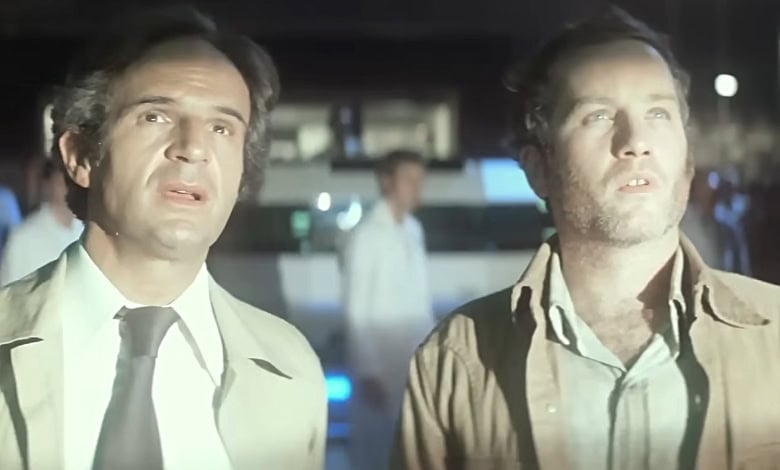
Dreyfuss is terrific at conveying the unstoppable need to know all, but he allows us to see the pain and humiliation his madness is costing his family. Garr is relatable and smart in what could have been a thankless role. Dillon is wonderful and earthy, as is Bob Balaban and legendary director Francois Truffaut in key turns.
When Spielberg’s “Close Encounters of the Third Kind,” his fourth film and first after “Jaws” (1975), opened in the fall of 1977, many wondered how it would compare with “Star Wars.” George Lucas’ first groundbreaking, pop-culture shaping and box office conquering mega-hit had overshadowed most other films released that year.
Could Spielberg, whose giant killer shark movie was now the former biggest hit of all time, top The Force? Is Spielberg’s UFO epic better than “Star Wars Episode IV: A New Hope”?
Let me go on record: You bet your pile of mashed potatoes it is!
STEVEN SPIELBERG is asked a great question on Inside The Actors Studio about Close Encounters Of The Third Kind, which blows his mind.pic.twitter.com/XVTHIUmzAZ
— All The Right Movies (@ATRightMovies) February 6, 2026
A consistent quality in Spielberg’s work is his gift for directing children. Note the famous dinner scene, in which an iconic pile of mashed potatoes triggers Roy’s obsession; although Dreyfuss is the focus of the scene, watch Shawn Bishop, the young actor playing his son, who is sitting next to Dreyfuss, matching him beat for beat.
As Neary’s oldest, Bishop is visibly crying and conveying the horror of watching his dad lose his mind.
A few scenes later, when Roy is tearing up his neighborhood, keep your eyes on Justin Dreyfuss (no relation), playing Toby, the youngest Neary boy: as Roy stalks around, trashing his front lawn, Toby follows him, helping him like a dutiful, confused little boy.
It’s an honest, perfect touch that Spielberg doesn’t underline. This is why his movie is still a masterpiece 40 years later: the human story is so real and authentic; it makes the sharp turns into science fiction seem plausible.
A standout aspect of Spielberg’s film is the hope and wonder it evokes. Not only is mankind’s crucial, first close encounter a good one overall but, with a youthful, infectious optimism, the film tells us to Watch the Skies. Not as a warning of those acid-blooded Xenomorphs from “Alien” (1979), nor the squid/crab thingies from “Independence Day”(1996), nor the dreadlocked, purring “Predator” (1987).
Spielberg is telling us to step outside our homes, walk onto the front lawn and gaze at the astonishing view above.
If you’ve never seen this movie, all I can say is to see it on the big screen and savor the experience. Let John Williams’ rich score wash over you, allow your jaw to gape at the still-incredible special effects and savor the witty dialogue, thoughtful questions on whether we’re alone in the universe and the moments of humor that frequently spring up.
When it was released in 1980, three years after the original version had circulated in theaters, “Close Encounters of the Third Kind- The Special Edition” grossed an astonishing $28 million. That’s a lot for some deleted scenes, added spectacle and the chance for the audience to see “inside.”
No prior re-release had ever been so highly touted as a “new” take on a previously existing film. Previous re-releases had not been hyped as a “special edition,” been quite so successful or noted in the marketing with the post-release changes, except for maybe the R-rated “Excalibur” (1981) and “Saturday Night Fever” (1977), both being re-released in recut PG editions early into their initial runs.
The growing videocassette market of the late 20th century, newly established pay cable networks and DVD extras would further introduce home viewing of new versions of films (which ranged from drastic alterations or simply new content added to prior existing versions). However, in theaters, the 1980 edition of Spielberg’s film was merely the beginning of the trend.
The highly touted, massively successful “Star Wars: Special Edition” in 1997 (with its pixelated additions and controversial Jabba the Hut sequence) was followed by each of the original trilogy returning to theaters with varying “upgrades”, leading decades later to the similar rollout (but without extensive alterations) to the 1999-2005 prequel trilogy.
Another highly debated and controversial “new edition” was Spielberg’s own “E.T. The Extra Terrestrial” (1982), with its added CGI and deleted bits that don’t actually enrich an already perfect work.
Other noteworthy theatrical special edition releases include “Apocalypse Now Redux” (2003), “Alien: The Director’s Cut” (2003), “Donnie Darko: The Director’s Cut” (2005), and “The Lord of the Rings” extended cuts.
George Lucas also revised his earlier breakthrough with “THX 1138: The Director’s Cut” (2012).
There have also been improved, lengthened or shortened versions released of Francis Ford Coppola’s “The Cotton Club” (1984), Michael Cimino’s “Heaven’s Gate” (1981) and Bob Guccione’s notorious and strangely durable “Caligula” (1980).
In limited release and/or film festival circuits, the director’s cuts of “Blade Runner” (1981), “Nightbreed” (1990), and “Brazil” (1985) found appreciative audiences. So did the extended cuts of “The Abyss” (1989), “Kingdom of Heaven” (2005), “Aliens” (1986), “Rocky IV” (1985), “The Counselor” (2013) and, arguably the most noted altered version in recent pop culture history, “Zack Snyder’s Justice League” (2017).
There were also the home releases of “Clue: The Movie” (1985), which allowed viewers to watch all three endings filmed in one sitting (unlike the theatrical release, with random theaters getting different versions) and “Little Shop of Horrors” (1986), with it famously downbeat and spectacular ending, cut for the theatrical release, then belatedly reinstated for digital release and solidifying its cult canon status.
Peter Bogdanovich’s “Mask” (1985) was released on DVD with different music than the theatrical release (out went Joe Cocker, back in were Bruce Springsteen tunes, as Bogdanovich originally intended).
As with all of these examples, it is just as easy to find longtime fans who declare only the original to be the preferred version as it is to find a vocal critic who states the new version is the best and definitive one.
Is a film truly ever finished?
That’s highly debatable, particularly if you ask the director.
I’ve always liked the tacked-on moments in the Special Edition of “Close Encounters of the Third Kind,” as this was the first version of the film I ever saw. It’s weird for me to see a version of the film that doesn’t follow Roy Neary into the spaceship. Yet, I must report that Mr. Spielberg himself admitted publicly that he regretted the inclusion and that most of the later editions of the film don’t have the Special Edition footage.
As with all of these Special Editions and the Original Theatrical Cut they sprung from, the debate will always continue over which experience is the preferred one, particuyalry for the first timers.
Two things always spring to mind when I think of “Close Encounters of the Third Kind,” which is a personal favorite (in either form) that was released the year I was born: The comic book adaptation was first I ever purchased and, while skinny, it was as wide as a coffee table. I carried it everywhere like a teddy bear.
Also, there’s the scene where Jillian runs onto her lawn, watching the light in the clouds fade away as a UFO steals her child. She lets out a horrible cry of “Baaaarrry!”
That scarred me for life.
Disclaimer: This content was automatically imported from a third-party source via RSS feed. The original source is: https://www.hollywoodintoto.com/close-encounters-of-the-third-kind-special-edition-review/?utm_source=rss&utm_medium=rss&utm_campaign=close-encounters-of-the-third-kind-special-edition-review. xn--babytilbehr-pgb.com does not claim ownership of this content. All rights remain with the original publisher.