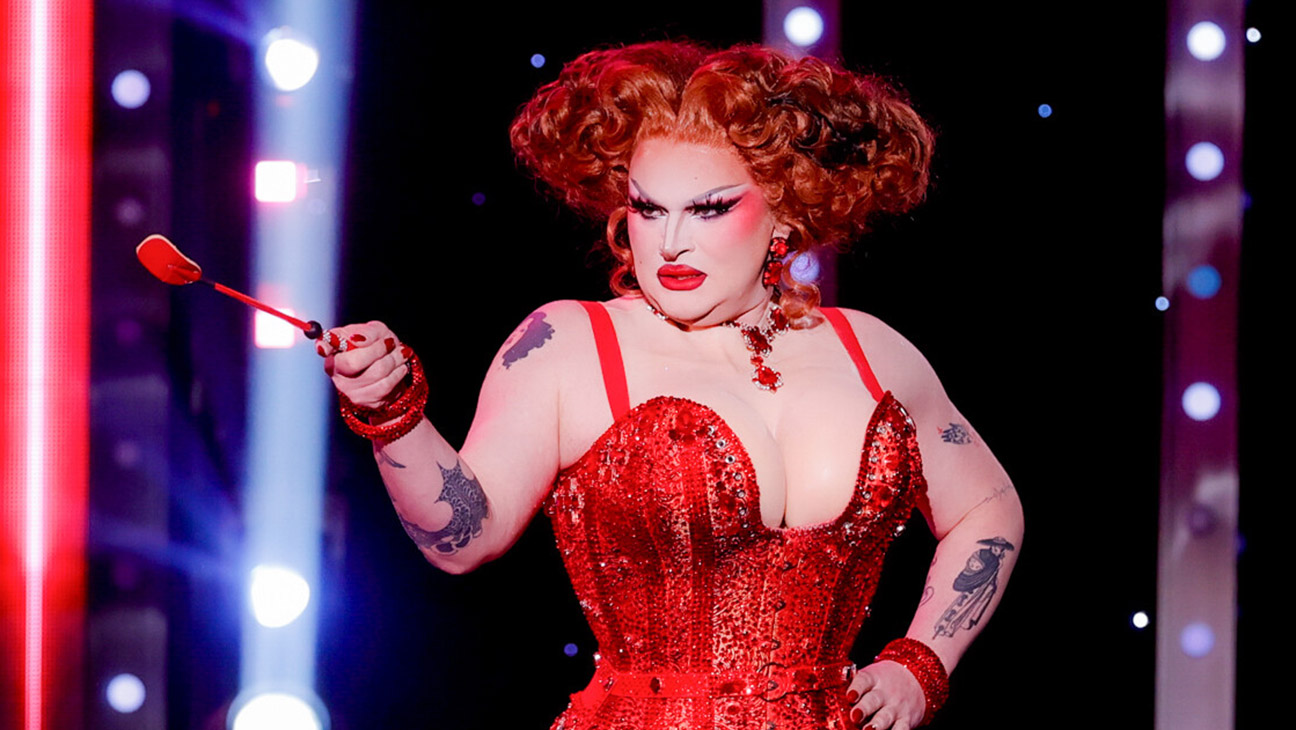
On the night her elimination aired, Jane Don’t was in Las Vegas. She was performing at a local gay nightclub, Piranha, co-hosted by a queen who didn’t know what was coming. The audience didn’t know either. Jane knew. She’d known for a year.
“Watching it back was probably the worst part,” she says now, calling in via Zoom from Seattle, a hoodie tugged down over her forehead, her cat climbing into frame. She’s been home for three days — a rare stretch of stillness in what has become a suddenly very loud life. The consistent odds-on favorite to win this season’s crown, the drag queen from Spokane, Washington, is still very clearly processing her startling elimination in the improv challenge that would prove her undoing.
“I’d done the emotional work to process how things played out. But watching it, I just didn’t have a ton of information, because we didn’t see each other’s scenes. I didn’t even see my own scene. So there were a lot of questions about what the judges were even talking about on stage,” she says.
That disorientation — performing blind, being judged on something she never got to watch — is at the center of the Jane Don’t story. It is also, she would tell you, completely beside the point.
The facts are almost absurd in retrospect. Jane Don’t placed in the top for the first ten consecutive weeks of RuPaul’s Drag Race season 18. She won three of those challenges. That was the strongest track record not just of this season but of the entire franchise. No queen in the show’s history had ever done it.
She arrived polished, prepared and slightly terrified. She proceeded to dismantle the competition week after week — while quietly falling apart in the confessionals.
There was the episode where she cried because she was doing too well. She laughs about it now, but only a little. “It’s hilarious and it’s completely delusional on some level,” she says. “But I genuinely just don’t know how to compute that kind of feedback. I’ve never been the person where everyone’s like, ‘You’re amazing.’ And so to be in a situation where I could feel that that was the turn things were taking just felt really overwhelming.”
“I just didn’t grow up in an environment where I was constantly told I was great. It’s just never been my mindset,” she says.
She traces this back to her upbringing. Her grandmothers were teachers. Her grandfathers were military. Her father ran a working-class ski school. The ethos of her childhood was not praise; it was correction. There is always something to fix, always something to do better. She absorbed it so completely that even when the judges were handing her wins, some part of her brain was looking for the flaw.
“Juicy [Love Dion, my season 18 competitor] would always say,” she recalls, “that when we did walkthroughs, ‘Jane is the only person that Ru talks to like a colleague.’” RuPaul would ask what she was planning on doing in a challenge; Jane would tell her; Ru would say: “You’ll make me laugh. You’ll be fine.”
“I did connect with her a lot,” Jane says, carefully. “I think she genuinely enjoyed me. I just think in that moment [of my elimination], she’s the host of a show. Sometimes she has to make a decision.”
***
The challenge that ended her run was called “Karens Gone Wild.” The five remaining queens were asked to perform improv scenes opposite RuPaul, playing variations of the viral “Karen” archetype — the entitled, screaming white woman demanding to speak to a manager, calling the cops, weaponizing her tears.
Jane Don’t found the premise morally repellent. She says so plainly, and then immediately tries to walk it back, and then says it again anyway. She was there. “My friends were getting tear-gassed in the street. I got gassed by the cops. Every night the air was still hard to breathe and spicy because the cops were just gassing the entire neighborhood,” she recalls.
In 2020, during the George Floyd uprisings, Seattle became one of the country’s most volatile flashpoints. The anarchist district — the CHOP zone — was blocks from her house. She was out protesting every day. The Karen videos that went viral during that period, she says, were not comedy to her — they were evidence.
“I don’t think a white woman crying and weaponizing her anger or her tears against people is particularly funny. I have a lot of residual baggage with that,” she explains.
None of this, she insists, is an excuse. “I’m not saying I’m better than the challenge. It’s Ru’s show. She picks the challenges.” But she went into it unable to find the joy, and built her Karen as a Christopher Guest character — characteristically cerebral, specific, actorly — in a challenge that demanded chaos.
Drag Race judge Michelle Visage told her she was trying to control the scene. She acknowledges the critique — but standing on that stage, she never saw the footage that led to the critique. As best as she can remember, she did the most with what the scenario presented.
“I think I didn’t personally feel like I was getting a ton to work with from Ru as a scene partner,” she says. “So I fell back on the story beats I’d built in my head. But yeah, I just don’t think any drag competition is ever judged in a quote-unquote fair manner. It’s not the Olympics. There’s no score sheet.”
She went into the lip sync against Nini Coco to Lady Gaga’s “Garden of Eden.” Cartwheels. Backflips. Everything she had. Nini stayed. Jane sashayed away.
She does not call it unfair. She almost seems allergic to the word. “Nobody ‘deserves’ to win Drag Race,” she says firmly. “Nobody’s entitled to win. The show has never presented itself as some ultra-objective situation. Ru says it herself: The final decision is hers.” She pauses. “Is any drag competition fair? What is fair when you’re judging something completely subjectively?”
There is one thing she will say, however, and she has said it in every interview since: she believes that her own track record worked against her. “I set myself up for a more difficult challenge by doing so well so consistently. My critiques for the Karen challenge essentially boiled down to: ‘We expected more from you. We know you’re capable of delivering more.’ Whereas other people’s critiques were essentially: ‘We thought you were going to do badly and then you didn’t.’”
“The one episode where I decided to let go of the neuroticism — to trust my talent, to just believe it — was the episode I got eliminated. I guess I was right. I guess if I let my guard down for even a moment, the axe was going to fall,” she says.
In the weeks before her elimination aired, Jane Don’t staged one of the more quietly brilliant pieces of performance art the show’s fandom has seen in years. She teased across social media that something was coming. A revelation. The internet — primed by years of Sherry Pie-style scandals and alumni drama — began digging. What had she done?
The answer: nothing. She was “annoying,” according to a faction of the fandom and former contestants like Monét X Change and Bob the Drag Queen. That was the whole thing. Buy the merch.
“The merch was almost an afterthought,” she says. “We designed it in two days. What I was really doing was holding up a mirror to the way certain factions of the fandom talk about all of us. I felt like I was getting dragged through the mud by alumni and fans about my personality. Everything was a referendum on whether I was too much. And I just thought, I don’t think being annoying is that big a deal.“
So she chose to own it. “If somebody admits that what people are saying is true, it takes the wind out of the sails,” Jane says. “And what was so funny was the people who were still upset even after I revealed it was nothing. The entire gay internet had searched for something I’d done wrong and couldn’t find anything. And then some of them were upset that I’d even joke about it.”
“So you’re mad that I’m actually a pretty decent person who minds her business? I don’t know,” she adds.
***
She went to school for musical theater. Seven years of voice lessons. “I’ve spent a lot of the past few years screaming in bars at gay people,” she says, “so it’s probably a little more Tom Waits than Sutton Foster at this point, but I can sing, yes.”
Broadway. Writing. Mainstream comedy. She wants all of it, and she is clear-eyed enough to see that her elimination, painful as it was, may have handed her something a win never could have.
“If I had won, there would’ve been a very loud contingent of people calling it ‘predictable,’ saying the season was ‘boring,’ saying I was just playing to the judges,” she says. “When you win, there’s a whole crowd of anti-people that emerge. Whereas being the robbed queen, it’s consolidated a level of support that maybe was there before, but hadn’t calcified. And now there’s this excitement to see me come back. Excitement to come out and see me on the road. That just otherwise might not have been there.”
She pauses. “I’m not stupid. At the end of the day, this whole thing — it’s kind of a gift. “
Her cat is still there, insistent, pressing against her arm. She’s been away a long time. She has three days home. She is 33 years old and sore when she wakes up and taking sleep vitamins and performing at 1:30 in the morning in cities she’s never lived in, for audiences who found her four months ago and feel, somehow, like they’ve known her forever.
She let her guard down once. She says she was right to have been scared. And yet here she is anyway, talking about it, making it funny, making it mean something. The show gave her a narrative it thought was tidy: the neurotic perfectionist who couldn’t get out of her own way. What it didn’t account for is that she was paying attention the whole time. She always was.
Disclaimer: This content was automatically imported from a third-party source via RSS feed. The original source is: https://www.hollywoodreporter.com/tv/tv-features/jane-dont-drag-race-history-rupaul-1236558136/. xn--babytilbehr-pgb.com does not claim ownership of this content. All rights remain with the original publisher.